
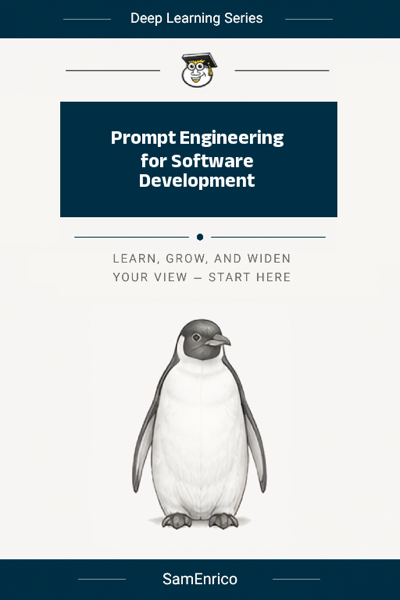
Prompt Engineering for Software Development eBook
A Coursebook on Prompt Engineering for Software De
by Simon Iris
A Coursebook on Prompt Engineering for Software Development
Formats
Free sample
Chapter 1: The Director's Awakening...--Imagine waking up one morning to discover that every line of code you have ever written has been erased. Not deleted maliciously, but rendered obsolete by a new kind of intelligence that can generate ten thousand functioning programs in the time it takes you to brew your first cup of coffee. The syntax you spent years memorizing? The design patterns you rehearsed until they became second nature? The algorithms you implemented from scratch to prove you understood them?
All of it has been commoditized, compressed into a statistical model that fits on a laptop and costs pennies per query.This is not a thought experiment. This is the reality of software development in the age of large language models. And if you are reading this book, you have already felt the tremor. Perhaps it came when Git Hub Copilot autocompleted an entire function you were about to write, and you realized the machine had read your mind. Perhaps it came when Chat GPT solved a bug in thirty seconds that had consumed your entire Thursday afternoon.
Or perhaps it came when a junior developer on your team, armed with nothing but a free account and audacious confidence, shipped a feature in three days that you estimated would take three weeks.The old rules have collapsed. And in their place, a new question has emerged—not about what you know, but about how you think.The Myth You Have Been Sold Let us begin by clearing away the nonsense. The internet is flooded with tutorials promising to teach you "prompt engineering" in thirty minutes. Social media influencers post screenshots of miraculous outputs alongside smug captions about how they have automated their entire job. Bootcamps charge five thousand dollars for courses that amount to little more than "be specific when you talk to the AI."Here is the truth they do not want you to hear: prompt engineering is not about learning special keywords or memorizing magic phrases.
There is no secret syntax that unlocks the AI's true potential. The difference between a developer who struggles with AI and one who thrives has nothing to do with how many prompts they have memorized and everything to do with how they break down problems, how they evaluate solutions, and how they maintain clarity when the model produces plausible nonsense.Prompt engineering for software development is not a linguistic exercise. It is a metacognitive discipline. It is the art of thinking about how you think, then translating that meta-awareness into instructions that a machine can follow.And that translation is far harder than it looks.Consider what happens when a typical developer approaches an AI for the first time. They type something like: "Write a function that sorts a list of users by their last name." The AI obediently produces a function.
It works. The developer is delighted. They try something slightly more complex: "Build a REST API for a task management app." The AI produces plausible-looking code that sort of works, but the authentication is insecure, the database queries are inefficient, and the error handling is nonexistent. The developer spends the next two hours debugging AI-generated garbage, concludes that AI is overhyped, and returns to writing code by hand.This developer failed, but not because the AI was incapable. They failed because they treated the AI as a code generator when they should have treated it as a collaborator.
They asked for output without providing context, constraints, or verification criteria. They abdicated their role as the human in the loop and expected the machine to read their mind.The Director Versus the Doer Throughout this book, we will return to a single mental model that distinguishes effective prompt engineers from ineffective ones. I call it the Director versus the Doer.The Doer is the AI. Its job is to generate text—code, documentation, tests, explanations—based on the patterns it learned during training. The Doer has no understanding, no intention, and no judgment.
It is a statistical engine that predicts the next most likely token based on the tokens that came before. When it produces correct code, it is not because it "understood" the problem. It is because the patterns in its training data aligned with the patterns of correct solutions.The Director is you. Your job is to define intent, set constraints, establish quality gates, and evaluate outputs. The Director does not need to know every syntax detail of every programming language.
The Director does need to know how to break a complex feature into prompt-sized pieces, how to provide the AI with the right context at the right time, and how to recognize when the AI is producing plausible nonsense disguised as correct code.Most developers instinctively want to be Doers. They want to write code. They take pride in their syntax knowledge, their algorithmic cleverness, their ability to wrestle a compiler into submission. But in the age of AI, the most valuable skill is not doing—it is directing. The developer who can articulate requirements with surgical precision, who can design verification strategies that catch edge cases, who can orchestrate multiple AI agents to work in concert—that developer is worth ten developers who simply type faster.Here is the hard truth: Within five years, the ability to write code by hand will be a niche skill, like knowing how to sharpen a quill or operate a manual lathe.
It will still have value in specific contexts, but it will no longer be the core competency of software development. The core competency will be the ability to translate human intent into machine-executable instructions across multiple levels of abstraction—requirements, architecture, implementation, testing, deployment.That translation skill is what this book teaches.The Four Dimensions of Quality Before we go any further, we need a shared language for evaluating the outputs the AI produces. Throughout this book, we will refer back to four dimensions of quality that every Director must assess.Correctness is the first and most obvious dimension. Does the code do what it is supposed to do? Does it pass the test cases?
Does it handle edge cases? Does it produce the right outputs for the right inputs? Correctness is necessary but not sufficient. Code can be correct and still be terrible.Readability is the second dimension. Can another human understand this code?
Are the variable names meaningful? Is the structure clear? Are there comments where necessary, and no comments where the code speaks for itself? Readability matters because code is read far more often than it is written, and because the AI may need to read its own code in the next interaction.Security is the third dimension. Does this code introduce vulnerabilities?
Is it susceptible to injection attacks? Does it handle secrets appropriately? Does it validate inputs and sanitize outputs? Security is often invisible in demos but catastrophic in production.Maintainability is the fourth dimension. Can this code be changed without breaking?
Is it modular? Are there duplication and hardcoded values that will become technical debt? Can a future developer (or a future AI) understand the design well enough to extend it safely?These four dimensions will appear as checklists and evaluation criteria throughout…
This is the end of the free sample. Get the eBook to keep going. Buy now
About this book
Details
- Author
- Simon Iris
- Publisher
- SamEnrico
- Language
- English
- Genre
- Non-Fiction, Informative, Educational
- Released
- 2026-05-06
- Pages (approx.)
- 151
- Available as
- eBook, Audiobook

Read better in the ZLOADR app
Your eBooks on your phone or tablet. Sign in with your SamEnrico account and start reading.
More by Simon Iris
 Judicial Annexations GuideSimon Iris$11.99
 FTC Merger Block AnalysisSimon Iris$11.99
 Assertiveness For ManagersSimon Iris$11.99
 Immigrant Event Planning Business GuideSimon Iris$11.99
 Metta For Customer ServiceSimon Iris$11.99
 Ending a Mentorship GracefullySimon Iris$11.99
 Plantar Fasciitis PreventionSimon Iris$11.99
 The Yelling WoundSimon Iris$11.99
 False Consensus EffectSimon Iris$11.99
 Charlemagne's Quantum Renaissance: The Carolingian Leap ForwardSimon Iris$11.99
 The Jade Dragon’s Oath: A Knight’s Quest for the Celestial HoardSimon Iris$11.99
 Hops & Hope: The Untold Story of the First Beer Made in SpaceSimon Iris$11.99