
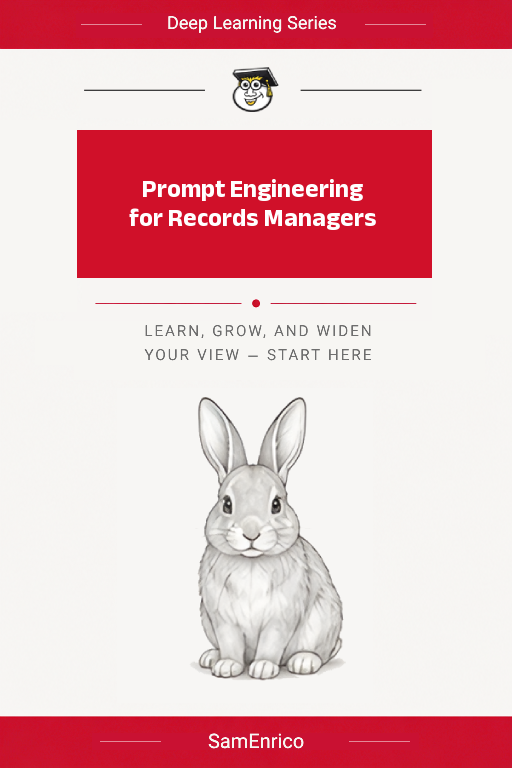
Non-FictionAI OperatorPrompt Design
Prompt Engineering for Records Managers
Craft prompts that classify documents by type, dep
Craft prompts that classify documents by type, department, and lifecycle stage. Includes real-world examples for legacy scans, emails, and forms.
Formats
About this book
Free sample
Chapter 1: Beyond Keyword Search...–- The Records Manager sat at her desk, staring at a scanned PDF from 1997. The file name was "doc_004582.pdf." There was no metadata, no department tag, no retention code. Somewhere in this digital orphanage of 14 million similarly anonymous files lay the only copy of a contract that, if not properly retained, could trigger a regulatory audit finding. She had two options: read every page of every file, or guess. Neither was acceptable.This is the reality of modern records management.
Not the orderly filing cabinets and labeled boxes of popular imagination, but a vast, chaotic ocean of dark data—documents that exist but cannot be found, classified, or managed because they lack the very structure that makes management possible. And the traditional tool for navigating this chaos, keyword search, is failing.The Illusion of Search For decades, records managers have been told that search is the answer. "Just index everything," the vendors promised. "OCR will make it text-searchable. Full-text retrieval will solve your problems." And for a certain class of documents—cleanly typed, consistently named, properly meta-tagged—search works reasonably well.
Type "2023 Q3 financial report" into an ECM system that has that exact phrase in a file name, and you will find your document.But the dark data problem is not a search problem. It is a classification problem.Consider the difference. Search asks: "Given a query, can I find documents that contain these words?" Classification asks: "Given a document, what is it? Who owns it? How long should we keep it?
When can we destroy it?" These are fundamentally different questions, requiring fundamentally different approaches.A typical organization's unstructured data landscape tells the story. Legacy scans from the 1990s and early 2000s—often the most legally significant documents—have no searchable text beyond what imperfect OCR could salvage. Email threads have been forwarded, replied to, and nested until the original signal is buried under ten layers of quoted boilerplate. Files migrated from legacy systems lost their metadata somewhere between the tape backup and the cloud migration. The result is petabytes of data that keyword search cannot touch.The…
This is the end of the free sample. Get the eBook to keep going. Buy now
Contents
- Chapter 1
- Chapter 2
- Chapter 3
- Chapter 4
- Chapter 5
- Chapter 6
- Chapter 7
- Chapter 8
- Chapter 9
- Chapter 10
- Chapter 11
- Chapter 12
Details
- Author
- Aranda Marvis
- Publisher
- SamEnrico
- Language
- English
- Genre
- Non-Fiction, AI Operator, Prompt Design
- Released
- 2026-06-01
- Pages (approx.)
- 140
- Available as
- eBook, Audiobook

Read better in the ZLOADR app
Your eBooks on your phone or tablet. Sign in with your SamEnrico account and start reading.
More by Aranda Marvis
 Failure Fear in FreelancingAranda Marvis$11.99
 Music Performance Anxiety WorkbookAranda Marvis$11.99
 Dixie Chicks Wide Open SpacesAranda Marvis$11.99
 Work Addiction Assessment WorkbookAranda Marvis$11.99
 Mental Rotation Cognitive TrainingAranda Marvis$11.99
 The Trollwife’s Curse: A Nordic Tale of Revenge and RedemptionAranda Marvis$11.99
 The Fire Makers: How Prehistoric Chemists Unlocked the Secrets of LifeAranda Marvis$11.99
 Understanding Freiberg's DiseaseAranda Marvis$17.99
 How to Become a Name-plate StamperAranda Marvis$11.99
 AI Data Governance GuideAranda Marvis$12.99
 X Twitter Growth and EngagementAranda Marvis$11.99
You may also like
 Hong Kong Handover 1997Dunn Johnnie$11.99
 Zumba For Postnatal Recovery CourseNeal Christian$11.99
 Zumba for BeginnersLadner Nikia$11.99
 YouTube Comment Mining GuideHumes Pandora$12.99
 Worry Box MeditationCarlin Rudy$11.99
 Workplace Stress MeditationNguyen Lynn$11.99
 Workplace Stress and Sleep RepairHawley Ivory$11.99
 Workplace Perfectionism CureDelaney Jeffry$11.99
 Workplace Injustice Anger GuideWallen Isabelle$11.99
 Work Addiction and Burnout LinkGreenwood Ester$11.99
 Women in Yoga and WellnessBeattie Galina$11.99
 Women in Stand Up ComedyChun Evangeline$11.99