
Non-FictionInformativeEducational
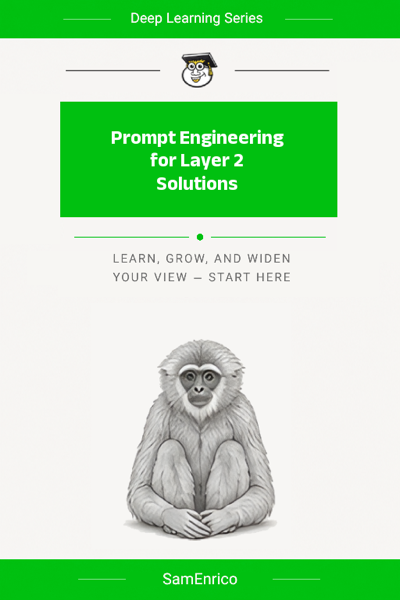
Prompt Engineering for Layer 2 Solutions eBook
A Coursebook on Prompt Engineering for Layer 2 Sol
by Simpson Ira
A Coursebook on Prompt Engineering for Layer 2 Solutions
Formats
Free sample
Chapter 1: The Unasked Question--–- Every significant technological leap in history has created a shadow—a space where knowledge fails to keep pace with innovation. When the printing press arrived, scribes spent decades learning to read mass-produced text differently. When the internet connected the world, an entire generation had to learn what not to click. And today, as artificial intelligence collides with blockchain scalability, we face a new shadow: the profound gap between what AI can do and what Layer 2 solutions actually need.This gap isn't theoretical. It has cost the cryptocurrency industry over $2.5 billion in the past three years—not because the technology was broken, but because the humans interacting with it didn't know how to ask the right questions of their AI assistants.
The Ronin bridge didn't collapse because of a cryptographic flaw. The Wormhole exploit didn't succeed because of a mathematical failure. These disasters happened because somewhere between a developer, their AI, and the L2 protocol, a question went unasked.This book exists to teach you that question. And then the next one. And the hundred after that.The Conversation That Never Happened Imagine a security researcher sitting at a desk on a Tuesday afternoon.
In one browser tab, they have a cross-chain bridge contract—the kind that moves assets between Ethereum and a half-dozen Layer 2 networks. In another tab, they have Chat GPT-4, the most powerful AI system ever released to the public. The researcher types: "Review this bridge contract for security vulnerabilities."The AI returns a well-structured answer. It mentions reentrancy, integer overflow, access control. Standard stuff.
The researcher nods, makes a few notes, and closes the tab.Three months later, that bridge loses $325 million to a vulnerability that was not in the AI's response—a signature malleability issue specific to the way the L2 bridge verified validator signatures. The AI could have identified it. The researcher could have prevented it. But the prompt that would have bridged the gap between general blockchain knowledge and L2-specific constraints was never written.This isn't a story about a bad AI. It's a story about an incomplete question.
And it's why you're reading this book.Why This Book Exists The market is flooded with prompt engineering books. They teach you how to make AI write better emails, summarize documents, generate code, and role-play as a marketing executive. These are useful skills. But they share a common flaw when applied to Layer 2: they assume the world is simple, deterministic, and final.Layer 2 is none of those things.When you prompt an AI about an Optimistic Rollup, you're asking it to reason about a system where nothing is final for seven days. When you prompt about a ZK-Rollup, you're asking it to reason about mathematical proofs that most computer scientists don't fully understand.
When you prompt about a state channel, you're asking it to track off-chain state that isn't recorded anywhere until something goes wrong.General prompt engineering books don't prepare you for this. They assume "confirmed" means confirmed, "final" means final, and "proof" means evidence. On L2, each of those words is a minefield.This book is the first comprehensive guide to navigating that minefield. It draws from the best practices of top prompt engineering literature—role assignment, few-shot learning, chain-of-thought reasoning—and extends them into the unique constraints of blockchain scalability. By the time you finish, you will not be a general prompt engineer.
You will be an L2 prompt engineer, capable of tasks that most developers can't accomplish even with hours of manual work.The Three Assumptions That Will Get You Hacked Before we can build effective L2 prompts, we must first unlearn three assumptions that general prompt engineering has taught us. These assumptions are so deeply embedded in how we interact with AI that you probably don't even notice them. That's what makes them dangerous.Assumption One: Immediate Finality When you ask a general AI about a transaction, it assumes a world where transactions execute and then they're done. This is how most databases work. This is how most APIs work.
This is how the AI's training data—drawn from a world of conventional computing—teaches it to think.L2 doesn't work this way.An Optimistic Rollup transaction can be "confirmed" by the sequencer at 2:00 PM and "reverted" by a fraud proof at 2:00 PM six days later. The transaction didn't fail. It didn't error. It was undone—erased from the canonical history by a mechanism that doesn't exist in any conventional database.Ask a general AI "is this transaction confirmed?" and it will check block explorers, look for the transaction hash, and report back "yes" with high confidence. But on Optimism, "confirmed" is a dangerous word.
The correct question is: "Has the challenge period for this transaction's batch expired without a successful fraud proof?"The AI knows the difference. But your prompt didn't ask.Assumption Two: Transparent Execution General AI systems assume that if you give them code, they can simulate how it runs. This is true for most programming environments. The rules are public. The state transitions are deterministic.
The AI can reason about what the code will do.L2 breaks this assumption in fascinating ways.Consider a ZK-Rollup. The code you write isn't what executes. The code you write is compiled into a circuit, then proven with a zero-knowledge proof, then verified on-chain. The actual execution happens inside a black box that produces a cryptographic certificate of correctness. The AI can reason about the code.
It cannot reason about the proof—not without understanding which proof system you're using (Groth16? PLONK? STARKs?) and how its specific constraints affect execution.Ask a general AI "generate a withdrawal function for my rollup" and it will produce Solidity that works beautifully on Ethereum mainnet. But on zk Sync Era, that function might fail because it uses block.number for timing (zk Sync returns a different value than expected) or because it assumes CREATE2 works identically (zk Sync requires deterministic salts). The code is correct in theory.
It fails in practice. The AI didn't know which proof system to target because your prompt didn't specify.Assumption Three: Trusted Components The single most dangerous assumption in general prompt engineering is the assumption of trust. When you ask an AI to "review this contract for security issues," it assumes the execution environment is honest. The sequencer sequences fairly. The validators validate correctly.
The bridge relays messages without delay.L2 is built on distrust.Every component in a Layer 2 system could be adversarial. The sequencer could censor your transactions. The validators could collude to accept invalid state roots. The bridge operators could delay your messages while they execute their own. These aren't theoretical edge cases—they've all happened in production systems.Your AI will not assume these threats unless you tell it to.
It defaults to cooperation. You must explicitly instruct it to assume the worst.Ask a general AI "is this bridge secure?" and it will check code patterns, signature verification, and access controls. Ask an adversarial L2 prompt "assuming the sequencer is actively censoring addresses in this list, the validators are colluding with the bridge operator, and the documentation is three months out of date—find three ways to steal…
This is the end of the free sample. Get the eBook to keep going. Buy now
About this book
Details
- Author
- Simpson Ira
- Publisher
- SamEnrico
- Language
- English
- Genre
- Non-Fiction, Informative, Educational
- Released
- 2026-05-04
- Pages (approx.)
- 143
- Available as
- eBook, Audiobook

Read better in the ZLOADR app
Your eBooks on your phone or tablet. Sign in with your SamEnrico account and start reading.
More by Simpson Ira
 Cognitive Behavioral Dream InterpretationSimpson Ira$11.99
 The Food Tech Capital OutlookSimpson Ira$11.99
 Empath Anxiety TranceSimpson Ira$11.99
 Bad Reference ResponseSimpson Ira$11.99
 Senior Depression EsteemSimpson Ira$11.99
 Recovery from Financial BurnoutSimpson Ira$11.99
 Brain Tumor MiracleSimpson Ira$11.99
 Antwerp Heist Cold Case ReviewSimpson Ira$11.99
 The Scholastic Crossroads: Oxford and the Birth of the Modern MindSimpson Ira$11.99
 The Lost Code of Hammurabi: Decoding the First LawmakerSimpson Ira$11.99
 Operation Gold: The Race for Soviet SecretsSimpson Ira$11.99
 Growing MyrtillocactusSimpson Ira$11.99
You may also like
 Hong Kong Handover 1997Dunn Johnnie$11.99
 Zumba For Postnatal Recovery CourseNeal Christian$11.99
 Zumba for BeginnersLadner Nikia$11.99
 YouTube Comment Mining GuideHumes Pandora$12.99
 Worry Box MeditationCarlin Rudy$11.99
 Workplace Stress MeditationNguyen Lynn$11.99
 Workplace Stress and Sleep RepairHawley Ivory$11.99
 Workplace Perfectionism CureDelaney Jeffry$11.99
 Workplace Injustice Anger GuideWallen Isabelle$11.99
 Work Addiction and Burnout LinkGreenwood Ester$11.99
 Women in Yoga and WellnessBeattie Galina$11.99
 Women in Stand Up ComedyChun Evangeline$11.99