
Non-FictionInformativeEducational
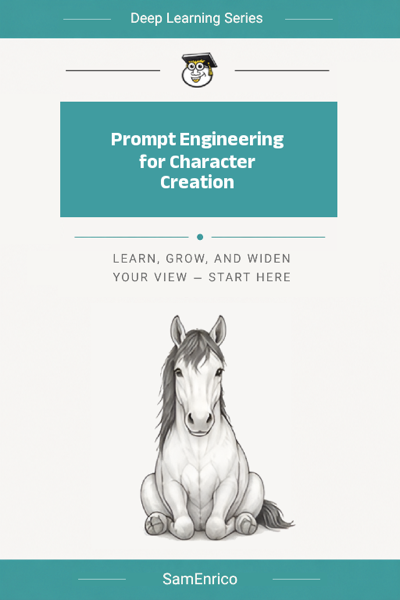
Prompt Engineering for Character Creation eBook
A Coursebook on Prompt Engineering for Character C
A Coursebook on Prompt Engineering for Character Creation
Formats
Free sample
Chapter 1: The Contradiction Engine...--–- Most prompt engineers fail before they write their first word. They open Chat GPT, Mid Journey, or Claude with the best of intentions. They type something like: "Create a brave warrior named Kaelen who is loyal to his friends and fears nothing." And the AI obediently produces exactly that. A warrior who is brave in every scene. Loyal in every interaction. Fearless in every crisis. And completely, utterly forgettable.–- This is not a failure of artificial intelligence. This is a failure of human instruction. The AI gave you precisely what you asked for: a list of traits masquerading as a person. Real human beings are not lists. You are not brave or cowardly. You are brave at work and cowardly in relationships. You are loyal to your family and disloyal to your own boundaries. You fear nothing physical and everything emotional. The most interesting people you know are walking contradictions. Your favorite characters in fiction are the same.–- This chapter introduces the single most important concept in this entire book: the Generative Conflict Model. You will learn to stop building characters from consistent traits and start building them from productive contradictions. You will engineer prompts that force the AI to generate characters who surprise you, challenge you, and—most importantly—feel real.The Flat Character Epidemic–- Let us diagnose the problem before we prescribe the cure. Open any prompt engineering forum, any AI art community, any writer’s group discussing Chat GPT. You will see the same pattern repeated thousands of times. A user posts: “I asked the AI to create a character and here is what I got.” What follows is almost always a paragraph of adjectives masquerading as personality. “Jenna is a confident detective who is sarcastic but caring. She struggles with trust issues but ultimately believes in justice.”–- This is not a character. This is a Mad Libs form filled out by someone who has confused description with depth. The AI can generate these trait-lists indefinitely because they require zero psychological insight. They are statistical averages of every detective ever written. They are the character equivalent of elevator music: present, unobjectionable, and instantly forgotten.–- Why does this happen? Because most prompt engineers treat the AI like a vending machine. They insert tokens (brave, loyal, smart) and expect a fully formed human to fall out. But the AI is not a vending machine. It is a probabilistic text generator trained on millions of books, articles, and conversations. When you feed it a list of positive traits, it generates the statistical average of every character who shares those traits. That average is always a stereotype. Stereotypes are not wrong because they are offensive. Stereotypes are wrong because they are boring.–- The solution is not to add more traits. The solution is to add contradictions. A character who is brave in public and cowardly alone is not a stereotype. A character who is loyal to their friends and treacherous to strangers is not predictable. A character who wants to be loved and believes they are unworthy of love is not a trope. These contradictions generate friction. Friction generates interest. Interest generates memorability.The Generative Conflict Model–- The Generative Conflict Model is simple to state and difficult to master. Here is the core principle: a character is defined not by their consistencies but by the productive tension between their opposing drives. In practice, this means you will never again prompt the AI with a list of traits. Instead, you will engineer prompts that generate characters around a central contradiction.–- Consider two prompts. The first is the standard approach: “Create a character named Maya who is intelligent, ambitious, and secretly lonely.” This will produce a character who is intelligent in every scene, ambitious in every decision, and lonely in every quiet moment. The consistency is the problem. Real intelligent people have blind spots. Real ambitious people have moments of paralyzing doubt. Real lonely people sometimes prefer solitude.–- The second prompt uses the Generative Conflict Model: “Create a character named Maya who is intellectually brilliant but emotionally illiterate. She can solve complex problems in seconds but cannot identify her own feelings. Her ambition drives her to succeed, but every success makes her feel more isolated because she does not know how to let people in. Show three specific situations where her intelligence and her emotional blindness contradict each other.”–- The difference is immediately apparent. The first prompt produces a sketch. The second prompt produces a person with predictable failure modes. You know exactly what will happen when Maya is promoted, falls in love, or loses a friend. Her intelligence will save her in the short term. Her emotional blindness will destroy her in the long term. That is dramatic tension. That is story fuel.–- The Generative Conflict Model rests on four pillars, each of which you will master in this chapter:The Core Wound: Every contradiction stems from an unresolved injury. You will learn to engineer prompts that generate characters from a single traumatic event, then derive their contradictions from that event.Cognitive Dissonance Architecture: You will learn to prompt the AI to generate two opposing desires and then force them to coexist within the same character. This is not about creating confusion. It is about creating the engine that drives every scene.The Contradiction Triad: You will learn to engineer characters with exactly three contradictions. Fewer than three is too simple. More than three is noise. Three is the sweet spot where complexity becomes legible.The Unresolved Question: Every contradiction creates a question the character cannot answer. You will learn to identify that question and use it as the seed for future development.The Core Wound Architecture–- Every memorable character in fiction is running from something. That something may be a death, a betrayal, a failure, or a moment of profound shame. The specific event matters less than its effect: the character developed a coping mechanism that worked in the moment and failed everywhere else.–- In this book, we call that event the Core Wound. The Core Wound is the single unresolved emotional injury that generates all of the character’s contradictions. A character who was abandoned at age seven does not simply feel sad about that event. They develop strategies to prevent abandonment. They may become hyper-independent, refusing to need anyone. Or they may become anxiously attached, terrified of being left again. Or they may become avoidant, leaving others before they can be left.–- Each of these strategies produces different contradictions. The hyper-independent character appears strong but collapses when forced to accept help. The anxiously attached character appears loving but smothers everyone they care about. The avoidant character appears calm but has never had a real relationship. The same wound produces different contradictions depending on the strategy the character developed to survive it.–- The Core Wound Architecture is a prompt engineering technique that forces the AI to generate characters from the wound outward. Here is the template:Core Wound Prompt Template:text Copy Download Generate a character defined by the following Core Wound: [Insert wound in 1-2 sentences].
From this wound, the character developed the following survival strategy: [Insert strategy in 1 sentence].…
This is the end of the free sample. Get the eBook to keep going. Buy now
About this book
Details
- Author
- Mattos Laveta
- Publisher
- SamEnrico
- Language
- English
- Genre
- Non-Fiction, Informative, Educational
- Released
- 2026-06-02
- Pages (approx.)
- 155
- Available as
- eBook, Audiobook

Read better in the ZLOADR app
Your eBooks on your phone or tablet. Sign in with your SamEnrico account and start reading.
More by Mattos Laveta
 Drag Along Tag AlongMattos Laveta$11.99
 Anger And Caregiver BurnoutMattos Laveta$11.99
 Lotus Flower Opening GuideMattos Laveta$11.99
 Script Recording for ClientsMattos Laveta$11.99
 Manganese Bone And Metabolism GuideMattos Laveta$11.99
 The Mining Engineer Stress GuideMattos Laveta$11.99
 Pet Loss For MuslimsMattos Laveta$11.99
 OCD QuizMattos Laveta$11.99
 Time Blocking For Chronic IllnessMattos Laveta$11.99
 Pandora's Curse: The Box That Never ClosedMattos Laveta$11.99
 The Silk Road of the Sea: Portugal’s Golden ArmadaMattos Laveta$11.99
 Growing WahlenbergiaMattos Laveta$11.99
You may also like
 Hong Kong Handover 1997Dunn Johnnie$11.99
 Zumba For Postnatal Recovery CourseNeal Christian$11.99
 Zumba for BeginnersLadner Nikia$11.99
 YouTube Comment Mining GuideHumes Pandora$12.99
 Worry Box MeditationCarlin Rudy$11.99
 Workplace Stress MeditationNguyen Lynn$11.99
 Workplace Stress and Sleep RepairHawley Ivory$11.99
 Workplace Perfectionism CureDelaney Jeffry$11.99
 Workplace Injustice Anger GuideWallen Isabelle$11.99
 Work Addiction and Burnout LinkGreenwood Ester$11.99
 Women in Yoga and WellnessBeattie Galina$11.99
 Women in Stand Up ComedyChun Evangeline$11.99