
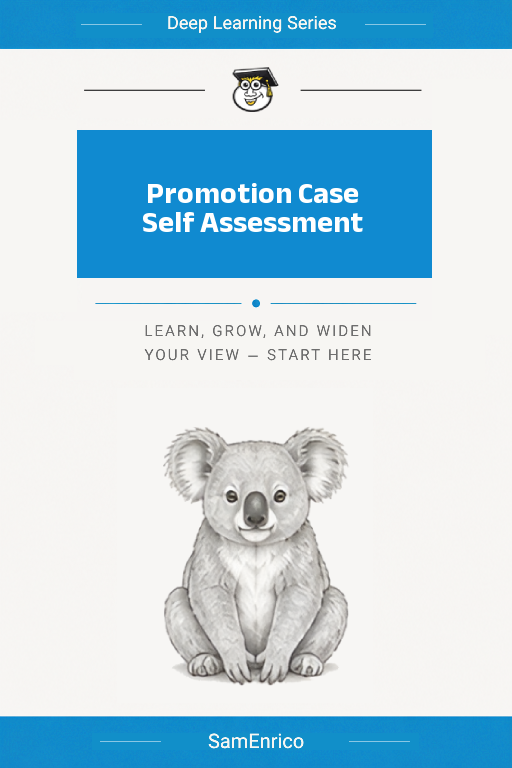
Non-FictionProfessional's Cheat SheetSelf Assessment
Promotion Case Self Assessment eBook
Score yourself against next-level competencies to
Score yourself against next-level competencies to identify gaps and strengths before your pitch.
Formats
Free sample
Chapter 1: The Diagnosis Trap--Most professionals fail promotions not because they lack talent, work ethic, or ambition. They fail because they are solving the wrong problem.Walk into any corporate office and you will find a familiar scene: a high-performing employee, recently passed over for promotion, sitting in their manager’s office asking, “What else do I need to learn?” They sign up for a certification course. They volunteer for a cross-functional project. They stay late for three months. And then, when the next promotion cycle arrives, they are passed over again.
The pattern repeats until they either leave the company or resign themselves to being “the reliable one” rather than “the leader.”This is the Diagnosis Trap.The Diagnosis Trap occurs when you correctly identify a weakness but misattribute its cause. You feel invisible, so you assume you lack skills. You feel undervalued, so you assume you need more training. You see colleagues advancing while you stagnate, so you assume the system is rigged. In each case, you are noticing a real symptom—but you are treating the wrong disease.This chapter exists to drag you out of that trap by introducing a single, brutal distinction: the difference between a Skill Gap and a Visibility Gap.A Skill Gap means you cannot do something required for the next level.
You lack technical knowledge, leadership experience, or strategic judgment. The solution is training, mentorship, deliberate practice, and time.A Visibility Gap means you can do the work, but the right people do not know about it. Your accomplishments are real, measurable, and valuable—but they are invisible to the promotion committee. The solution is not more training. It is communication strategy, stakeholder mapping, and narrative control.Here is the painful truth that most self-help career books will not tell you: the majority of professionals stuck below their potential are suffering from a Visibility Gap, not a Skill Gap.
They are spending months learning skills they already possess instead of spending weeks making their existing work visible. They are paying for certificates no one will read instead of writing a single email that would change their trajectory.By the end of this chapter, you will know exactly which gap is holding you back. You will have completed the Diagnosis Matrix, a tool that separates “Effort Illusions” (tasks that feel important but create no perceived value) from “Value Blind Spots” (achievements you have ignored because they seemed routine but are actually promotion-worthy). And you will never waste another month training for a problem you could solve with visibility.The Anatomy of a Failed Promotion Before we can fix the diagnosis, we must understand how it breaks. Let me walk you through the career of a fictional but painfully real professional named Sarah.Sarah is a senior marketing coordinator at a mid-sized B2B software company.
She has been in her role for three years. Her manager, David, describes her as “reliable, hardworking, and technically excellent.” Her peers come to her for help with analytics tools. She has never missed a deadline. Her campaigns consistently deliver above-average engagement metrics.When Sarah applied for a promotion to marketing manager, she was rejected. The feedback was vague: “We need to see more strategic thinking.” So Sarah enrolled in a $3,000 strategy certification course.
She spent weekends learning frameworks like SWOT analysis, Porter’s Five Forces, and balanced scorecards. She aced the exam.Six months later, she applied again. Rejected again. This time, the feedback was different: “We need to see you take more ownership of cross-functional initiatives.” So Sarah volunteered to lead a project involving the sales and product teams. She created a detailed project plan.
She ran weekly status meetings. The project launched on time.Twelve months later, she applied a third time. Rejected. David pulled her aside and said, “Honestly, Sarah, I don’t know what else to tell you. You’re doing everything we asked.
But when the promotion committee meets, your name just doesn’t come up.”Sarah quit three months later. She now works at a competitor, where she was hired directly into a manager role.What happened?Sarah fell into the Diagnosis Trap at every turn. After her first rejection, she assumed a Skill Gap (strategic thinking) and invested in training she did not need. After her second rejection, she assumed another Skill Gap (cross-functional ownership) and invested in project work that, while valuable, did not address the real problem. The real problem was a Visibility Gap.
David knew Sarah was excellent. But David was not the promotion committee. The committee members—a director from sales, a VP of product, and an HR business partner—had never heard of Sarah’s campaigns, her analytics expertise, or her cross-functional project. They saw a coordinator who had been in role for three years with no obvious upward trajectory. They assumed she was not ready.Sarah’s story is not unusual.
It is the norm.The Career Balance Sheet: Effort vs. Value To escape the Diagnosis Trap, you need a new way of looking at your work. Most professionals keep a mental ledger of their contributions, but that ledger is almost always biased toward Effort Metrics—activities that feel hard, take time, and require sacrifice. Effort Metrics include hours worked, emails sent, meetings attended, late nights, weekends sacrificed, and tasks completed.Effort Metrics are seductive because they are easy to measure and easy to feel. You know when you worked late.
You know when your inbox was overwhelming. You know when you attended back-to-back meetings. But Effort Metrics are also dangerously misleading. The promotion committee does not care how hard you worked. They care what you produced.Value Metrics, by contrast, measure impact.
Revenue generated, costs reduced, risks eliminated, time saved, decisions enabled, clients retained, errors prevented, processes accelerated. Value Metrics are harder to track because they require you to translate your work into the language of business outcomes. But Value Metrics are the only language the promotion committee speaks.This is the Career Balance Sheet. On one side, you list every significant activity from the past twelve months. On the other side, you categorize each activity as either Effort (how hard it was) or Value (what it produced).Most people, when they complete this exercise for the first time, discover something uncomfortable: they have been spending 80% of their time on tasks that generate 20% of their measurable value.
They are exhausted and invisible simultaneously.Let me give you an example.Effort Illusion: You spend ten hours per week manually cleaning data in a spreadsheet because the automated system is unreliable. You feel productive. You are solving a real problem. But what is the Value Metric? The value is not “ten hours of work.” The value is “enabled accurate reporting” — which is real, but vague.
The committee cannot evaluate “enabled accurate reporting.” They can evaluate “reduced reporting errors from 12% to 2%,” or “eliminated 40 hours of manual data cleaning per month by building an automation script.”Value Blind Spot: You noticed a recurring question from customers and created a one-page FAQ that you shared internally. You did it in twenty minutes and forgot about it. But that FAQ was then used by the sales team…
This is the end of the free sample. Get the eBook to keep going. Buy now
About this book
Details
- Author
- Iverson Kaylene
- Publisher
- SamEnrico
- Language
- English
- Genre
- Non-Fiction, Professional's Cheat Sheet, Self Assessment
- Released
- 2026-05-30
- Pages (approx.)
- 144
- Available as
- eBook, Audiobook

Read better in the ZLOADR app
Your eBooks on your phone or tablet. Sign in with your SamEnrico account and start reading.
More by Iverson Kaylene
 Body Appreciation MeditationIverson Kaylene$11.99
 Alcoholism and Self MedicationIverson Kaylene$11.99
 Gut Brain Axis And MemoryIverson Kaylene$11.99
 The Tommy Orange StoryIverson Kaylene$11.99
 Nicoya Peninsula LongevityIverson Kaylene$11.99
 Affirmations For MindfulnessIverson Kaylene$11.99
 Okinawa LifestyleIverson Kaylene$11.99
 Catastrophizing Anger FixIverson Kaylene$11.99
 Operation Midnight Serpent: The KGB’s Forgotten Mole in the PentagonIverson Kaylene$11.99
 The Celestial Codebreakers: How Two African Scholars Deciphered the StarsIverson Kaylene$11.99
 How to Produce Varathane Exterior PaintIverson Kaylene$11.99
 B2B Sales for Waste ManagementIverson Kaylene$12.99
You may also like
 Hong Kong Handover 1997Dunn Johnnie$11.99
 Zumba For Postnatal Recovery CourseNeal Christian$11.99
 Zumba for BeginnersLadner Nikia$11.99
 YouTube Comment Mining GuideHumes Pandora$12.99
 Worry Box MeditationCarlin Rudy$11.99
 Workplace Stress MeditationNguyen Lynn$11.99
 Workplace Stress and Sleep RepairHawley Ivory$11.99
 Workplace Perfectionism CureDelaney Jeffry$11.99
 Workplace Injustice Anger GuideWallen Isabelle$11.99
 Work Addiction and Burnout LinkGreenwood Ester$11.99
 Women in Yoga and WellnessBeattie Galina$11.99
 Women in Stand Up ComedyChun Evangeline$11.99