
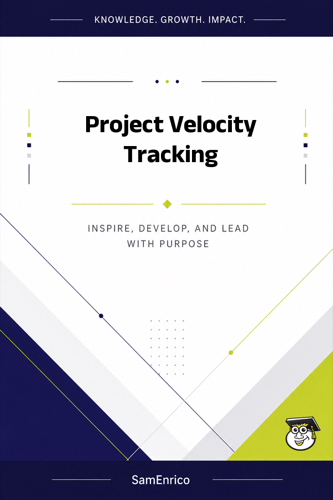
Non-FictionBusiness BriefVelocity
Project Velocity Tracking eBook
Measure team throughput across all projects.
Measure team throughput across all projects.
Formats
Free sample
Chapter 1: The Estimation Lie--–- Every Monday morning, in thousands of conference rooms around the world, highly paid professionals perform a ritual that has been proven, repeatedly and empirically, to produce no value whatsoever. They gather around a whiteboard or a digital backlog. They pick up a user story. They argue for forty-five minutes about whether it is a “three” or a “five.” They average their guesses. They write down that average.
Then they move to the next story. This ritual is called estimation. And it is the single greatest destroyer of project velocity that most organizations have never questioned.The seduction of estimation is obvious. Human beings crave certainty. The future is uncertain.
Estimation offers a bridge between the two—a promise that with enough collective wisdom, we can predict how long something will take. Managers demand estimates because they need to commit to stakeholders. Stakeholders demand estimates because they need to budget. Executives demand estimates because they need to forecast. And so the ritual continues, generation after generation, despite overwhelming evidence that most software estimates are wrong by a factor of two or more, and that the act of estimating does nothing to improve delivery speed.This chapter will dismantle the estimation economy.
It will show you why the tools you have been taught to trust—story points, hours, ideal days, t-shirt sizes—are not merely imprecise but actively harmful to multi-project velocity. It will introduce the only metric that actually works for tracking throughput across multiple projects. And it will give you permission to stop estimating. Not because estimation is hard, but because estimation is a lie that keeps your organization busy without making it effective.The Origins of the Estimation Delusion To understand why estimation fails, we must first understand where it came from. The practice of estimating software work did not emerge from malice or stupidity.
It emerged from a reasonable impulse applied to the wrong domain.In traditional manufacturing and construction, estimates work reasonably well. A civil engineer can estimate how many cubic yards of concrete a bridge will require because concrete is predictable. A factory manager can estimate how many units a production line will output because the machine has a fixed cycle time. These domains benefit from what statisticians call “low variance” and “repeatable processes.” The same input, processed the same way, produces the same output.Software development is nothing like this. A feature that took two days last month might take two weeks this month because the codebase has degraded, a key person is on vacation, or a hidden dependency has emerged.
A bug that looks trivial might consume three days of debugging. A complex integration that everyone feared might take five minutes because someone already wrote a library. Software is a domain of high variance, novel problems, and non-repeatable conditions. Estimating software is like estimating how long it will take to write a poem or solve a novel mathematical proof.The agile movement, for all its contributions, made this problem worse. When the creators of Scrum introduced story points in the early 2000s, they were trying to solve a real problem: hours-based estimates were obviously fake because developers padded them, managers discounted them, and no one trusted anyone.
Story points were supposed to be relative, abstract, and immune to the politics of time. A “three” didn’t mean three hours or three days. It just meant “bigger than a two and smaller than a five.”But the abstraction that was meant to liberate teams became a new cage. Teams still spent hours debating whether something was a three or a five. Managers still demanded that points map to time (“how many points can you do in a sprint?”).
And organizations still used point velocity to compare teams, reward performance, and punish “underperformance.” The estimation machine had simply been rebranded.Why Story Points Destroy Multi-Project Velocity Here is the specific mechanism by which estimation damages multi-project throughput. It is not a theoretical claim. It is observable in any organization that uses story points across multiple teams and multiple projects.First, estimation creates local optimization without global awareness. A team that finishes forty story points in a sprint feels productive. They celebrate.
Their manager praises them. But those forty points might be distributed across three different projects. If the team is spending 70% of its points on Project A but Project A is already ahead of schedule while Project B is critically behind, the local celebration obscures a global failure. The team has optimized for “point output” rather than “project completion.” No one notices until the end-of-quarter review, when Project B is late and no one understands why.Second, estimation makes cross-project comparison mathematically invalid. Different teams define story points differently.
One team’s “three” is another team’s “eight.” One team includes testing in their points; another team treats testing as a separate activity. One team’s points represent effort; another team’s points represent complexity; a third team’s points represent risk. When you try to aggregate point velocity across multiple projects, you are adding apples, oranges, and bicycles. The resulting number is not just imprecise. It is meaningless.Third, estimation incentivizes the wrong behaviors.
When teams know they will be judged on point velocity, they do predictable things. They inflate estimates to create safe buffers. They break large stories into many tiny stories to inflate point counts. They avoid hard problems because hard problems have unpredictable points. They hide technical debt work in feature stories because technical debt has no points of its own.
The measurement becomes the target, and Goodhart’s Law applies: when a measure becomes a target, it ceases to be a good measure.I have witnessed this in organizations ranging from five-person startups to fifty-thousand-person enterprises. In every case, the teams that were most obsessed with points were the teams that delivered the least predictable value. The teams that ignored points and focused on throughput—raw counts of completed work items—were the teams that stakeholders actually trusted.The Multi-Project Dilemma The multi-project dilemma is the central problem this book exists to solve. Here it is in plain language:When a team works on only one project, you can use almost any metric and eventually figure out what is happening. When a team works on multiple projects simultaneously, most metrics become useless because you cannot tell which project the work belongs to or whether progress on one project is being stolen from another.Consider a concrete example.
Team Alpha has five engineers. Over the course of a week, they close twenty tickets. Those twenty tickets are distributed across three projects: Project X (twelve tickets), Project Y (five tickets), and Project Z (three tickets).Now ask yourself: is this good or bad? You cannot answer without additional context. Maybe Project X is on track and Project Y is already finished, so the low number on Y is fine.
Maybe Project Z is a critical compliance project with a regulatory deadline, and three tickets per week is disastrously slow. Maybe the team is thrashing, spending one day on X, one day on Y, one day on Z, and never making sustained progress on any of them.Traditional estimation tools…
This is the end of the free sample. Get the eBook to keep going. Buy now
About this book
Details
- Author
- Mckenna Shaneka
- Publisher
- SamEnrico
- Language
- English
- Genre
- Non-Fiction, Business Brief, Velocity
- Released
- 2026-06-09
- Pages (approx.)
- 147
- Available as
- eBook, Audiobook

Read better in the ZLOADR app
Your eBooks on your phone or tablet. Sign in with your SamEnrico account and start reading.
More by Mckenna Shaneka
 Financial Recovery After AlcoholMckenna Shaneka$11.99
 Storytelling Memory PreservationMckenna Shaneka$11.99
 Walking Meditation For Social Anxiety WorkbookMckenna Shaneka$11.99
 The Body Scan for Attorneys GuideMckenna Shaneka$11.99
 The Golden Ink of Timbuktu: How Africa's Scholars Built a Global Learning EmpireMckenna Shaneka$11.99
 How to Start a Chimney Pots Made of Ceramic Business (Beginners Guide)Mckenna Shaneka$11.99
 Avery Dennison SWOTMckenna Shaneka$12.99
 German University for African StudentsMckenna Shaneka$12.99
 Understanding Occlusive Infantile AteriopathyMckenna Shaneka$17.99
 Specification WriterMckenna Shaneka$11.99
You may also like
 Hong Kong Handover 1997Dunn Johnnie$11.99
 Zumba For Postnatal Recovery CourseNeal Christian$11.99
 Zumba for BeginnersLadner Nikia$11.99
 YouTube Comment Mining GuideHumes Pandora$12.99
 Worry Box MeditationCarlin Rudy$11.99
 Workplace Stress MeditationNguyen Lynn$11.99
 Workplace Stress and Sleep RepairHawley Ivory$11.99
 Workplace Perfectionism CureDelaney Jeffry$11.99
 Workplace Injustice Anger GuideWallen Isabelle$11.99
 Work Addiction and Burnout LinkGreenwood Ester$11.99
 Women in Yoga and WellnessBeattie Galina$11.99
 Women in Stand Up ComedyChun Evangeline$11.99