
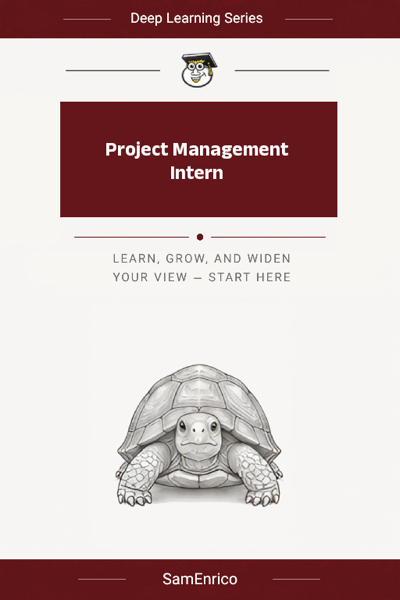
Non-FictionInformativeEducational
Project Management Intern eBook
A Coursebook on Project Management Intern
A Coursebook on Project Management Intern
Formats
Free sample
Chapter 1: The Unlearning Curve--–- The email arrived at 11:47 PM on a Sunday. You weren't supposed to see it until Monday morning, but like most interns in their first week, you had already set up email notifications on your phone. The subject line read: "Welcome! Here's your first project assignment." Your heart raced. This was it.
The moment you had been waiting for through three rounds of interviews, two case studies, and that awkward Zoom call where your camera froze while you were nodding. You opened the attachment. And then you felt it: the slow, creeping realization that you had absolutely no idea what you were looking at.The document was titled "Project Initiation Document – Q3 Dashboard Integration." It contained thirty-seven pages of acronyms you had never seen, a Gantt chart with dependencies that looked like a bowl of spaghetti, and a section called "Stakeholder RACI" that might as well have been written in ancient Greek. You had a 3.8 GPA. You had taken two project management courses in college.
You had even earned a Scrum certification that cost you four hundred dollars and a weekend of your life. None of it prepared you for this.This chapter is about why that feeling is not only normal but necessary. The single biggest predictor of internship success is not technical knowledge, certification count, or even raw intelligence. It is the speed with which you can unlearn the classroom and relearn the corporate world. Schools reward perfect individual outputs delivered on a fixed deadline with a known rubric.
Businesses reward imperfect team progress delivered under conditions of ambiguity where the rubric is invented as you go. The two systems are not just different. They are opposites. And the faster you accept that, the faster you stop feeling like an imposter and start feeling like a project manager.The Academic-to-Corporate Transition Matrix Let us begin with a simple comparison. In school, every assignment comes with a known problem statement.
The professor tells you exactly what to build, often down to the number of pages or slides. In business, the problem statement is usually something like "make the dashboard better" or "fix the onboarding experience." No one tells you what "better" means. You have to discover it by asking questions that feel dumb but are actually strategic.In school, the deadline is fixed and non-negotiable. The syllabus says "due May 15 at 11:59 PM," and late submissions lose points. In business, deadlines are also fixed, but they are constantly negotiated.
A senior leader might say "we need this by Friday" and then, when you explain what would have to drop, say "okay, Tuesday is fine." The trick is learning which deadlines are real and which are wishes.In school, the rubric is known in advance. You know that citations are worth 10 percent, analysis 40 percent, and so on. In business, there is no rubric. The stakeholder who reviews your work might care about formatting, or they might care about a single number buried on page seven. You will not know until you deliver something and get feedback.
That feedback is often brutal, late, and contradictory.Here is the most important difference: in school, you work alone or in teams where everyone ultimately gets the same grade. In business, you work in teams where accountability is individual and collective simultaneously. If you fail, the team fails. If the team fails, you fail. There is no curve.
No extra credit. No office hours where the professor tells you the answer. There is only the project and the clock.The intern's first job, then, is not to prove how much you know. It is to learn which of the three constraints—scope, time, cost—is actually fixed on your specific project. In predictive (waterfall) environments, scope is fixed and time is estimated.
In adaptive (agile) environments, time is fixed and scope is flexible. Your manager will rarely tell you which environment you are in. You have to diagnose it yourself by observing how often the scope changes and how tightly people guard the deadline.Reading the Organizational Chart as an Intern On your first day, someone will send you an organizational chart. It will look like a hierarchy of boxes with names and titles. Most interns look at this chart and see power: who is above whom, who reports to whom, who can fire whom.
This is a mistake. The org chart is not a map of power. It is a map of reporting relationships, which are only loosely correlated with actual influence.You need to read the org chart as three different maps layered on top of each other. The first map is reporting lines: who signs your timesheet and writes your performance review. This person has formal authority over you.
They can assign tasks, approve overtime, and end your internship early. You must manage this relationship above all others. The second map is information flow: who actually knows what is happening on a day-to-day basis. This is often not the person at the top of the chart. It is the senior analyst who has been there for eight years and knows where all the bodies are buried.
The third map is budget authority: who can approve overtime, software licenses, vendor contracts, or travel expenses. This person may be three levels above you and have no idea who you are. You will need something from them eventually, and you will need a path to get it.Here is a practical exercise for your first week: print out the org chart. Draw three different colored circles around the names that matter for each map. Red for reporting lines.
Blue for information flow. Green for budget authority. The people who appear in all three circles are your most critical stakeholders. The people who appear in none of them are probably safe to ignore. The people who appear in only one circle are situational: useful in specific contexts but not worth daily attention.This exercise reveals something uncomfortable: your direct manager may not be the most influential person for your success.
The person who reviews your work (quality authority) might be in a different department. The person who approves your software access (budget authority) might be in IT two floors away. The person who actually knows how to fix the broken spreadsheet might be another intern who started three weeks before you. The org chart does not show any of this. You have to discover it by talking to people.The Four Pillars of Intern Success Technical knowledge will get you in the door.
The Four Pillars will keep you there. These are drawn from the Agile Practice Guide's mindset shifts, adapted specifically for the intern experience. Each pillar is a behavior, not a trait. You are not born reliable. You become reliable through small, consistent actions.Pillar One: Reliability Reliability is doing the small, boring things exactly when you promised.
It sounds simple. It is not. Reliability means replying to emails within twenty-four hours, even when the email is annoying. It means showing up to the daily stand-up on time, every time, even when you have nothing to report. It means updating the task tracker before your manager asks, not after.
Reliability compounds faster than brilliance. A single brilliant insight forgotten the next day is worthless. A hundred small reliable actions…
This is the end of the free sample. Get the eBook to keep going. Buy now
About this book
Details
- Author
- Blanchette Marisela
- Publisher
- SamEnrico
- Language
- English
- Genre
- Non-Fiction, Informative, Educational
- Released
- 2026-06-03
- Pages (approx.)
- 141
- Available as
- eBook, Audiobook

Read better in the ZLOADR app
Your eBooks on your phone or tablet. Sign in with your SamEnrico account and start reading.
More by Blanchette Marisela
 Toddler Parenting Stress GuideBlanchette Marisela$11.99
 The Parent Morning Routine GuideBlanchette Marisela$11.99
 The In Game Purchase TrapBlanchette Marisela$11.99
 AI Real-Time Video Effects GuideBlanchette Marisela$11.99
 The Deep Unknown: How a Brazilian Microbiologist Redefined Oceanic Life (1980s)Blanchette Marisela$11.99
 The Last Voyage of the MV Derbyshire: Titanic of the SeasBlanchette Marisela$11.99
 Understanding Bruton Type AgammaglobulinemiaBlanchette Marisela$17.99
 Small Business Budgeting AI ToolsBlanchette Marisela$12.99
 Express Entry Draw AnalysisBlanchette Marisela$12.99
 How to Become a Schedule MakerBlanchette Marisela$11.99
You may also like
 Hong Kong Handover 1997Dunn Johnnie$11.99
 Zumba For Postnatal Recovery CourseNeal Christian$11.99
 Zumba for BeginnersLadner Nikia$11.99
 YouTube Comment Mining GuideHumes Pandora$12.99
 Worry Box MeditationCarlin Rudy$11.99
 Workplace Stress MeditationNguyen Lynn$11.99
 Workplace Stress and Sleep RepairHawley Ivory$11.99
 Workplace Perfectionism CureDelaney Jeffry$11.99
 Workplace Injustice Anger GuideWallen Isabelle$11.99
 Work Addiction and Burnout LinkGreenwood Ester$11.99
 Women in Yoga and WellnessBeattie Galina$11.99
 Women in Stand Up ComedyChun Evangeline$11.99