
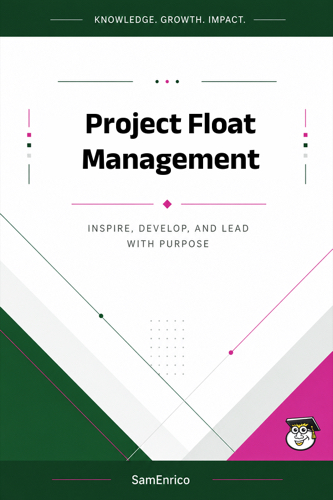
Project Float Management eBook
Use slack time to absorb delays without affecting
Use slack time to absorb delays without affecting deadline.
Formats
Free sample
Chapter 1: The 3AM Phone Call...--–- The phone rang at 3:14 AM on a Tuesday. Not a text message notification or a spam call from a blocked number—a persistent, aggressive ring that vibrates across a nightstand like a fire alarm. Sarah Chen, Senior Project Manager at Nexus Dynamics, knew instantly that something had gone catastrophically wrong. Project managers do not receive 3 AM phone calls for good news. Good news arrives via email at 10 AM, sandwiched between meeting invitations.
Bad news arrives at 3 AM, and it always has a name. Tonight, the name was Project Chimera.Sarah had been managing Project Chimera for eleven months. It was a $47 million initiative to deploy a new inventory management system across Nexus's fifteen warehouses nationwide. The deadline was fixed—not flexible, not aspirational, but legally contracted with a major retailer who had promised shelf space contingent on the system going live by October 1st. Every day of delay cost Nexus $340,000 in penalties and lost revenue.
Sarah had known this for eleven months. She had repeated it in every status meeting, every steering committee presentation, every budget review. She had built a schedule with 47 days of total float distributed across the non-critical work packages. She had identified the critical path—a sequence of seventeen tasks that absolutely, positively could not slip. She had done everything her PMP certification taught her to do.And now, at 3:14 AM, the critical path had just been destroyed.The Anatomy of a Meltdown The voice on the phone belonged to Marcus Webb, the lead systems integrator for the warehouse automation subproject.
Marcus was not an alarmist. He was the kind of engineer who used phrases like "mild concern" to describe situations that would send ordinary humans into cardiac arrest. When Marcus Webb says, "We have a problem," the correct response is not to ask for clarification. The correct response is to assume the building is on fire."The core API gateway failed certification," Marcus said. His voice was calm, which made it worse.
"The test harness detected a memory leak that corrupts transaction logs after roughly twelve hours of continuous operation. The fix requires rewriting the event handling module from scratch. Best-case timeline: fourteen days."Sarah sat up in bed, her heart pounding against her ribs. Fourteen days. The critical path had exactly three days of contingency remaining—a buffer she had fought to preserve through six months of scope creep and resource reallocation.
Three days of safety for a fourteen-day problem. The math was brutal and unambiguous: Project Chimera was now eleven days late before the sun had even risen.She pulled up the project schedule on her tablet, the blue bars of the Gantt chart glowing in the dark bedroom. The critical path tasks were highlighted in red—Task 3.4 (API Development), Task 4.1 (Integration Testing), Task 5.2 (Warehouse Pilot). All of them had been on track yesterday. All of them were now in free fall.
The non-critical tasks—the training documentation, the user acceptance testing preparation, the parallel reporting dashboard—still showed positive float, green bars with little white numbers indicating how many days of slack remained. But those numbers were now irrelevant. When the critical path collapses, all the slack in the world cannot save you.Sarah had three options, and she hated all of them.Option One: Crash the Schedule The first option was crashing—throwing more resources at the problem to compress the timeline. If the API rewrite required fourteen days with the existing team of three engineers, perhaps it could be done in nine or ten days with six engineers. Sarah had seen this work before, usually on television shows about heroic software developers who saved Christmas by typing furiously while dramatic music played.
In real life, crashing had diminishing returns and hidden costs.The law of diminishing returns in project management is unforgiving. Adding resources to a late task does not reduce duration linearly because communication overhead increases, coordination complexity multiplies, and the original team must spend time training new members instead of doing the work. Fred Brooks, in his legendary book The Mythical Man-Month, codified this as Brooks's Law: "Adding manpower to a late software project makes it later." The optimal number of engineers for the API rewrite was probably four or five. Adding more would create chaos, not speed.Even if crashing worked perfectly—a fantasy, but Sarah needed to consider it—the cost would be brutal. Overtime premiums, contractor rates, the opportunity cost of pulling senior engineers off other projects.
At least $400,000 in additional spending, plus the morale damage of asking an already exhausted team to work even harder. And after all that, the best-case outcome was still a delay. Eleven days late instead of fourteen. The retailer's penalty clock would still start ticking.Option Two: Fast-Track the Sequence The second option was fast-tracking—overlapping tasks that were originally planned sequentially. In the original schedule, the API rewrite (Task 3.4) had to be fully completed before integration testing (Task 4.1) could begin.
But what if testing started after only seventy percent of the rewrite was finished? The testing team could work on the completed modules while the rewrite team finished the remaining pieces. In theory, this could shave several days off the critical path.In theory. In practice, fast-tracking was a gamble with terrible odds. Starting testing before the API was stable meant that testers would encounter failures that were not actually bugs—just incomplete features.
They would file false defect reports, investigate phantom issues, and waste days chasing problems that would resolve themselves once the API was finished. The rework rate on fast-tracked projects was often fifty percent or higher. Sarah had seen teams spend two weeks testing an incomplete system, only to discover that the completed system behaved completely differently, invalidating all their work.Fast-tracking might save five days. It might also create twenty days of rework. There was no way to know until you were already committed, which was precisely what made it so dangerous.
Sarah remembered a mentor's advice: "Fast-tracking is like playing poker with your deadline. Sometimes you win. Usually, you lose. And you never find out until the river card turns over."Option Three: Negotiate the Scope The third option was the most politically painful: scope negotiation. The retailer needed the inventory management system to track stock levels, generate purchase orders, and synchronize data across warehouses.
Did they also need the real-time dashboard? The automated reordering algorithm? The integration with their legacy ERP system? Perhaps some of these features could be deferred to a Phase 2 release, after the October 1 deadline. The system would still work.
It just wouldn't do everything.Scope negotiation was the only option that did not require working the team harder or accepting massive rework risk. It was also the only option that required Sarah to admit failure to the executive sponsor. "We cannot deliver everything we promised by October 1" was not a conversation she wanted to have. Sponsors did not respond well to this message. They tended to ask questions like "Why didn't you tell me sooner?" and "What have you been doing for eleven months?" and "Do you expect me to explain this to the retailer?"But the question was not whether Sarah…
This is the end of the free sample. Get the eBook to keep going. Buy now
About this book
Details
- Author
- Fenner Melvin
- Publisher
- SamEnrico
- Language
- English
- Genre
- Non-Fiction, Business Brief, Float
- Released
- 2026-06-06
- Pages (approx.)
- 149
- Available as
- eBook, Audiobook

Read better in the ZLOADR app
Your eBooks on your phone or tablet. Sign in with your SamEnrico account and start reading.
More by Fenner Melvin
 Walking Meditation For Weight Loss HandbookFenner Melvin$11.99
 Vision Loss Memory ConnectionFenner Melvin$11.99
 The Body Scan for Students GuideFenner Melvin$11.99
 Empty Nest Alcohol RecoveryFenner Melvin$11.99
 The Poisoner of Lyon: The Deadly Charms of Hélène JégadoFenner Melvin$11.99
 Understanding Obstructive Sleep ApneaFenner Melvin$17.99
 German Part Time Job HandbookFenner Melvin$12.99
 Crown Holdings SWOTFenner Melvin$12.99
 How to Become a Compression-molding-machine TenderFenner Melvin$11.99
 Software Implementation ConsultantFenner Melvin$11.99