
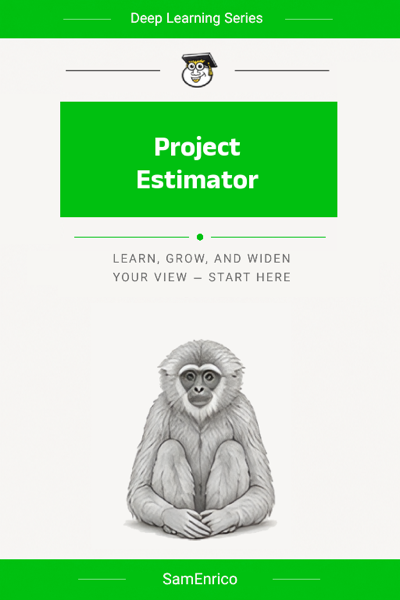
Non-FictionInformativeEducational
Project Estimator eBook
A Coursebook on Project Estimator
by Bolin Yanira
A Coursebook on Project Estimator
Formats
Free sample
Chapter 1: The Number That Lies--Every failed project begins with a single number.That number sits in a spreadsheet, projected on a conference room screen, printed in a contract. It looks precise. It looks professional. It looks like math. But more often than not, it is a fiction—a convenient fiction, an accepted fiction, but a fiction nonetheless.
And when reality refuses to conform to that fiction, the blaming begins. The estimator is called incompetent. The project manager is called naive. The contractor is called dishonest. Everyone loses.
And the next project starts the cycle all over again.Here is the truth that the best estimators in the world learn early, and that the rest learn painfully: a single-point estimate is always wrong. Not sometimes wrong. Not wrong in certain industries. Always, mathematically, inevitably wrong.This is not a statement about your skill or your data. You could have perfect historical records.
You could have a team of Nobel laureates. You could have a supercomputer running simulations until the sun burns out. You would still be unable to predict the future with single-point precision. The world is too complex, too variable, too full of surprises.Yet the demand for single numbers never stops. Clients want a price before they know what they are building.
Executives want a delivery date before they understand the complexity. Regulators want a cost commitment before any design work begins. The estimator is trapped between the impossible demand for certainty and the messy reality of uncertainty.This chapter is your escape route from that trap. You will learn what an estimate actually is, why your current approach is failing, and how to communicate uncertainty in a way that builds trust instead of destroying it. You will learn the three classes of estimates that every professional uses, the critical distinction between estimating and pricing, and the one number you should never, ever give to anyone.Let us begin by demolishing the most dangerous idea in project management.The Single-Point Delusion Imagine you are asked to predict the exact number of heads that will appear when you flip a fair coin one hundred times.
You know the expected value is fifty. But would you bet your career that it will be exactly fifty? Of course not. You know that the actual result will be somewhere in the forties or fifties, almost certainly not exactly fifty. You would give a range.Project estimation is no different.
Every task, every deliverable, every project is a coin flip—except with thousands of coins, all of different shapes, all flipped under different conditions, all interacting with each other. Predicting a single number is absurd. Yet this is exactly what most organizations demand.The single-point delusion persists for several reasons.First, it is simple. A single number fits on one line of a budget. It can be compared easily to actual results.
It does not require explaining probability distributions to executives who slept through statistics class.Second, it is confident. A single number sounds like you know what you are talking about. "The project will cost ten million dollars" sounds more authoritative than "the project will cost between nine and twelve million dollars." The former sounds like a promise. The latter sounds like a guess.Third, it is what everyone else does. When every other department gives single-point estimates, the estimator who gives a range looks evasive or uncertain.
The pressure to conform is enormous.But the single-point delusion has a terrible cost. When you give a single number, you are almost certainly wrong. Your stakeholder hears that number as a commitment. When the project inevitably deviates, trust is broken. Relationships sour.
Lawsuits follow. Careers end.The solution is not better single-point estimates. The solution is no single-point estimates at all.What an Estimate Actually Is If a single number is not an estimate, what is? The answer is both simple and profound.A professional estimate is a range, a confidence level, and a statement of purpose. These three components work together to communicate what you know, what you do not know, and how the estimate should be used.The range tells the stakeholder how much variation to expect.
A narrow range (plus or minus 5 percent) suggests high confidence and detailed information. A wide range (minus 25 percent to plus 75 percent) suggests early-stage uncertainty and the need for further analysis.The confidence level tells the stakeholder how likely it is that the final outcome will fall within that range. An 80 percent confidence level means that out of ten similar projects, eight will land inside your range and two will land outside. This is the industry standard for professional estimating, though higher confidence (90 percent) or lower (50 percent) may be appropriate depending on the situation.The statement of purpose tells the stakeholder what the estimate is meant to achieve. Is this for feasibility screening?
For budget approval? For contract execution? Each purpose requires a different range, different methodology, and different level of detail.When you combine these three components, a professional estimate looks like this:"Based on our analysis, we estimate this project will cost between 900,000 dollars and 1.1 million dollars with 80 percent confidence. This is a budgetary estimate for preliminary funding approval. It should not be used for contract execution."Notice what is missing.
There is no single number. There is no false precision. There is no implied promise. Instead, there is honest communication about uncertainty, risk, and the appropriate use of the estimate.This is not weakness. This is the opposite of weakness.
It takes courage to tell stakeholders that you do not know the future with certainty. But it is the only path to trust and the only path to project success.The Accuracy Paradox Here is where estimation becomes truly counterintuitive.The estimates that have the highest impact on decisions are the least accurate. And the estimates that are most accurate have the lowest impact on decisions. This is the Accuracy Paradox, and it explains why estimators are constantly fighting an uphill battle.Early in a project, when all you have is a concept or a vague requirement, your decisions shape everything that follows. Should you invest five million or fifty million?
Should you hire fifty people or five hundred? Should you commit to twelve months or thirty-six months? These decisions set the project on a trajectory that is extraordinarily difficult to change.But at this early stage, you know almost nothing. You have no design. You have no vendor quotes.
You have no detailed scope. Your estimate might be off by 50 percent in either direction. This is not incompetence. This is the nature of early-stage uncertainty.Late in a project, when the design is complete, the materials are purchased, and the team is working, you can estimate with remarkable precision. Your definitive estimate might be accurate within 5 percent.
But by this point, all the major decisions have already been made. The budget is approved. The contract is signed. The only thing left is to execute.The professional estimator navigates this paradox by being explicit about which stage the project is in and which class of estimate is appropriate. You do not apologize for wide ranges early on.
You explain them. You educate your stakeholders. You help them understand that precision comes with time, and that the cost…
This is the end of the free sample. Get the eBook to keep going. Buy now
About this book
Details
- Author
- Bolin Yanira
- Publisher
- SamEnrico
- Language
- English
- Genre
- Non-Fiction, Informative, Educational
- Released
- 2026-06-02
- Pages (approx.)
- 142
- Available as
- eBook, Audiobook

Read better in the ZLOADR app
Your eBooks on your phone or tablet. Sign in with your SamEnrico account and start reading.
More by Bolin Yanira
 Life And Laughs MemoirBolin Yanira$11.99
 Depression And RelationshipsBolin Yanira$11.99
 Foster Care Prom NightBolin Yanira$11.99
 The Hyaluronic Acid Moisture GuideBolin Yanira$11.99
 Teen Gratitude PracticeBolin Yanira$11.99
 The Phantom Notes of Vienna: Beethoven’s Ghostly SymphonyBolin Yanira$11.99
 The Breeder's Guide to Spanish ChickensBolin Yanira$11.99
 First Time Founder Accounting GuideBolin Yanira$12.99
 Minority Firm Procurement CenterBolin Yanira$12.99
 10 Ways to Use Fruit (Recipe Book)Bolin Yanira$11.99
You may also like
 Hong Kong Handover 1997Dunn Johnnie$11.99
 Zumba For Postnatal Recovery CourseNeal Christian$11.99
 Zumba for BeginnersLadner Nikia$11.99
 YouTube Comment Mining GuideHumes Pandora$12.99
 Worry Box MeditationCarlin Rudy$11.99
 Workplace Stress MeditationNguyen Lynn$11.99
 Workplace Stress and Sleep RepairHawley Ivory$11.99
 Workplace Perfectionism CureDelaney Jeffry$11.99
 Workplace Injustice Anger GuideWallen Isabelle$11.99
 Work Addiction and Burnout LinkGreenwood Ester$11.99
 Women in Yoga and WellnessBeattie Galina$11.99
 Women in Stand Up ComedyChun Evangeline$11.99