
Non-FictionInformativeEducational
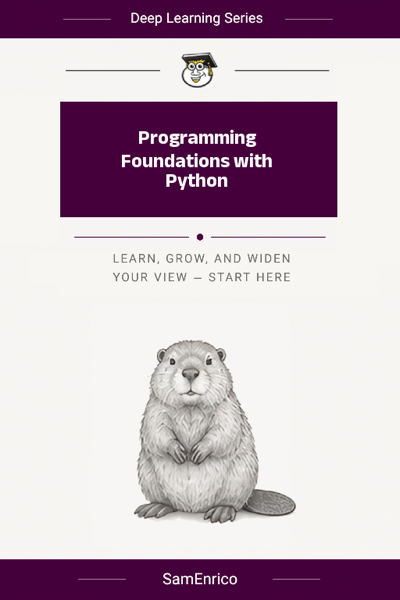
Programming Foundations with Python eBook
A Coursebook on Programming Foundations with Pytho
A Coursebook on Programming Foundations with Python
Formats
Free sample
Chapter 1: The Compass Before the Code--–- The screen glows white. A blinking cursor pulses at the top of an otherwise empty file. Your finger hovers over the keyboard. You have heard that Python is "easy to learn" and that "anyone can code." But staring at this emptiness, a quiet question forms: What do I actually type?If that feeling resonates, you are not behind. You are not lacking some natural talent for machines.
You are, in fact, exactly where every professional programmer started. The difference between someone who quits in this moment and someone who builds a career is not intelligence or memory. It is something far more accessible: a mental framework for turning confusion into action.This chapter will not begin by teaching you syntax. It will not ask you to memorize keywords or recite definitions. Instead, it will give you something far more valuable: a compass.
By the time you finish this chapter, you will understand what programming actually is (and what it is not). You will have a working Python environment on your computer. And you will write your first program, not as a mindless ritual, but as a deliberate act of communication between you and your machine.Let us begin by unlearning something important.The Great Misconception: Programming Is Not Memorization Walk into any bookstore’s computer science section and you might conclude that programming is a vocabulary test. Hundreds of books present thousands of syntax rules, expecting you to absorb them like vocabulary flashcards. This approach fails for a simple reason: human memory is terrible at recalling isolated facts, but exceptional at remembering stories, patterns, and solved problems.Consider how you learned to drive a car.
You did not memorize the torque specifications of the engine or the chemical formula for gasoline. You learned where the steering wheel is, what the pedals do, and how to respond when another driver swerves into your lane. Driving is a practice built on principles, not a recitation of specifications.Programming works the same way. The goal is not to store every Python function in your brain. The goal is to recognize situations, recall that you have solved something similar before, and adapt that solution to your current problem.
Professional programmers search documentation constantly. They look up syntax they have used a hundred times. What they carry in memory is not code—it is structure, logic, and problem-solving patterns.This book will teach you those patterns. Syntax will appear when you need it, and you will practice it until it feels natural. But you will never be asked to memorize for the sake of memorization.Computational Thinking: The Four Moves of Problem Solving Before you write a single line of code, you need a way to think about problems that computers can understand.
This way of thinking is called computational thinking, and it breaks down into four moves. These moves are not unique to programming. You already use versions of them every day.Move 1: Decomposition – Break It Down Large problems feel impossible because they are too big to hold in your mind at once. Decomposition means cutting a large problem into smaller, manageable pieces. Each piece becomes its own small problem, and solving all the small problems solves the big one.Example outside programming: You need to host a dinner party for eight people.
That one task decomposes into: choose recipes, create a shopping list, buy groceries, prepare the kitchen, cook each dish, set the table, and greet guests. Each piece is simpler than "host dinner party."Example in programming: You want to build a program that tracks your daily expenses. Decompose into: accept user input for an expense, store that expense somewhere, calculate totals by category, display a summary, and save data between sessions. Each of these becomes a chapter in your program.Move 2: Pattern Recognition – Find the Similarities Once you have broken a problem into pieces, you will often notice that different pieces share a structure. Recognizing patterns allows you to solve one piece and reuse that solution multiple times.Example outside programming: Every time you enter a new restaurant, you follow a pattern: wait to be seated, review the menu, order from a server, eat, request the check, pay.
You do not relearn "how to eat out" for every restaurant. You recognize the pattern.Example in programming: Your expense tracker needs to display expenses by day, by week, and by category. These three displays share a pattern: fetch data, organize it by a key, sum the values, output the result. You can write one display function and adapt it with different grouping rules.Move 3: Abstraction – Ignore the Irrelevant Details Abstraction is the art of focusing on what matters and ignoring what does not. Every model is a simplification of reality.
A subway map does not show every tree and building. It shows stations and tracks. That abstraction makes the map useful.Example outside programming: When you check the weather app, you see temperature, chance of rain, and wind speed. You do not see the barometric pressure at three different altitudes or the humidity in Topeka. Those details are irrelevant to your decision about carrying an umbrella.Example in programming: When you work with a list of customer orders, you might care about the order total, the date, and the customer ID.
You do not care about the exact millisecond the order was placed or the internal ID in the database. You abstract away those details.Move 4: Algorithm Design – Write the Steps An algorithm is a finite sequence of unambiguous instructions for solving a problem. Recipes are algorithms. Assembly instructions are algorithms. Driving directions are algorithms.
If you can write steps that someone else can follow exactly, you have designed an algorithm.Example outside programming: How to make tea: (1) Fill a kettle with water. (2) Place the kettle on the stove. (3) Turn the burner to high. (4) When the water boils, pour it into a cup containing a tea bag. (5) Wait three minutes.
(6) Remove the tea bag. (7) Add sugar if desired.Example in programming: How to find the largest number in a list: (1) Assume the first number is the largest so far. (2) Look at each remaining number one by one. (3) If the current number is larger than the largest so far, replace the largest so far with this number. (4) After checking all numbers, output the largest so far.These four moves—decomposition, pattern recognition, abstraction, algorithm design—are the real foundation of programming.
Syntax changes between programming languages. These moves do not. Learn them well, and you can learn any language later.Coding vs. Programming: A Distinction That Will Save You Hours The words "coding" and "programming" are often used interchangeably, but the distinction between them is worth understanding.Coding is the act of translating an algorithm into a specific programming language's syntax. It is typing.
It is converting your thoughts into a format the computer can execute. Coding is the last step of programming, not the first.Programming is everything that happens before you type. Programming is decomposition, pattern recognition, abstraction, and algorithm design. Programming is thinking. Programming is drawing diagrams on a whiteboard, writing pseudocode on a napkin, and arguing with a colleague about whether a loop…
This is the end of the free sample. Get the eBook to keep going. Buy now
About this book
Details
- Author
- Laporte Collette
- Publisher
- SamEnrico
- Language
- English
- Genre
- Non-Fiction, Informative, Educational
- Released
- 2026-06-02
- Pages (approx.)
- 152
- Available as
- eBook, Audiobook

Read better in the ZLOADR app
Your eBooks on your phone or tablet. Sign in with your SamEnrico account and start reading.
More by Laporte Collette
 Tinnitus Sleep ManagementLaporte Collette$11.99
 CDSA Test InterpretationLaporte Collette$11.99
 Empathy Without Taking On StressLaporte Collette$11.99
 Mindfulness Meditation for RegretLaporte Collette$11.99
 Argentina Remote Tax GuideLaporte Collette$11.99
 TM for Emotional EatingLaporte Collette$11.99
 Sleep Apnea Driving RisksLaporte Collette$11.99
 Kurosawa DreamsLaporte Collette$11.99
 Pomodoro For ChoresLaporte Collette$11.99
 The Battle of the Aegates: Rome's Naval Gambit That Broke Carthage (241 BC)Laporte Collette$11.99
 Love Letters from the Pacific: The Secret Correspondence of a WAC and a MarineLaporte Collette$11.99
 The Last Broadcast: The Strange Fate of the SS Ourang MedanLaporte Collette$11.99
You may also like
 Hong Kong Handover 1997Dunn Johnnie$11.99
 Zumba For Postnatal Recovery CourseNeal Christian$11.99
 Zumba for BeginnersLadner Nikia$11.99
 YouTube Comment Mining GuideHumes Pandora$12.99
 Worry Box MeditationCarlin Rudy$11.99
 Workplace Stress MeditationNguyen Lynn$11.99
 Workplace Stress and Sleep RepairHawley Ivory$11.99
 Workplace Perfectionism CureDelaney Jeffry$11.99
 Workplace Injustice Anger GuideWallen Isabelle$11.99
 Work Addiction and Burnout LinkGreenwood Ester$11.99
 Women in Yoga and WellnessBeattie Galina$11.99
 Women in Stand Up ComedyChun Evangeline$11.99