
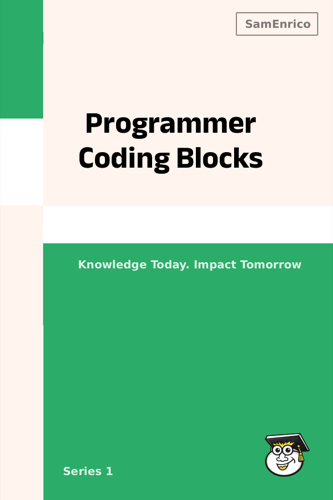
Programmer Coding Blocks eBook
Uses flow time for coding and batch time for email
Uses flow time for coding and batch time for emails.
Formats
Free sample
Chapter 1: The $10,000 Interruption--–- Alex Chen stared at his screen, his fingers frozen above the keyboard. The cursor blinked mockingly at line 47, where he had been writing a recursive tree traversal function five minutes ago. Now, staring at the same line, he had absolutely no idea what he was trying to do. His Slack notification badge read 14 unread messages. His email inbox showed 23 new emails since morning.
And somewhere in the middle of answering what his manager called "just a quick question," Alex had lost an entire mental model he had spent forty-five minutes building.This had happened three times today. It was only 11:30 AM.Alex is fictional, but his reality is not. Across the world, millions of software developers sit down every morning with genuine intention, ready to build, solve, and create. And across the world, millions of those same developers walk away at 6 PM wondering why they wrote only forty lines of code, fixed one bug, and spent the rest of the day feeling frazzled, unproductive, and strangely exhausted despite never leaving their chair.The culprit is not laziness. It is not lack of skill.
It is not even too many meetings, though meetings certainly do not help. The culprit is something far more insidious, far more invisible, and far more expensive than most developers realize. It is the interruption.And this book argues something radical: that interruption is not merely an annoyance. Interruption is the single largest drain on programmer productivity that no one is talking about. It costs the global software industry hundreds of billions of dollars annually.
It burns out engineers. It introduces bugs that pass through code review. And it has become so normalized that most developers do not even recognize it as a problem anymore.This chapter will change that. It will put a dollar figure on every Slack ping, a cost on every email notification, and a name on the silent productivity killer hiding in plain sight. By the end of this chapter, you will never look at your notification badge the same way again.The Hidden Math of Interruption Let us return to Alex.
He earns $10,000 per month as a senior backend engineer at a mid-sized tech company. That breaks down to roughly $62.50 per hour, assuming forty-hour weeks. But here is where the math gets uncomfortable.When Alex is writing code, he is not just "working." He is holding a complex mental model in his head. He is tracking three different variables, their states, the call stack, an edge case he discovered ten minutes ago, and a refactoring idea that he has not yet implemented. This mental model is fragile.
It is like a house of cards built in a windstorm.Now a Slack message arrives. A product manager asks, "Hey, can you review that API spec change when you have a sec?" Alex, being a responsive team player, glances at the message. He does not even reply. He just reads it.In that moment, the house of cards collapses.The research on this phenomenon is both extensive and alarming. A seminal study from the University of California, Irvine, found that after an interruption, it takes an average of twenty-three minutes and fifteen seconds to return to the original task with the same level of cognitive focus.
More recent research specific to software development, published in the IEEE Transactions on Software Engineering, found that for complex programming tasks, the resumption lag can stretch to twenty-five minutes or longer.Let us apply that to Alex. One interruption costs him roughly twenty-two minutes of lost productivity on average, a figure we will use throughout this book as the standard resumption lag. But that is not just twenty-two minutes of doing nothing. It is twenty-two minutes of being at work but operating at maybe thirty percent cognitive capacity. He is reading emails, switching contexts, trying to remember where he was, making small mistakes, fixing those mistakes, and slowly rebuilding that house of cards.If Alex suffers just four interruptions in a workday, he loses nearly ninety minutes of productive flow.
That is 11% of his eight-hour day. Applied to his monthly salary, those four daily interruptions cost his company roughly $1,100 per month, or $13,200 per year. For just one developer.Now multiply that across a team of ten developers: $132,000 per year in lost productivity. Across a company of one hundred developers: $1.32 million. Across the global software industry, estimated at twenty-seven million developers?
The number becomes almost too large to comprehend. Approximately $350 billion annually, by conservative estimates.And that is only counting the resumption lag. It does not count the bugs introduced when developers rush, the overtime worked to catch up, the burnout-related turnover, or the opportunity cost of features that never ship.The $10,000 interruption is not a metaphor. It is a line item on your company's hidden profit and loss statement.The Myth of the Multitasking Programmer Before we go further, we must kill a dangerous idea. Many developers, and even more managers, believe that some people can multitask effectively.
"I am good at context switching," they say. "I can answer emails while keeping my code mental model intact."This is not true. It has never been true. And the neuroscience is unambiguous.The human brain does not multitask. It task-switches.
When you believe you are doing two things at once, what is actually happening is that your brain is rapidly toggling attention between tasks, each toggle carrying a cognitive penalty. This is not a matter of opinion or personal skill. It is a fundamental limitation of the architecture of human attention.A landmark study from Stanford University compared heavy multitaskers against light multitaskers. The researchers expected that heavy multitaskers would have developed some special ability to filter irrelevant information or switch more efficiently. They found the opposite.
Heavy multitaskers were worse at every measure of cognitive control. They were more easily distracted, less able to ignore irrelevant information, and paradoxically, more likely to switch tasks even when it hurt their performance.For programmers, this is particularly devastating because programming is not like other knowledge work. Writing a legal brief or responding to customer emails involves linear, language-based thinking. Programming involves holding abstract, nested, stateful mental models. To write a recursive function correctly, you must track the base case, the recursive case, the current stack depth, and the transformations applied at each level.
This is not something you can do while also monitoring a Slack channel.The chapter's protagonist Alex learned this the hard way. The bug he introduced on that recursive function, the one he forgot after the Slack interruption, made it to production. It caused an infinite loop on a background job that processed customer refunds. It took four hours to diagnose, rolled back three valid refunds, and required a post-mortem that consumed six engineers for an additional two hours.The total cost of that one Slack message, the one Alex did not even reply to? Approximately $4,000 in engineering time.
Plus customer trust. Plus the emotional toll on Alex, who spent the next week feeling like a fraud.Multitasking is not a skill. It is a tax.The Resumption Lag: What Actually Happens Inside Your Brain Let us walk through the resumption lag in slow motion…
This is the end of the free sample. Get the eBook to keep going. Buy now
About this book
Details
- Author
- Stanfield Chanda
- Publisher
- SamEnrico
- Language
- English
- Genre
- Non-Fiction, Self-Help, Programming
- Released
- 2026-06-07
- Pages (approx.)
- 136
- Available as
- eBook, Audiobook

Read better in the ZLOADR app
Your eBooks on your phone or tablet. Sign in with your SamEnrico account and start reading.
More by Stanfield Chanda
 Afternoon Energy BlockingStanfield Chanda$11.99
 Nick Drake Pink MoonStanfield Chanda$11.99
 New Role Imposter FixStanfield Chanda$11.99
 Fixed Assets for StartupsStanfield Chanda$11.99
 Digital Nomad Talent TrendsStanfield Chanda$11.99
 Self Hypnosis Audio JournalStanfield Chanda$11.99
 Focus For SalespeopleStanfield Chanda$11.99
 The Snow Queen's Gambit: Catherine the Great and the Russo-Turkish WarStanfield Chanda$11.99
 The Siege of Mount Egmont: Betrayal in the New Zealand FrontierStanfield Chanda$11.99
 How to Produce Door StopsStanfield Chanda$11.99
 Brussels Sprouts: Harvesting Timing, Frost Sweetness & StorageStanfield Chanda$11.99
 Payment for Digital Service Exports BlueprintStanfield Chanda$12.99
You may also like
 Pomodoro for Coding PracticePearson Enrique$11.99
 Growth Mindset In CodingBray Silas$11.99
 Method of Loci For Software CodeStine Alva$11.99
 Coding Syntax CardsElias Rusty$11.99
 Emotional Intelligence for ProgrammersMcneill Shantae$11.99
 Dream Incubation For Coders Programmers WorkbookSalas Cori$11.99
 Coding Syntax PegsHook Ina$11.99
 The Working Memory for Coding GuideEscalante Gabriele$11.99
 Anki For Coding SyntaxCoates Carlyn$11.99
 Pattern Recognition in DebuggingGould Ellie$11.99
 Dream Incubation for Coding BugsKimbrell Wilhelmina$11.99
 Time Blocking for CodersClifford Jann$11.99