
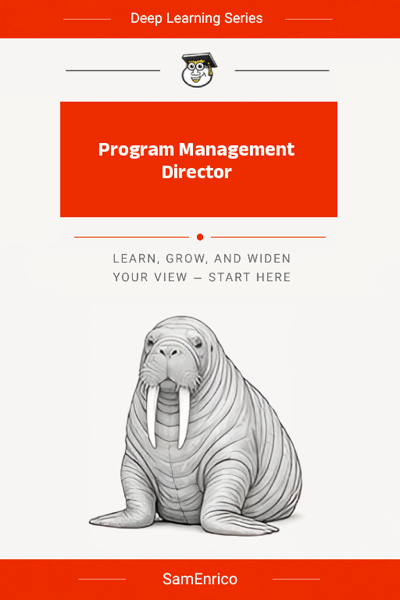
Program Management Director eBook
A Coursebook on Program Management Director
by Abernathy Jc
A Coursebook on Program Management Director
Formats
Free sample
Chapter 1: The 67% Lie...--–- You have been promoted. Congratulations. The title on your business card now reads "Program Management Director." Your salary has increased. Your office—if you have one—is slightly larger. People nod at you with a deference they did not show last week.And you are terrified.Not because you lack skill.
You have delivered projects. You have managed teams. You have rescued failing initiatives and celebrated successful launches. You know what a Gantt chart is, what a RACI matrix does, and how to run a steering committee meeting.But somewhere in the back of your mind, a question gnaws at you like a rat in the walls: What if I am just a Program Manager with a fancier title?That question is the reason this book exists. And the answer, which you will understand by the time you finish this chapter, is both comforting and alarming.
You are not a bigger Program Manager. You are not a super-Project Manager. You are something fundamentally different—a role that sits at the intersection of strategy, governance, and leadership. And if you try to do this job the way you did your last one, you will fail. Not slowly.
Not quietly. You will fail in a way that people will remember for years.Let us start with a number. A number that should be tattooed on the inside of your eyelids.Sixty-seven percent.That is the percentage of large-scale programs that fail to deliver their stated benefits according to decades of research from Mc Kinsey, the Project Management Institute, and the Harvard Business Review. Not "run a little late." Not "go slightly over budget." Fail. As in: the benefits promised in the business case never materialized.
The strategic objectives that justified the investment were never achieved. And somewhere along the way, someone—maybe you—got fired.Here is the part that will keep you awake: most of those programs delivered their projects perfectly.Let that land.The technology was installed. The construction was completed. The new process was documented. The training was delivered.
On time. On budget. According to the plan. And still, the benefits did not appear. The cost savings never showed up in the quarterly reports.
The revenue lift never materialized. The customer satisfaction scores stayed flat.The program succeeded as a collection of projects. And failed as a program.This is the 67% Lie. The lie is not that the number is wrong—it is terrifyingly accurate. The lie is what most organizations believe causes it.
They blame bad project management. They blame unclear requirements. They blame incompetent vendors or lazy employees.They are wrong.Programs fail because organizations confuse outputs with outcomes. They confuse delivery with value. They promote their best Project Managers into Program Director roles and then wonder why the results look exactly the same—only bigger and more expensive.You were not promoted to manage more projects.
You were promoted to manage value. And value does not come from a status report that says "green."The Core Distinction: Projects vs. Programs vs. Portfolios Before we go any further, let us define our terms with absolute clarity. You will see these definitions throughout this book, but this is the only time they will be explained in full.
Every subsequent chapter will reference this foundation without re-teaching it.A project is a temporary endeavor that produces an output. A bridge. A software module. A new hiring process. A training course.
Projects have a defined start and end. They have a project manager. They are measured by scope, schedule, and cost. When the output is delivered, the project is done.A program is a collection of related projects managed together to achieve benefits not available from managing them individually. A program does not produce outputs; it produces outcomes and benefits.
A program has a director. It is measured by strategic value, benefits realization, and return on investment. When the benefits are achieved and handed over to operations, the program is done.A portfolio is a collection of programs and projects selected and governed at the enterprise level to balance risk, resource allocation, and strategic objectives. A portfolio has a governance board or a PMO. It is measured by aggregate value, strategic alignment, and resource efficiency.Here is the diagram you will remember—the one that will save you from the 67% Lie:text Copy Download PROJECTS → OUTPUTS PROGRAMS → OUTCOMES → BENEFITS → STRATEGY PORTFOLIOS → OPTIMIZATIONA Project Manager asks: "Did we build it right?"A Program Director asks: "Did we build the right thing, and did it create value?"A Portfolio Manager asks: "Are we investing in the right collection of things?"You are the middle question.
And most of your predecessors never figured that out.The Value Triangle: Replacing the Iron Coffin You know the Iron Triangle. Every Project Manager memorizes it. Scope. Schedule. Cost.
You can only change one without affecting the others. It is a useful model for a project.It is a death sentence for a program.When you manage a program using the Iron Triangle, you optimize for the wrong things. You deliver outputs on time and on budget, but you never ask whether those outputs actually produce value. You celebrate when the software is deployed, ignoring that nobody uses it. You applaud when the building is finished, ignoring that the operational costs exceed the savings.Programs require a different model.
Call it the Value Triangle.At the three corners of the Value Triangle are:Strategic Alignment – Does this program support the organization's stated strategy? Not the strategy on the website. The real strategy. The one that determines where the CEO spends political capital and budget authority.Benefits Realization – Can we measure, in concrete terms, the value this program will produce? Cost reduction?
Revenue growth? Risk mitigation? Competitive advantage? If you cannot measure it, it does not exist.Transformational Change – Is the organization ready and willing to change? New processes require new behaviors.
New technology requires new skills. If the people do not change, the outputs are worthless.Balanced against these three corners are the traditional constraints of scope, schedule, and cost. But here is the difference: in the Iron Triangle, scope, schedule, and cost are the primary variables. In the Value Triangle, they are secondary. You can adjust them—within reason—as long as you protect strategic alignment, benefits realization, and transformational change.A concrete example.
Imagine a program to implement a new customer relationship management system. The Iron Triangle says: deliver the CRM on time and on budget with all required features. The Value Triangle asks: will the sales team actually use the system? Will it increase cross-selling revenue by 15% as promised? Have we trained the sales team and changed their compensation incentives to encourage adoption?The Iron Triangle delivers a perfect CRM that nobody uses.
The Value Triangle delivers an imperfect CRM that transforms the business.You are not building software. You are building change.Key Roles Defined: Who Is Who in Your World Before you can lead, you need to know who you are leading with and who you are leading against. This book will reference these roles constantly. Learn them now.The Program Management Director (You) – Accountable for the program's success.…
This is the end of the free sample. Get the eBook to keep going. Buy now
About this book
Details
- Author
- Abernathy Jc
- Publisher
- SamEnrico
- Language
- English
- Genre
- Non-Fiction, Informative, Educational
- Released
- 2026-05-18
- Pages (approx.)
- 150
- Available as
- eBook, Audiobook

Read better in the ZLOADR app
Your eBooks on your phone or tablet. Sign in with your SamEnrico account and start reading.
More by Abernathy Jc
 Menopause Skin ChangesAbernathy Jc$11.99
 Income Elasticity WorkbookAbernathy Jc$11.99
 Food Addiction and CholesterolAbernathy Jc$11.99
 Body Scan for Trauma HealingAbernathy Jc$11.99
 The Forgotten Siege: Changsha's Three Defenses Against Japan (1939-1944)Abernathy Jc$11.99
 Department Budget Forecast GuideAbernathy Jc$12.99
 How to Produce Accessories and PartsAbernathy Jc$11.99
 How to Become a Glove FormerAbernathy Jc$11.99