
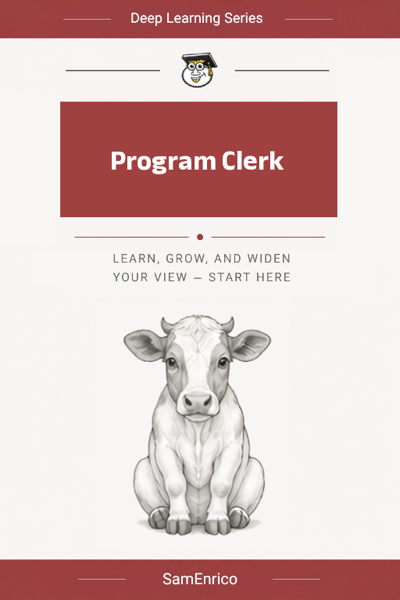
Non-FictionInformativeEducational
Program Clerk eBook
A Coursebook on Program Clerk
by Dias Shawnta
A Coursebook on Program Clerk
Formats
Free sample
Chapter 1: The Invisible Throne...--The first time a program clerk saves an organization, no one cheers. There is no standing ovation, no bonus, no plaque on the wall. Instead, there is a quiet exhale—the kind that happens when a board member says, “Wait, did we actually vote on that?” and the clerk opens a notebook and says, “Yes. At 3:42 PM. The motion carried six to two.
I have the exact wording here.” And just like that, a potential lawsuit, a rescinded decision, or a four-hour rehash of a ten-minute conversation evaporates. No one thanks the clerk. But everyone, suddenly, is paying attention.This book is about becoming that person. Not the hero who saves the day with a dramatic speech or a tie-breaking vote, but the invisible throne upon which all legitimate governance rests. The program clerk does not command armies or sign checks or cut ribbons at grand openings.
The program clerk writes things down. And in the world of boards, nonprofits, government bodies, and any organization that makes decisions collectively, the person who writes things down holds a power that is almost never discussed and almost always underestimated.If you have picked up this book, you are likely one of three people. First, you might be a newly appointed program clerk who has no idea what the job actually entails. You were handed a laptop, a past binder of minutes, and a vague instruction to “take notes.” You have since discovered that board meetings are chaotic, that people contradict themselves, and that no one can agree on what was decided five minutes ago, let alone five months ago. You are looking for a lifeline.
Second, you might be an experienced clerk who has realized that your organization treats minutes as a bureaucratic afterthought—until something goes wrong. You have been asked to “clean up” the record, to “revise” history, or to defend minutes that were poorly written by your predecessor. You know there is a better way, but you lack the framework to implement it. Third, you might be a board member, executive director, or chair who has suffered through bad minutes and wondered why no one has written the definitive guide to this critical function. You are here because you want to fix a broken system.Whoever you are, welcome.
You are about to learn why the program clerk is the most misunderstood and most essential role in governance.The Great Misconception: The Clerk as Passive Note-Taker Ask ten people what a program clerk does, and nine will say “takes minutes.” The tenth will say “makes sure the paperwork is filed.” All ten will be technically correct and fundamentally wrong. The misconception that a clerk is a passive note-taker—a human dictation machine who transcribes whatever happens in a meeting—is not merely inaccurate. It is dangerous. It leads to minutes that are legally insufficient, politically naive, and practically useless. It leads to clerks who burn out because they think their job is to capture every word, every tangent, and every side conversation.
And it leads to organizations that cannot defend their own decisions because the record is a mess.The passive note-taker model assumes that meetings unfold like scripts. The chair speaks. Members respond. Motions are made clearly. Votes are taken cleanly.
And the clerk simply records what any reasonable person would have heard. Anyone who has actually attended a board meeting knows this is fantasy. Real meetings are messy. Motions are mumbled. Amendments are proposed as jokes.
Votes are taken by acclamation while three people are checking their phones. Side conversations happen while the chair is ruling on a point of order. And through all of this chaos, the clerk is supposed to produce a document that a judge, an auditor, or a future board can trust.The passive note-taker cannot do this. The passive note-taker is overwhelmed by the chaos, because the passive note-taker believes the job is to write down what happened. The strategic clerk—the kind this book will teach you to become—understands something different.
The job is not to write down what happened. The job is to construct a legally sufficient, narratively coherent, and practically useful record of what the organization decided and why. That construction requires judgment, technique, and authority. It requires you to stop being a bystander and start being the person who shapes how decisions are memorialized.This reframing is the single most important shift you will make as a clerk. You are not a recorder.
You are a builder.The Three Hidden Roles You Must Embrace If you are not a passive note-taker, what are you? The answer is three roles, each of which redefines a different dimension of the clerk’s work. These roles are not metaphorical. They are practical frameworks that will guide every decision you make, from how you set up your notebook to how you handle a chair who asks you to delete a sentence from the draft minutes.Role One: The Archivist The archivist is the guardian of institutional memory. This role is forward-looking, not backward-looking.
A museum curator does not merely store old artifacts; the curator decides what is worth keeping, how to organize it, and how to make it accessible to future generations. The clerk as archivist does the same for organizational decisions. You are responsible for ensuring that minutes are not just stored but findable, readable, and trustworthy. This means creating and maintaining the Minutes Bible—a master document that contains past motions, precedents, glossary terms, and recurring agenda templates. (For detailed guidance on building your Minutes Bible, see Chapter 2.) The archivist anticipates what future boards, auditors, or courts might need to see and structures the record accordingly.A practical example: A clerk who only writes down what happened in the meeting is a note-taker.
A clerk who notices that the same ambiguous motion language keeps causing confusion, creates a style sheet for future motions, and trains the chair to use it—that clerk is an archivist. The archivist does not wait for problems to arise. The archivist builds systems that prevent problems.Role Two: The Process Engineer The process engineer designs efficient workflows. This role asks: How can we capture decisions with the least effort and the highest accuracy? How can we automate the repetitive parts of minute-taking without losing human judgment?
How can we structure the agenda so that motions are clear, votes are clean, and the clerk is not guessing? The process engineer is not satisfied with “the way we have always done it.” The process engineer tests, measures, and improves.For example, many clerks struggle with tracking action items. Someone makes a motion, it carries, and then six months later no one can remember who was supposed to do what. The process engineer solves this not by taking better notes but by redesigning the workflow: a motion-tracking template (see Appendix B), a post-meeting action item distribution system (see Chapter 4), and a quarterly audit of how many action items are actually completed (see Chapter 11). The process engineer turns chaos into system.Role Three: The Meeting Architect The meeting architect shapes how groups deliberate.
This role is the most surprising to new clerks, because it seems to violate the principle of neutrality. How can…
This is the end of the free sample. Get the eBook to keep going. Buy now
About this book
Details
- Author
- Dias Shawnta
- Publisher
- SamEnrico
- Language
- English
- Genre
- Non-Fiction, Informative, Educational
- Released
- 2026-05-04
- Pages (approx.)
- 140
- Available as
- eBook, Audiobook

Read better in the ZLOADR app
Your eBooks on your phone or tablet. Sign in with your SamEnrico account and start reading.
More by Dias Shawnta
 Ransom Payment and Recovery Protocol GuideDias Shawnta$11.99
 Psychotherapy For Persistent DepressionDias Shawnta$11.99
 Congress Member Seniority PowerDias Shawnta$11.99
 BPH Natural Supplements GuideDias Shawnta$11.99
 UK Global Tariff System GuideDias Shawnta$11.99
 Dust and Data: How a Forgotten Desert Town Became the Internet’s BackboneDias Shawnta$11.99
 The Lost Rivers of the Kalahari: Laetoli’s Forgotten ExplorersDias Shawnta$11.99
 Inventory Buffer Strategy GuideDias Shawnta$12.99
 China Visa Photo RequirementsDias Shawnta$12.99
 Understanding Congenital Hypotrichosis MiliaDias Shawnta$17.99
 How to Start a Preparation and Linkage of Digital Data Business (Beginners Guide)Dias Shawnta$11.99
You may also like
 Hong Kong Handover 1997Dunn Johnnie$11.99
 Zumba For Postnatal Recovery CourseNeal Christian$11.99
 Zumba for BeginnersLadner Nikia$11.99
 YouTube Comment Mining GuideHumes Pandora$12.99
 Worry Box MeditationCarlin Rudy$11.99
 Workplace Stress MeditationNguyen Lynn$11.99
 Workplace Stress and Sleep RepairHawley Ivory$11.99
 Workplace Perfectionism CureDelaney Jeffry$11.99
 Workplace Injustice Anger GuideWallen Isabelle$11.99
 Work Addiction and Burnout LinkGreenwood Ester$11.99
 Women in Yoga and WellnessBeattie Galina$11.99
 Women in Stand Up ComedyChun Evangeline$11.99