
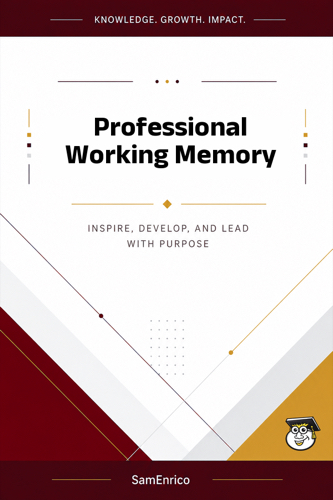
Free sample
Chapter 1: The 20-Minute Wall--–- Sarah had never thought of herself as someone with a memory problem. She was, after all, a partner at a major law firm, a graduate of Yale Law School, and someone who could recite the key holdings of Pennoyer v. Neff from memory nearly twenty years after taking the bar exam. But somewhere between her thirty-seventh and forty-second birthday, something had shifted. She couldn't name it.
She couldn't measure it. But she could feel it every single day, usually right after lunch, when she would sit down to draft a motion and find herself reading the same opening paragraph four times without understanding a word of it.The first time it happened, she dismissed it as fatigue. The tenth time, she started to worry. The fiftieth time, she found herself googling "early onset dementia" in incognito mode, her heart pounding as she scrolled through symptom checklists that didn't quite fit.She wasn't forgetting where she put her keys. She wasn't losing her vocabulary.
She was losing something else entirely—something she hadn't even known she had until it started to slip away. She was losing the ability to hold things in her mind and work with them. To follow a complex argument from beginning to end without losing the thread. To juggle the competing demands of a negotiation, a deposition, and a client call without feeling like her brain was a desk buried under an avalanche of paper.Sarah's problem wasn't her intelligence. It wasn't her knowledge.
It wasn't her commitment or her work ethic or her passion for the law. Her problem was her working memory—and she had no idea that it was the single most important cognitive skill she possessed, or that she could train it, or that almost every professional she knew was struggling with the exact same invisible bottleneck.This chapter is about why you feel overloaded even when you're not doing more than you used to. It's about the biological reality of your attention, the hidden cost of every switch you make between tasks, and the single most important truth about your brain that no one ever taught you: your working memory is not a storage tank. It is a workbench. And right now, yours is buried under clutter you didn't even know you were piling on.The Workbench: A Better Metaphor for Your Mind Before we can understand why you feel overloaded, we need a shared picture of what's actually happening inside your head.
And the picture most people carry—without ever consciously choosing it—is wrong.Most of us, if asked to describe how our memory works, default to some version of a storage metaphor. We talk about "filing things away" or "pulling things up" or "having a lot on our plate." We imagine our brains as libraries or hard drives or filing cabinets, with information stored in neat folders waiting to be retrieved.This metaphor is not just oversimplified. It is actively misleading.Here's why. When a computer stores a file, that file sits inert on the hard drive, consuming no processing power until it's called up. You can store a million files, and your computer's ability to run a spreadsheet in the present moment is completely unaffected.
Storage and processing are separate systems.Your brain does not work this way. The information you have stored in long-term memory—your knowledge of French grammar, your recollection of your child's birthday, your understanding of antitrust law—does not sit inert. It is constantly, subtly influencing your present thinking. And more importantly, the information you are actively holding in mind right now is not stored at all. It is being processed.This is the crucial distinction.
Working memory is not where you keep things. It is where you work on them.Think of a carpenter's workbench. The workbench is not the storage room. The storage room holds all the lumber, tools, and supplies the carpenter might need for a hundred different projects. The workbench is the small, flat surface where the actual building happens.
You cannot build a cabinet in the storage room. You have to bring the relevant materials to the workbench, arrange them in a usable way, and then manipulate them with your tools. And crucially, your workbench has a limited surface area. You can only spread out so many boards and screws and blueprints at once. If you try to work on three cabinets simultaneously, you won't build any of them faster.
You'll just create a mess.Working memory is your mental workbench. It is the small, precious surface where thinking actually happens. Long-term memory is your storage room—vast, almost unlimited, but useless for present-moment work. The challenge of professional life is not that you lack storage. It is that your workbench is too small for the demands you place on it.And here is the truth that Sarah discovered, the truth that changed everything for her: you cannot expand your workbench.
The surface area is biologically fixed. But you can learn to keep it perfectly clean. You can learn to organize it intelligently. And you can learn to return to it efficiently after every interruption, every rest, every switch between tasks.The question is not whether your workbench is large enough. It is whether you are using it wisely.The Four Tools on Your Workbench Now that we have the metaphor, let's look under the hood.
The science of working memory is surprisingly settled, thanks largely to the work of psychologists Alan Baddeley and Graham Hitch, who proposed the dominant model in 1974 and have been refining it ever since. Their model identifies four distinct components of working memory—four tools on your mental workbench. Understanding each one will help you diagnose exactly where your own cognitive bottlenecks are.The Phonological Loop: Your Verbal Notepad The first tool is the phonological loop. This is the part of your working memory that handles verbal and auditory information—words, numbers, names, instructions. It has two subcomponents: a short-term storage system that holds sounds for a few seconds, and a rehearsal system that allows you to refresh that information by silently repeating it to yourself.Here's how you know your phonological loop exists.
Someone tells you a phone number. You don't have a pen. You repeat it to yourself—five, five, five, one, two, three, four—over and over until you can write it down. That's your rehearsal system at work. And if someone interrupts you while you're rehearsing, you lose the number immediately.
That's because your phonological loop can only hold information for about two seconds without active rehearsal.The limit of the phonological loop is roughly seven items for numbers, four for unrelated words. But more important than the number is the vulnerability. Your phonological loop is easily disrupted by competing verbal information—like someone else talking, or a podcast playing in the background, or your own internal monologue worrying about something else.The Visuospatial Sketchpad: Your Drawing Surface The second tool is the visuospatial sketchpad. This handles visual and spatial information—images, maps, layouts, the relative positions of objects. If you close your eyes and picture the floor plan of your office, you are using your visuospatial sketchpad.…
This is the end of the free sample. Get the eBook to keep going. Buy now
About this book
Details
- Author
- Overton Joaquina
- Publisher
- SamEnrico
- Language
- English
- Genre
- Non-Fiction, Self-Help
- Released
- 2026-06-06
- Pages (approx.)
- 145
- Available as
- eBook, Audiobook

Read better in the ZLOADR app
Your eBooks on your phone or tablet. Sign in with your SamEnrico account and start reading.
More by Overton Joaquina
 Benzodiazepine Protracted WithdrawalOverton Joaquina$11.99
 Anchor Dream SymbolOverton Joaquina$11.99
 Road Rage Legal ConsequencesOverton Joaquina$11.99
 Immigrant Founder Work Ethic CourseOverton Joaquina$11.99
 Cross Border Franchise Tax GuideOverton Joaquina$12.99
 Morning Reading RitualsOverton Joaquina$11.99
 Self Empathy FirstOverton Joaquina$11.99
 Heartburn Acid RefluxOverton Joaquina$11.99
 Buffer Block Scheduling GuideOverton Joaquina$11.99
 The Silent Ropes: How a Legendary Gymnastics Coach Manipulated an EmpireOverton Joaquina$11.99
 The Silk Road Code: The Alchemist’s Heist for the Secrets of LifeOverton Joaquina$11.99
 The Last Broadcast: The Mysterious Final Transmission of Flight MH370Overton Joaquina$11.99
You may also like
 Workplace Stress MeditationNguyen Lynn$11.99
 Volcano Monitoring ScientistCox Alexis$11.99
 The Tech Professional NetAguiar Nevada$11.99
 The Morning Metta RitualCanales Anya$11.99
 The Chunking Memory TechniqueClanton Hyacinth$11.99
 The Beginner Mistake FixAmmons Cassondra$11.99
 Surrendering to What IsGrimm Reatha$11.99
 Self Hypnosis for Fear of FireBillups Eli$11.99
 Road Rage for Professional DriversBrackett Janise$11.99
 Psychiatric Ward Nurse StressDunning Wyatt$11.99
 Observation vs Evaluation NVCTimmons Alda$11.99
 Networking for Nonprofit ProfessionalsPoole Jesse$11.99