
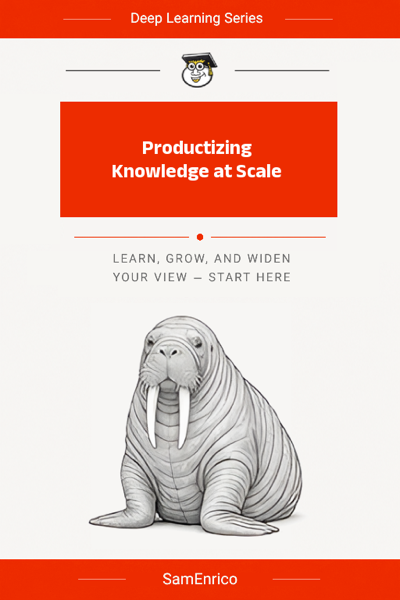
Non-FictionInformativeEducational
Productizing Knowledge at Scale eBook
A Coursebook on Productizing Knowledge at Scale
A Coursebook on Productizing Knowledge at Scale
Formats
Free sample
Chapter 1: The Hour Trap...--“I don’t have a revenue problem,” Sarah said, staring at the spreadsheet that had just made her nauseous. “I have a time problem.”She had just finished a seventy-two-hour week—her fourth in a row. Three client deliverables, two prospect calls, one emergency fire drill for a long-term customer who had waited until the last possible moment to ask for help, and exactly zero hours for herself. Her revenue for the month was $23,000. That sounded good.
That sounded like success.Then she did the math she had been avoiding.Seventy-two hours a week, times four weeks, was two hundred and eighty-eight hours. Divide 23,000by288,andherrealhourlyrate—notthe23,000 by 288, and her real hourly rate—not the 23,000by288,andherrealhourlyrate—notthe250 she billed, but her actual take-home after all the unbilled work, the admin, the sales calls that went nowhere, the proposals she wrote and never heard back on—was just shy of $80 an hour.Eighty dollars an hour. For a senior consultant with fifteen years of experience, a master’s degree, and a roster of blue-chip clients.She could have made that managing a coffee shop.This is the moment that breaks most knowledge entrepreneurs. Not the big dramatic failure—the slow, grinding realization that the harder you work, the more trapped you become. You cannot save your way to growth when your only asset is time.
You cannot outwork a broken business model.But here is what Sarah did not know yet, and what this book will teach you: her problem was not her work ethic, her clients, or her expertise. Her problem was structural. She was trading hours for dollars in a market that had already moved on. And until she understood what scalability actually means—and more importantly, what it does not mean—she would keep running faster and ending up in the same place.1.1 The Most Expensive Lie in the Knowledge Economy There is a lie that circulates quietly through every consulting firm, agency, and freelance practice in the world. You have heard it.
You may have said it to yourself.“If I just work harder, I’ll get ahead.”It sounds like discipline. It sounds like grit. But it is a trap disguised as virtue.Here is why: in a business where you trade time for money, every hour you work has a fixed maximum value. You can raise your rates—and you should, within reason—but eventually you hit the ceiling of what the market will bear for an hour of your time. You can hire more people—and many do—but then you are buying their hours and reselling them, which adds management complexity without solving the underlying constraint.The constraint is not your talent, your network, or your marketing.
The constraint is the simple, brutal arithmetic of the calendar. There are only twenty-four hours in a day. You cannot manufacture more. And every hour you spend delivering to one client is an hour you cannot spend selling to another, developing a new offering, or—God forbid—resting.This is what I call The Hour Trap.The trap has three characteristics that make it especially cruel. First, it is invisible when you are busy.
Revenue is coming in, clients are happy, and the buzz of activity feels like progress. Second, it is self-reinforcing. The more clients you take on, the less time you have to build systems that would reduce your workload. You become too busy to escape the busyness. Third, and most dangerously, the trap punishes efficiency.
If you get faster at delivering a service, you have just reduced the number of hours you can bill for that service. The system is literally designed to reward slowness.Let me say that again: in a pure hourly model, efficiency is a pay cut.This is not a sustainable business. It is a hustle. And a hustle is not a strategy.1.2 What Scalability Actually Means (And What It Does Not)Before we go any further, we need to agree on a definition. Because the word “scalability” has been used to mean so many different things that it has almost lost its meaning.
I have seen it used to describe everything from hiring a virtual assistant to building a billion-user social network.Here is the definition we will use throughout this book:Scalability means that your revenue can grow without a proportional growth in your time or team headcount.That is it. Not “working smarter.” Not “hiring better people.” Not “getting a bigger office.” The test of whether something is scalable is simple: if you double your revenue, does your required time or team size double? If yes, you have not scaled—you have just gotten bigger. Growth is not the same as scale.This definition resolves a confusion that has derailed countless productization efforts. Consider two scenarios:Scenario A: A consultant creates a proprietary diagnostic framework.
She still delivers every diagnosis herself, one client at a time. Her revenue grows because she raises her prices and fills her calendar. Is this scalable? No. Her time is still the constraint.
She is a more expensive hour-trapper, but still a trapper.Scenario B: A different consultant creates a template pack based on her most common recommendations. She sells it for $97. Customers download it, use it themselves, and she never touches them after the sale. Her revenue grows because she sells more copies. Her time barely changes.
Is this scalable? Yes. Her revenue grew without a proportional increase in her time.Notice something important: the first consultant has a more sophisticated product (a proprietary framework) but a less scalable model. The second consultant has a simpler product (template pack) but a more scalable model. Sophistication is not the same as scalability.The IP Ladder we will explore in Chapter 3 shows you how to climb from simple to sophisticated without losing scalability.
But the ladder is a path up the mountain, not the mountain itself. The mountain is revenue decoupled from hours.1.3 The Two Kinds of High-Touch Service (And Why One Destroys You)Now we arrive at a distinction that will save you years of confusion. Because if you have been paying attention, you may have noticed a tension. On one hand, I am telling you that trading hours for dollars is a trap. On the other hand, almost every successful knowledge business I know starts with high-touch service.
How can both be true?The answer is that not all high-touch service is the same. There are two kinds. One is an anchor. The other is an engine.Reactive High-Touch Service is what most experts fall into by default. A client calls with a problem.
You drop everything to solve it. You charge by the hour. The work is undifferentiated—each client gets a unique, custom solution that you invent from scratch every time. You are a firefighter. The clients control your schedule.
You are always on, always responding, and always exhausted.This is the trap. This is the single-engine plane from the introduction. When your business is 100 percent reactive high-touch, any turbulence—a lost client, an illness, a market shift—sends you into a tailspin.Strategic High-Touch Service is something else entirely. In this model, you still…
This is the end of the free sample. Get the eBook to keep going. Buy now
About this book
Details
- Author
- Mcelroy Dillon
- Publisher
- SamEnrico
- Language
- English
- Genre
- Non-Fiction, Informative, Educational
- Released
- 2026-05-06
- Pages (approx.)
- 145
- Available as
- eBook, Audiobook

Read better in the ZLOADR app
Your eBooks on your phone or tablet. Sign in with your SamEnrico account and start reading.
More by Mcelroy Dillon
 MBSR For Healthcare Professionals GuideMcelroy Dillon$11.99
 The Titanic Chronicling ProjectMcelroy Dillon$11.99
 Cooperative Camel Milk GuideMcelroy Dillon$11.99
 Job Insecurity Anxiety GuideMcelroy Dillon$11.99
 The MDD Hormone Connection GuideMcelroy Dillon$11.99
 The Ghost in the Machine: How a Teen Hacker Exposed the NSA’s Darkest SecretsMcelroy Dillon$11.99
 A Beginners Guide to Five-pins (Volume 1)Mcelroy Dillon$11.99
 PNC Financial SWOTMcelroy Dillon$12.99
 Ontario PNP Graduate StreamMcelroy Dillon$12.99
You may also like
 Hong Kong Handover 1997Dunn Johnnie$11.99
 Zumba For Postnatal Recovery CourseNeal Christian$11.99
 Zumba for BeginnersLadner Nikia$11.99
 YouTube Comment Mining GuideHumes Pandora$12.99
 Worry Box MeditationCarlin Rudy$11.99
 Workplace Stress MeditationNguyen Lynn$11.99
 Workplace Stress and Sleep RepairHawley Ivory$11.99
 Workplace Perfectionism CureDelaney Jeffry$11.99
 Workplace Injustice Anger GuideWallen Isabelle$11.99
 Work Addiction and Burnout LinkGreenwood Ester$11.99
 Women in Yoga and WellnessBeattie Galina$11.99
 Women in Stand Up ComedyChun Evangeline$11.99