
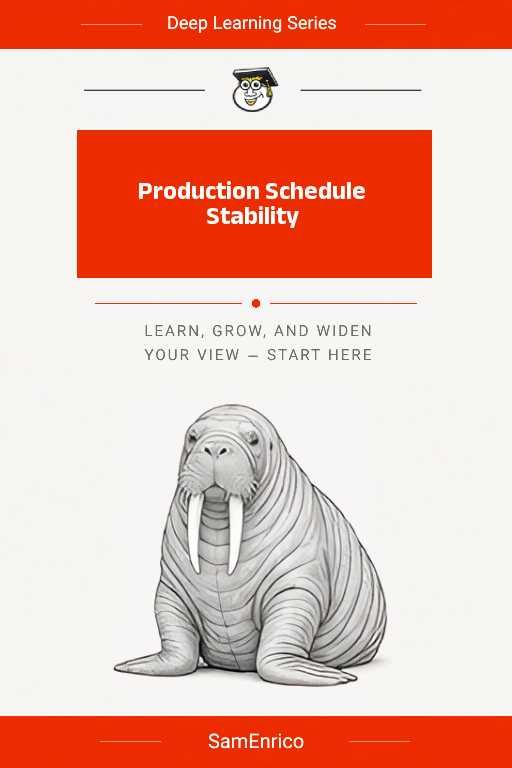
Production Schedule Stability
Freeze schedule windows and manage engineering cha
Freeze schedule windows and manage engineering changes to protect production from disruption.
Formats
About this book
Free sample
Chapter 1: The Chaos Tax--–- Mary Chen had been production manager at Apex Medical Devices for exactly eleven months when she found herself standing in the parking lot at 3:47 AM, staring at her phone and trying to remember if she had eaten dinner the night before. She could not recall. The phone buzzed again. A text from her lead supervisor, Diego: "Third shift just walked. The bracket change hit at 2 AM.
They're done. I'm done. Call me when you have a real schedule."She did not call him. Instead, she sat in her idling car, the November rain streaking across the windshield, and calculated the damage. Three shifts of production lost.
A $2.4 million shipment due in ten days. An engineering change that had been submitted at 4:00 PM yesterday, approved by her boss at 4:30 PM because "the customer wants it," and dropped on the night shift like a bomb. The old bracket design used a 10mm steel stamping. The new design used an 8mm aluminum forging. Same hole pattern.
Same fit. Different material. Different tooling. Different thermal expansion properties. Different everything.No one had told Diego until he clocked in at 10 PM.
By 2 AM, his team had scrapped 400 units trying to make aluminum behave like steel. By 3 AM, they had walked.Mary turned off the engine. She sat in the silence. Then she opened her notebook and wrote a question that would change everything: "How much does chaos actually cost?"The High Cost of the "Emergency Culture"This chapter dismantles a dangerous belief that persists in manufacturing organizations around the world: that constant firefighting, schedule flexibility, and the ability to "adapt to change" are signs of an agile, responsive, competitive organization. This belief is wrong.
It is expensively, catastrophically wrong.Drawing from Eliyahu Goldratt's The Goal and Jeffrey Liker's The Toyota Way, this chapter introduces a critical distinction that most managers never make: the difference between bad variability and good variability.Bad variability is unplanned disruption. It is the engineering change that arrives after the freeze window. It is the supplier who ships late. It is the quality escape that shuts down the…
This is the end of the free sample. Get the eBook to keep going. Buy now
Contents
- Chapter 1
- Chapter 2
- Chapter 3
- Chapter 4
- Chapter 5
- Chapter 6
- Chapter 7
- Chapter 8
- Chapter 9
- Chapter 10
- Chapter 11
- Chapter 12
Details
- Author
- Maier Lashonda
- Publisher
- SamEnrico
- Language
- English
- Genre
- Non-Fiction, Operational Efficiency Manual, Schedule Stability
- Released
- 2026-06-01
- Pages (approx.)
- 143
- Available as
- eBook, Audiobook

Read better in the ZLOADR app
Your eBooks on your phone or tablet. Sign in with your SamEnrico account and start reading.
More by Maier Lashonda
 Virtual Icebreaker GuideMaier Lashonda$11.99
 TM Course What To ExpectMaier Lashonda$11.99
 The Governor's Prison FightMaier Lashonda$11.99
 IBS Food Chemical SensitivityMaier Lashonda$11.99
 Data Leak Legal Hold Notification ScriptsMaier Lashonda$11.99
 The Lost Pharaohs of the Red Land: Uncovering Egypt's Forgotten KingsMaier Lashonda$11.99
 Swipe Right for Revolution: How a Single App Toppled a DictatorMaier Lashonda$11.99
 A Beginners Guide to Archery (Volume 1)Maier Lashonda$11.99
 Andela YC Application MasteryMaier Lashonda$12.99
 Understanding Cleft Palate Heart Disease Polydactyly Absent TibiaMaier Lashonda$17.99