
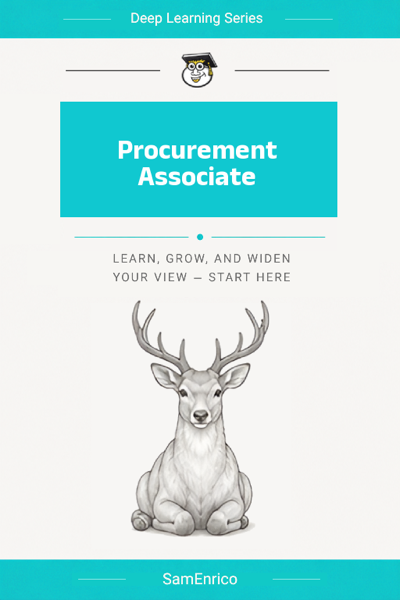
Procurement Associate eBook
A Coursebook on Procurement Associate
A Coursebook on Procurement Associate
Formats
Free sample
Chapter 1: The Five Rights--–- Every morning, Maria stared at the same spreadsheet. Three columns. Endless rows. Each line represented a request—a requisition for laptops, a rush order for office supplies, a special request for spare parts for a machine no one could name. She clicked, typed, and forwarded.
Click, type, forward. Eight hours a day. Her job title said "Procurement Associate," but she felt like a postal worker sorting mail that never stopped arriving.Six months earlier, Maria had graduated with a degree in supply chain management. Her professors spoke of strategy, of partnerships, of leveraging data to drive competitive advantage. Her first job promised a career in "global procurement." Instead, she found herself trapped behind a desk, drowning in purchase orders, wondering where the grand vision had gone.This chapter is for Maria.
And for every new procurement professional who has ever felt like a clerk when they dreamed of being a strategist. Because before you can transform the procurement function, before you can negotiate million-dollar contracts or redesign supply chains, you must master something far more fundamental. You must understand what procurement actually is, how it differs from the myth of "just buying things," and why getting the basics right is the only path to becoming a strategic partner.The truth is simple but powerful: purchasing is not procurement. One is a transaction. The other is a process.
One is reactive. The other is strategic. And at the center of that distinction sits a framework so elegant and so practical that it has guided procurement professionals for decades. It is called the Five Rights of Procurement. Get these right, and you earn the right to play a bigger game.
Get them wrong, and nothing else matters.Let us begin.The Myth Versus The Reality Walk into any office and ask ten people what procurement does. Eight will say "buying stuff." One will say "ordering supplies." The tenth might shrug and ask if you need a new mouse pad.This is the myth. It is persistent, damaging, and completely wrong.Procurement is not purchasing. Purchasing is a subset of procurement—the tactical, transactional act of placing an order. Purchasing happens at the end of a long chain of decisions.
Someone else decides what to buy. Someone else decides how much to spend. Someone else negotiates the price. The purchasing clerk simply executes. They click "submit" on a purchase order.
They chase a delivery. They reconcile an invoice.Procurement, by contrast, begins long before the purchase order is created and continues long after the goods arrive. Procurement is the end-to-end process of identifying a need, researching the market, selecting a supplier, negotiating terms, managing the contract, and ensuring that the goods or services deliver value throughout their entire lifecycle.The difference is not academic. It is the difference between being an order-taker and being a strategic asset to your organization.Consider two professionals. Both work for the same manufacturing company.
Both are responsible for buying safety gloves for factory workers.The first is a purchaser. When a requisition arrives, she opens the approved supplier catalog, matches the item number, creates a purchase order, and sends it to the supplier. When the gloves arrive, she checks the quantity against the packing slip and files the paperwork. When an invoice arrives, she verifies the price matches the PO and sends it to accounts payable. She is efficient.
She makes no mistakes. But she adds no value beyond processing.The second is a procurement professional. When she receives a requisition for safety gloves, she does not immediately create a PO. Instead, she asks questions. Why are we buying this brand?
How many pairs does each worker go through per month? Are there injuries from glove failure? Is there a better glove that costs more upfront but lasts longer? She researches the market and finds a new composite material glove that costs 40 percent more per pair but lasts six times longer. She calculates total cost of ownership and discovers the new glove saves $50,000 per year in replacement costs and reduces hand injuries by 25 percent.
She negotiates a volume discount, updates the approved supplier list, and trains the factory workers on proper glove care.Both did their job. One saved the company $50,000 and improved worker safety. The other clicked buttons.That is the difference between purchasing and procurement. And that is why the Five Rights matter.The Five Rights: Your North Star The Five Rights of Procurement are the foundational criteria for every successful acquisition. They are simple enough to remember, yet deep enough to guide complex decisions.
A procurement professional who consistently delivers all five has mastered the basics. A professional who misses any one of them, no matter how skilled in other areas, has failed.Here they are, in order of importance:Right Quality Right Quantity Right Price Right Place Right Time Notice something missing? "Right Supplier" is not one of the five. That is not an oversight. The supplier is the means to deliver the five rights, not an end in itself.
A famous supplier with a beautiful website and a polished sales team means nothing if they cannot deliver the right quality at the right time.Notice something else? "Lowest Price" is not the right price. Cost is important, but never at the expense of quality, quantity, place, or time. The cheapest laptop that crashes daily is not a bargain. The cheapest shipping that arrives three weeks late is not a deal.
The cheapest raw material that fails inspection is not a saving.Let us examine each right in detail.Right Quality: The Non-Negotiable Foundation Quality is the first right because without it, nothing else matters. A product of poor quality fails to meet the need that created the requisition in the first place. A surgeon cannot operate with a scalpel that dulls after one incision. A factory cannot produce with a replacement part that shears under load. A teacher cannot teach with a projector that flickers and dies.Quality means fitness for use.
It does not mean "expensive" or "premium" or "brand name." It means the good or service performs its intended function reliably, safely, and for an acceptable duration.Defining quality begins with specifications. A specification is a precise description of what you need. Specifications can be technical (the bolt must withstand 200 pounds of shear force), performance-based (the software must process 1,000 transactions per second), or brand-name-or-equal (Dell Latitude or equivalent). The best specifications are tight enough to ensure performance but loose enough to allow competition.Consider a hospital purchasing surgical gowns. A poor specification says "high quality surgical gown." What does that mean?
To one supplier, it means a gown that meets the bare minimum regulatory standard. To another, it means a gown with reinforced seams and fluid-resistant fabric. The buyer who writes "high quality" has not defined quality at all. A proper specification says "surgical gown meeting ASTM F1671 standard for bloodborne pathogen resistance, with reinforced cuffs, and a minimum of 30 minutes of fluid protection."The right quality also requires verification. How do you know the supplier delivered what you specified?
Incoming inspection, certificates of analysis, sample testing, and performance audits are all tools for verifying quality. Never assume. Document and…
This is the end of the free sample. Get the eBook to keep going. Buy now
About this book
Details
- Author
- Jacobs Martha
- Publisher
- SamEnrico
- Language
- English
- Genre
- Non-Fiction, Informative, Educational
- Released
- 2026-05-04
- Pages (approx.)
- 155
- Available as
- eBook, Audiobook

Read better in the ZLOADR app
Your eBooks on your phone or tablet. Sign in with your SamEnrico account and start reading.
More by Jacobs Martha
 HIIT Intensity ProgressionJacobs Martha$11.99
 Menopause Diet GuideJacobs Martha$11.99
 Body Scan Meditation HandbookJacobs Martha$11.99
 Food Addiction and Chronic DietingJacobs Martha$11.99
 Hagia Sophia: The Crown Jewel of ByzantiumJacobs Martha$11.99
 Global Team All Hands GuideJacobs Martha$12.99
 How to Produce Absinthe FountainsJacobs Martha$11.99
 How to Start a Hobby in American Civil War reenactmentJacobs Martha$11.99