
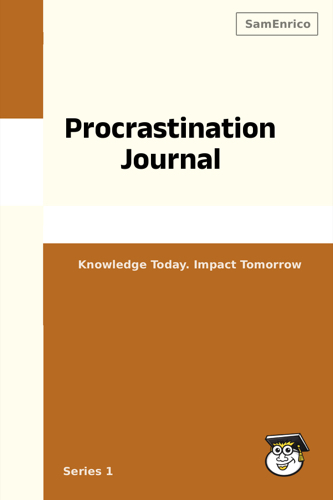
Non-FictionSelf-HelpJournaling
Procrastination Journal eBook
Daily prompts to track delay patterns.
Daily prompts to track delay patterns.
Formats
Free sample
Chapter 1: The Hidden Trigger...--–- You are not lazy. You are not broken. And you are certainly not alone in reading the first page of a book about procrastination instead of doing the thing you are actually supposed to be doing right now. Let that land for a moment. Whatever task you are currently avoiding—taxes, a work project, a difficult conversation, cleaning a closet, starting that workout—it is not sitting beside you because you lack willpower.
It is sitting there because your brain has made a perfectly logical, deeply unconscious calculation: that task hurts. Not physically, but emotionally. And your brain’s number one job, more important than your career success or your personal goals, is to avoid pain.This is the single most important shift you will make in this entire book. Procrastination is rarely a time-management problem. It is an emotion-management problem.
You do not delay because you cannot figure out how to schedule your day. You delay because the task triggers something uncomfortable—fear, boredom, anxiety, resentment, or the crushing weight of perfectionism—and your brain offers you a thousand tiny escapes. A glance at your phone. A sudden urge to organize your desk. A deep dive into a Wikipedia article about something you do not care about.
These are not signs of weakness. They are signs of a healthy brain doing exactly what it evolved to do: protect you from discomfort. The only problem is that the discomfort is not actually dangerous. And the avoidance, while temporarily relieving, makes the task feel even heavier the next time you look at it.This chapter is called The Hidden Trigger because most people have no idea what is actually causing their delay. They think they are procrastinating because the task is boring, or hard, or long.
But those are surface explanations. Beneath the surface, there is always an emotion. By the time you finish this chapter, you will have done something most people never do: you will have identified the specific feeling that drives your specific pattern of delay. And once you name it, you take the first step toward unhooking from it.The Emotion-Avoidance Cycle Let me walk you through the cycle that plays out in your brain dozens of times per day, usually without your conscious awareness.Step one: You look at a task. Maybe it is an email you need to send, a report you need to start, or a call you need to make.
For a split second, your brain evaluates that task not for its logical importance but for its emotional valence. Does this feel good, neutral, or bad?Step two: Your brain detects a negative emotion. This happens incredibly fast—faster than you can think. The emotion might be fear (What if I do this wrong?), boredom (This is so dull I cannot stand it), anxiety (There are too many steps, I do not know where to begin), resentment (Why do I have to do this? Someone else should be handling it), or perfectionism (If I cannot do this perfectly, I should not start at all).Step three: Your brain seeks relief.
It does not try to solve the task. It tries to solve the feeling. And the fastest way to solve a negative feeling is to look away. You pick up your phone. You get a snack.
You check the news. You suddenly remember that you meant to research something completely unrelated. This is not a moral failing. This is your limbic system doing its job.Step four: Temporary relief arrives. The moment you switch your attention, the negative feeling drops.
Your brain releases a small amount of dopamine—not because you accomplished something, but because you escaped something. This feels good. This feels like relief. And because it feels good, your brain learns: avoidance works.Step five: The task becomes heavier. Here is the cruel paradox.
By avoiding the task, you have not reduced its difficulty. You have increased it. Because now, in addition to the original negative emotion, you have added a layer of self-criticism. You know you avoided it. You feel a little guilty.
And tomorrow, when you look at the same task, it will feel even bigger, even heavier, even more aversive. This is the cycle that turns a five-minute email into a three-day dread.Most people live inside this cycle without ever seeing its shape. They just know they feel bad, they avoid things, and they feel worse. But you are about to step outside the cycle. You are going to become a detective of your own experience.
And the first tool you need is the ability to name the emotion hiding beneath the delay.The Emotional Taxonomy of Procrastination Not all procrastination feels the same. If you pay close attention, you will notice that different tasks trigger different emotional signatures. Below are the five most common emotional drivers of delay. Read each one carefully. As you do, think about the task you are currently avoiding.
Which of these feels closest to what you experience when you imagine doing it?Fear of Failure This is the classic procrastination story. You care about the outcome. You want to do well. But the possibility of doing poorly is so uncomfortable that you would rather not try at all. Fear of failure often shows up in high-stakes tasks—performance reviews, creative projects, important conversations.
The inner voice says: What if I am not good enough? What if someone finds out I do not know what I am doing? The irony is that by delaying, you guarantee a worse outcome than any attempt would have produced. But the fear is not rational. It is emotional.
And it is powerful.Boredom Intolerance Some people procrastinate not because they are afraid, but because they are under-stimulated. Their brain craves novelty, excitement, or stimulation. A dull task—data entry, cleaning, reading a dry report—feels physically uncomfortable. Not painful, exactly, but aversive in a low-grade, grinding way. Boredom-intolerant procrastinators are often creative, high-energy people who struggle with routine.
Their delay is not about fear. It is about the desperate search for something more interesting. The problem is that the boring task does not go away. It just waits.Anxiety and Overwhelm This driver is about quantity and complexity. The task is not necessarily scary or boring.
It is just too big. There are too many steps, too many unknowns, too many places to get stuck. Anxiety-driven procrastination feels like standing at the base of a mountain and looking up. You cannot see the path. Every time you try to start, your brain floods with all the things you do not know.
So you walk away. Not because you are lazy, but because you are overwhelmed. The cure is not more motivation. The cure is smaller steps—which we will cover extensively in Chapter 3.Resentment This is the procrastination that comes from obligation. You did not choose this task.
Someone else assigned it to you, or circumstances forced it upon you. And some part of you rebels against that lack of autonomy. The inner voice says: Why should I have to do this? This is not fair. I will show them…
This is the end of the free sample. Get the eBook to keep going. Buy now
About this book
Details
- Author
- Wingate Terisa
- Publisher
- SamEnrico
- Language
- English
- Genre
- Non-Fiction, Self-Help, Journaling
- Released
- 2026-06-05
- Pages (approx.)
- 145
- Available as
- eBook, Audiobook

Read better in the ZLOADR app
Your eBooks on your phone or tablet. Sign in with your SamEnrico account and start reading.
More by Wingate Terisa
 Memory Palace For Passport InfoWingate Terisa$11.99
 Nigeria British AmalgamationWingate Terisa$11.99
 Hinton Faith During IncarcerationWingate Terisa$11.99
 Square Breathing For RageWingate Terisa$11.99
 Divorce Related Children's DreamsWingate Terisa$11.99
 Bahadur Shah Zafar Last StandWingate Terisa$11.99
 Dream Journaling for First RespondersWingate Terisa$11.99
 The Last Telegram: The Unsung Heroes of the Great Pacific Air BattleWingate Terisa$11.99
 The Ghost of Burma: Ko Ni's Last StandWingate Terisa$11.99
 Mastering The Wrist ExtensorsWingate Terisa$11.99
 Grant Writing for Health NonprofitsWingate Terisa$12.99
 After Hours Nervous System ResetWingate Terisa$12.99
You may also like
 Hong Kong Handover 1997Dunn Johnnie$11.99
 Zumba For Postnatal Recovery CourseNeal Christian$11.99
 Zumba for BeginnersLadner Nikia$11.99
 YouTube Comment Mining GuideHumes Pandora$12.99
 Worry Box MeditationCarlin Rudy$11.99
 Workplace Stress MeditationNguyen Lynn$11.99
 Workplace Stress and Sleep RepairHawley Ivory$11.99
 Workplace Perfectionism CureDelaney Jeffry$11.99
 Workplace Injustice Anger GuideWallen Isabelle$11.99
 Work Addiction and Burnout LinkGreenwood Ester$11.99
 Women in Yoga and WellnessBeattie Galina$11.99
 Women in Stand Up ComedyChun Evangeline$11.99