
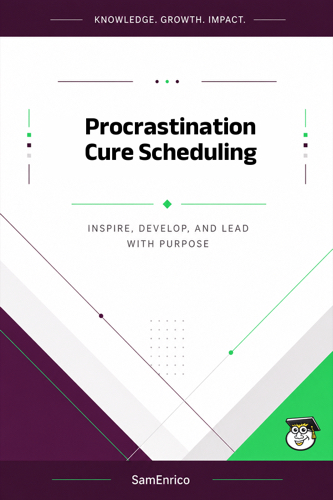
Non-FictionSelf-HelpProcrastination
Procrastination Cure Scheduling eBook
Break dreaded tasks into tiny blocks to overcome a
by Payton Jaye
Break dreaded tasks into tiny blocks to overcome avoidance.
Formats
Free sample
Chapter 1: The 300-Second Lie--–- The email subject line read “URGENT: Q3 Report Overdue.” You opened it three hours ago. Since then, you have organized your desktop icons by color, read the Wikipedia page for the mongoose, and watched a video about how to sharpen kitchen knives. The report sits there, untouched. You hate yourself for this. But here is what no one has ever told you: the hatred is the problem.Every productivity book, every motivational speaker, every well-meaning colleague who says “just do it” is operating from a fundamental misunderstanding of how your brain actually works.
They assume you are rational. They assume you weigh costs and benefits, calculate return on investment, and then act accordingly. If that were true, procrastination would not exist. You know the report is important. You know delaying will cause more pain later.
And yet, here you are, three hours deep into the mating habits of the Indian grey mongoose.This chapter dismantles the single most useless piece of advice in human history and replaces it with a truth so simple, so embarrassingly small, that you will be tempted to skip ahead. Do not skip. The 300-second lie – the lie you are about to tell yourself on purpose – is the only thing that has ever worked for the chronic avoider. But first, you need to understand why everything else failed.The Rational Actor Delusion Traditional time management systems assume you are a rational actor. David Allen’s Getting Things Done assumes that if you capture every task in a trusted system, your brain will relax and you will execute.
The Eisenhower Matrix assumes that if you sort tasks by urgency and importance, you will naturally prioritize. Time blocking assumes that if you carve out a chunk of your calendar, you will sit down and do the work during that chunk.These systems work beautifully for people who do not struggle with procrastination. For the rest of us, they become elaborate shame factories.Here is what actually happens when a chronic procrastinator faces a dreaded task. The brain does not calculate ROI. It calculates threat.
Your amygdala – the ancient, lizard part of your brain responsible for detecting danger – scans the task and asks one question: “Will this hurt?” If the answer is yes, or even maybe, the amygdala fires a warning signal. Your body responds with a cascade of stress hormones. Your heart rate increases. Your palms sweat. And then, because you are a human being with a prefrontal cortex that can rationalize anything, you tell yourself a story.“I work better under pressure.”“I need to do more research first.”“I’ll start at the top of the hour.”“I’ll start after this one video.”None of these are excuses.
They are survival mechanisms. Your body is literally trying to flee from the spreadsheet as if it were a predator. The rational actor model collapses the moment you understand this. You are not lazy. You are not broken.
You are having a neurological false alarm.The Pain of Starting (The 2011 Study That Changes Everything)In 2011, researchers led by Ethan Kross at the University of Michigan conducted a now-famous study using functional magnetic resonance imaging (f MRI). They asked participants to lie in the scanner and think about a painful romantic breakup. Then they asked them to anticipate an upcoming unpleasant task. Then they compared the brain images.The results were stunning. Anticipating a dreaded task activated the same brain regions – the insula and the amygdala – as anticipating physical pain.
Your brain does not distinguish between “I might get burned by a hot stove” and “I might have to write that performance review.” Both register as threats. Both trigger the same fight-or-flight response.This is not a metaphor. This is neurobiology.When you sit down to start a difficult task, your brain releases stress chemicals. Your body prepares to defend itself. And because you cannot punch the spreadsheet or run away from the blank page, you do the next best thing: you flee into something else.
Wikipedia. Email. Instagram. Cleaning the baseboards. Suddenly, cleaning the baseboards feels urgent.
That is not laziness. That is a fear response wearing a productivity disguise.The cruel irony is that the actual work – the typing, the calculating, the writing – rarely hurts. The anticipation hurts. The starting hurts. Once you are in motion, the pain usually subsides.
But your brain does not know that. Your brain only knows that the last time you thought about this task, you felt terrible. So it tries to protect you from feeling terrible again.This is why “just do it” is not just useless. It is actively harmful. Telling someone in the grip of a fear response to “just do it” is like telling someone who is afraid of heights to “just jump.” The fear is real.
The advice ignores the mechanism. And when you inevitably fail to “just do it,” you add shame to the fear. Now you are afraid of the task and ashamed of yourself. The loop tightens.Micro-Engagements: The 300-Second Lie Here is the solution, and it will sound ridiculous at first. You are going to lie to yourself.
Not about anything important. You are going to lie about how long you are going to work.You are not going to finish the report. You are not going to write the whole chapter. You are not going to clean the entire garage. You are going to do exactly one thing: touch the task for 300 seconds.
Five minutes. That is it. When the timer rings, you have unconditional, guilt-free permission to stop. No questions asked. No shame.This is the 300-second lie.
You are lying to your amygdala. You are saying, “This is not a threat. This is only five minutes. You can survive five minutes.” And because your brain does not fear five minutes – it fears hours of struggle – the fear response calms down.The research behind this is robust. In studies of exposure therapy for anxiety disorders, therapists have found that the most effective way to help someone face a fear is to break the exposure into tiny, non-threatening increments.
You do not ask someone with a fear of elevators to ride to the 20th floor on the first try. You ask them to stand near the elevator. Then to press the button. Then to step inside and immediately step out. Each increment is so small that the fear response does not activate.This is exactly what you are doing with a dreaded task.
The Pebble – the smallest possible unit of work, something that takes five minutes or less – is your elevator door. You are not riding to the 20th floor. You are just standing near it. And once you are standing there, something interesting happens.The Zeigarnik Effect and the Cognitive Itch In the 1920s, a Russian psychologist named Bluma Zeigarnik noticed something curious about waiters in Viennese cafes. The waiters could remember complex orders while they were being placed, but once the food was delivered, the memory vanished.
Zeigarnik conducted experiments and discovered a fundamental principle of human cognition: our brains remember incomplete tasks better than completed ones. Unfinished business creates mental tension. We want…
This is the end of the free sample. Get the eBook to keep going. Buy now
About this book
Details
- Author
- Payton Jaye
- Publisher
- SamEnrico
- Language
- English
- Genre
- Non-Fiction, Self-Help, Procrastination
- Released
- 2026-06-09
- Pages (approx.)
- 114
- Available as
- eBook, Audiobook

Read better in the ZLOADR app
Your eBooks on your phone or tablet. Sign in with your SamEnrico account and start reading.
More by Payton Jaye
 Body Scan for Muscle RecoveryPayton Jaye$11.99
 Heist Anniversary CoveragePayton Jaye$11.99
 Blaming Cognitive RestructuringPayton Jaye$11.99
 Ghanaian Student To Investment BankerPayton Jaye$11.99
 Doe Network Transgender CasesPayton Jaye$11.99
 BED Master GuidePayton Jaye$11.99
 Atomic Habits For Habit CoachPayton Jaye$11.99
 The Deal That Changed Football: WAGs, Agents, and the Rise of Social Media PowerPayton Jaye$11.99
 The Black Market of Blood: Canada's First Organ Trafficking ScandalPayton Jaye$11.99
 How to Produce an Air ShowerPayton Jaye$11.99
 How to Start a Hobby in Model rocketsPayton Jaye$11.99
 A Collector's Handbook to the Singer 6Payton Jaye$11.99
You may also like
 Hong Kong Handover 1997Dunn Johnnie$11.99
 Zumba For Postnatal Recovery CourseNeal Christian$11.99
 Zumba for BeginnersLadner Nikia$11.99
 YouTube Comment Mining GuideHumes Pandora$12.99
 Worry Box MeditationCarlin Rudy$11.99
 Workplace Stress MeditationNguyen Lynn$11.99
 Workplace Stress and Sleep RepairHawley Ivory$11.99
 Workplace Perfectionism CureDelaney Jeffry$11.99
 Workplace Injustice Anger GuideWallen Isabelle$11.99
 Work Addiction and Burnout LinkGreenwood Ester$11.99
 Women in Yoga and WellnessBeattie Galina$11.99
 Women in Stand Up ComedyChun Evangeline$11.99