
Non-FictionSelf-HelpPTSD Management
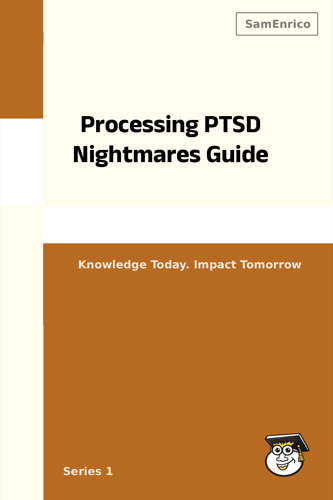
Processing PTSD Nightmares Guide eBook
Addresses trauma related dreams using imagery rehe
by Sledge Rey
Addresses trauma related dreams using imagery rehearsal therapy techniques.
Formats
Free sample
Chapter 1: The 3 AM Assassin--–- The clock on your nightstand reads 3:14 AM. Your heart is pounding so hard you can feel it in your throat. You are drenched in sweat despite the room being cold. The sheets are twisted around your legs like you’ve been fighting someone. Your first conscious thought is not a thought at all—it is a full-body certainty that something terrible is still in the room with you.
You hold your breath and listen. The house is silent. No footsteps. No broken glass. No intruder.
But your body doesn’t care about the silence. Your body is still running from whatever just chased you, caught you, or killed you inside your own mind. You were not watching a movie. You were not reading a scary story. You were asleep in your own bed, and yet you experienced something so real, so visceral, that waking up feels like the second trauma rather than the escape.Welcome to the 3:00 AM assassin.
That is what trauma-related nightmares are. They do not just disturb your sleep. They assassinate your sense of safety, your trust in your own mind, and your hope that tomorrow night will be any different.If you are reading this book, you already know the rhythm. You spend the day dreading the night. You delay going to bed because you know what waits for you there.
You fall asleep eventually—not because you are ready, but because your body collapses from exhaustion. Then, somewhere between two and four in the morning, the nightmare comes. You wake up in panic. You spend twenty minutes convincing yourself it wasn’t real. You fall back asleep just before your alarm goes off.
You start the day already exhausted. And then you do it all over again.This chapter is going to explain why this is happening to you. Not in vague metaphors about “unresolved trauma,” but in actual neurological and physiological terms that make sense of your experience. You will learn why trauma nightmares feel different from ordinary bad dreams. You will learn about the vicious cycle that keeps you trapped.
And most importantly, you will learn the single most important fact that changes everything: this is not a character flaw, and there is a treatment that works for seventy to eighty percent of people who use it correctly.Let us begin with a fundamental distinction that most people never learn.The Difference Between a Bad Dream and a Trauma Nightmare Everyone has bad dreams. A typical person without a trauma history will have a disturbing dream maybe once a week or once a month. In that dream, they might be chased by something vague, or show up to an exam unprepared, or have their teeth fall out. These dreams are unpleasant, but they do not typically cause the dreamer to wake up in a full physiological panic. The dreamer might think, “That was weird,” roll over, and go back to sleep within a few minutes.A trauma nightmare is a different category of experience entirely.Clinically, trauma-related nightmares are defined by several specific features that distinguish them from ordinary bad dreams.
First, they are almost always repetitive in nature. The same dream, or a variation of the same dream, returns night after night or week after week. It is not random. It follows a script. Second, they are hyperrealistic in a way that ordinary dreams are not.
During a trauma nightmare, you do not have that hazy, dreamlike quality where things shift and change. Instead, the dream feels more real than waking life. Colors are vivid. Sounds are sharp. Physical sensations—heat, cold, pressure, pain—are present in full force.
Third, trauma nightmares are almost always accompanied by physical sensations that persist after waking. Your heart rate does not return to normal for ten, twenty, or thirty minutes. You may have a headache from clenching your jaw. Your muscles may ache from having tensed them for hours. Fourth, and most critically, trauma nightmares are replaying something related to your actual traumatic experience—not necessarily the exact event, but the same threat, the same helplessness, the same physical sensations, or the same emotional core.Consider two examples.A person without PTSD has a bad dream about being chased through a mall by a shadowy figure.
They wake up startled, check their phone, realize it is 4 AM, and go back to sleep. The next morning, they barely remember the dream.A person with PTSD has a nightmare in which they are back in the exact car where the accident happened. The smell of gasoline is overwhelming. The seatbelt is cutting into their chest. They hear the specific sound of metal crumpling.
They wake up gasping, convinced for several seconds that they are still in the car. Their chest hurts where the seatbelt was. They cannot go back to sleep for an hour. The next night, the same dream happens again.That second experience is not a bad dream. It is a trauma nightmare.
And it is not happening because you are weak or broken. It is happening because your brain is trying to do something that it was never designed to do.Why Your Brain Keeps Replaying the Trauma To understand why trauma nightmares persist, you have to understand how the brain normally processes memories. Under ordinary circumstances, when you experience an event, your brain goes through a process called memory consolidation. During the day, your hippocampus—a seahorse-shaped structure deep in your brain—acts like a temporary holding tank for new experiences. At night, during sleep, your brain transfers those experiences from the temporary tank into long-term storage.
Part of that process involves stripping away the emotional charge from the memory. The event becomes a fact rather than a feeling. “I was in a car accident” becomes a sentence you can say without your heart rate spiking.This process works beautifully for ordinary stressful events. It fails catastrophically for traumatic events.When you experience something that overwhelms your nervous system—something that your brain interprets as a life-threatening danger—the normal consolidation process breaks down. The memory does not get properly filed away.
Instead, it remains in a kind of neurological limbo, stored not as a coherent narrative but as fragmented sensory pieces: sounds, smells, images, and bodily sensations. These fragments are not connected to a timeline or a context. They are just pieces of danger floating around your brain.Here is where nightmares come in. During REM sleep—the stage of sleep where most dreaming occurs—your brain is working hard to integrate these fragments into something coherent. But because the trauma memory was never properly consolidated in the first place, the integration attempt fails repeatedly.
Your brain tries again the next night. And the next night. And the night after that. Each attempt produces a nightmare because your brain is essentially trying to solve a problem that it does not have the right tools to solve.This is not a metaphor. This is the actual neurobiology of trauma-related nightmares.
Your brain is not punishing you. Your brain is not trying to send you a message. Your brain is not revealing some hidden truth about your psyche. Your…
This is the end of the free sample. Get the eBook to keep going. Buy now
About this book
Details
- Author
- Sledge Rey
- Publisher
- SamEnrico
- Language
- English
- Genre
- Non-Fiction, Self-Help, PTSD Management
- Released
- 2026-06-06
- Pages (approx.)
- 139
- Available as
- eBook, Audiobook

Read better in the ZLOADR app
Your eBooks on your phone or tablet. Sign in with your SamEnrico account and start reading.
More by Sledge Rey
 Injustice Sensitivity Triggers CourseSledge Rey$11.99
 Trying to Conceive HolidaysSledge Rey$11.99
 Caregiver Burnout In Veterans FamiliesSledge Rey$11.99
 Cognitive Restructuring for Political AngerSledge Rey$11.99
 The 1984 World Series: The Night Baseball Defied the Cold WarSledge Rey$11.99
 Understanding Oculodentoosseous Dysplasia RecessiveSledge Rey$17.99
 How to Become a Computer Security SpecialistSledge Rey$11.99
 Merck SWOT Library GuideSledge Rey$12.99
 Chinese University Acceptance GuideSledge Rey$12.99
 Broker AssistantSledge Rey$11.99
You may also like
 Hong Kong Handover 1997Dunn Johnnie$11.99
 Zumba For Postnatal Recovery CourseNeal Christian$11.99
 Zumba for BeginnersLadner Nikia$11.99
 YouTube Comment Mining GuideHumes Pandora$12.99
 Worry Box MeditationCarlin Rudy$11.99
 Workplace Stress MeditationNguyen Lynn$11.99
 Workplace Stress and Sleep RepairHawley Ivory$11.99
 Workplace Perfectionism CureDelaney Jeffry$11.99
 Workplace Injustice Anger GuideWallen Isabelle$11.99
 Work Addiction and Burnout LinkGreenwood Ester$11.99
 Women in Yoga and WellnessBeattie Galina$11.99
 Women in Stand Up ComedyChun Evangeline$11.99