
Non-FictionAI OperatorProcess Modeling
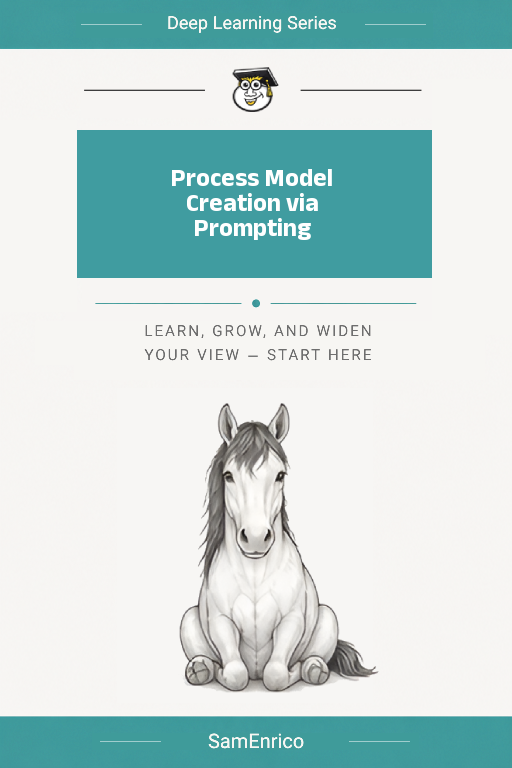
Process Model Creation via Prompting
Generate BPMN and UML diagrams from process descri
Generate BPMN and UML diagrams from process descriptions using systematic prompt engineering techniques.
Formats
About this book
Free sample
Chapter 1: The Whiteboard Trap--–- Every Monday morning, across thousands of conference rooms, business analysts and product owners do something remarkably inefficient. They gather around whiteboards, draw boxes and arrows with colorful markers, photograph their work with smartphones, and then spend the next four to six hours manually recreating those diagrams in Visio, Lucidchart, or draw.io. They call this "process modeling." In reality, it is a hidden bottleneck that costs Fortune 500 companies millions annually in lost productivity, and it is entirely avoidable.The problem is not that these professionals lack skill. The problem is that the tools and workflows they rely upon were designed for an era before large language models. That era is ending.
This chapter proves that prompt-based diagram generation is not merely faster than manual modeling—it produces more structurally sound, standards-compliant diagrams by enforcing rules that humans consistently forget under deadline pressure. By the time you finish this chapter, you will understand why dragging and dropping shapes is a relic, and you will have generated your first BPMN diagram from a simple email description in under ninety seconds.The Anatomy of Inefficiency: Why Manual Diagramming Fails Let us begin with an honest accounting of how process modeling actually works in most organizations today. A stakeholder writes a seven-hundred-word email describing a refund process. A business analyst reads the email, extracts the logical flow, and opens a diagramming tool. She drags a start shape onto the canvas.
She drags a task shape. She connects them with an arrow. She realizes the arrow is crooked, spends twenty seconds straightening it, then continues. Forty-five minutes later, she has a diagram. She emails it to the stakeholder.
The stakeholder replies: "Actually, the finance team reviews refunds over five hundred dollars, not over one thousand." The analyst reopens the diagram, moves three shapes, realigns ten connectors, and sends an update. This cycle repeats three times. The final diagram is technically correct but took four hours to produce. Now multiply this by every process, every system, every quarter.This is the Whiteboard Trap. Whiteboard sessions produce rich discussion and rapid iteration but…
This is the end of the free sample. Get the eBook to keep going. Buy now
Contents
- Chapter 1
- Chapter 2
- Chapter 3
- Chapter 4
- Chapter 5
- Chapter 6
- Chapter 7
- Chapter 8
- Chapter 9
- Chapter 10
- Chapter 11
- Chapter 12
Details
- Author
- Coughlin Gilberte
- Publisher
- SamEnrico
- Language
- English
- Genre
- Non-Fiction, AI Operator, Process Modeling
- Released
- 2026-05-30
- Pages (approx.)
- 136
- Available as
- eBook, Audiobook

Read better in the ZLOADR app
Your eBooks on your phone or tablet. Sign in with your SamEnrico account and start reading.
More by Coughlin Gilberte
 Men Body Image Insecurity GuideCoughlin Gilberte$11.99
 Hair Loss From Hats MythCoughlin Gilberte$11.99
 Burnout Warning Signs Detection GuideCoughlin Gilberte$11.99
 Room Sharing Sleep SolutionsCoughlin Gilberte$11.99
 The Senior Caregiver Spouse Self WorthCoughlin Gilberte$11.99
 The Hollow Drill: The Last Whisper of the Black Diamond MineCoughlin Gilberte$11.99
 Ultimate Handbook Guide to Xianyang : (China) Travel GuideCoughlin Gilberte$11.99
 Understanding Mental Retardation UCoughlin Gilberte$17.99
 California Privacy Rights Act GuideCoughlin Gilberte$12.99
 Specialty Sales RepresentativeCoughlin Gilberte$11.99
You may also like
 Hong Kong Handover 1997Dunn Johnnie$11.99
 Zumba For Postnatal Recovery CourseNeal Christian$11.99
 Zumba for BeginnersLadner Nikia$11.99
 YouTube Comment Mining GuideHumes Pandora$12.99
 Worry Box MeditationCarlin Rudy$11.99
 Workplace Stress MeditationNguyen Lynn$11.99
 Workplace Stress and Sleep RepairHawley Ivory$11.99
 Workplace Perfectionism CureDelaney Jeffry$11.99
 Workplace Injustice Anger GuideWallen Isabelle$11.99
 Work Addiction and Burnout LinkGreenwood Ester$11.99
 Women in Yoga and WellnessBeattie Galina$11.99
 Women in Stand Up ComedyChun Evangeline$11.99