
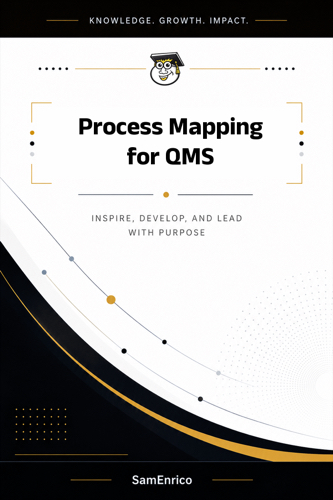
Process Mapping for QMS Audiobook
Diagram core workflows to identify inputs, outputs
by Thorn Merry
Diagram core workflows to identify inputs, outputs, and control points.
Formats
Free sample
Chapter 1: The Cartography Crisis--–- Every quality management system tells a story. Unfortunately, for most organizations, that story is a confusing, contradictory, and utterly unreliable work of fiction. The quality manager insists the process works one way. The production supervisor swears it works another. The operator, who actually does the work every day, knows a third version entirely.
And the auditor? The auditor will eventually find the truth—and when they do, they will write a non-conformance that costs you time, money, and credibility.This is the Cartography Crisis: the dangerous gap between how you think your processes work, how you document your processes work, and how your processes actually work. It is the single most common failure mode in quality management systems across every industry, from medical devices to automotive manufacturing to food processing. And the root cause is almost always the same: you are using the wrong tool to describe your operations.For decades, organizations have relied on narrative procedures—dense paragraphs of text that read like legal documents—to explain how work gets done. These procedures are written by well-intentioned quality professionals, approved by management, and then promptly ignored by everyone else.
They sit on shared drives, inside three-ring binders, or behind login screens that no one can remember the password for. When an employee needs to know how to handle a non-conforming material, they do not open the 47-page "Non-Conformance Management Procedure." They ask the person next to them. They follow the sticky note on the monitor. They do what they did last time, even if last time was wrong.This chapter exists because the old way is failing. The evidence is overwhelming: narrative procedures are fundamentally incompatible with how the human brain processes information under stress, how modern audits evaluate compliance, and how continuous improvement actually happens.
The solution is not better writing. The solution is better mapping.But not just any mapping. This chapter will introduce you to the foundational anatomy of a Quality Management System (QMS) process, the tools that separate professional process mapping from amateur flowcharting, and the single most important concept you must master before you draw your first box: the SIPOC. By the end of this chapter, you will understand why a structured process map is the most defensible form of documentation an organization can produce, and you will never again confuse activity with transformation.The Anatomy of a Process: More Than…
This is the end of the free sample. Get the Audiobook to keep going. Buy now
About this book
Details
- Author
- Thorn Merry
- Publisher
- SamEnrico
- Language
- English
- Genre
- Non-Fiction, Operational Efficiency Manual, Process Mapping
- Released
- 2026-06-08
- Pages (approx.)
- 151
- Available as
- eBook, Audiobook

Listen in the VoxFlicks app
Audiobooks and audio dramas wherever you go. Sign in with your SamEnrico account and press play.
More by Thorn Merry
 The Listening Journal MethodThorn Merry$11.99
 Twelve Step Program Slips and RelapseThorn Merry$11.99
 Growth Hormone and Collagen SynthesisThorn Merry$11.99
 Upwork Talent Badge GuideThorn Merry$11.99
 Ricky Gervais AtheismThorn Merry$11.99
 Grief and Sleep After Parent DeathThorn Merry$11.99
 Nonprofit Salary GuideThorn Merry$11.99
 The Battle of Diu: Portugal's Naval Gambit That Defined an Empire (1509)Thorn Merry$11.99
 Love and Cannonfire: Letters from the Siege of Diu (1509)Thorn Merry$11.99
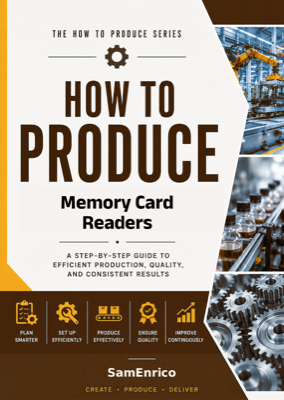 How to Produce Memory Card ReadersThorn Merry$11.99
 How to Become a Progress ClerkThorn Merry$11.99
 A Collector's Handbook to the Packard 120Thorn Merry$11.99