
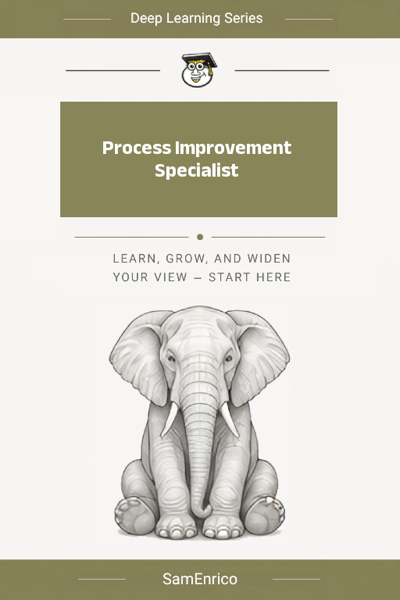
Non-FictionInformativeEducational
Process Improvement Specialist eBook
A Coursebook on Process Improvement Specialist
by Gass Tresa
A Coursebook on Process Improvement Specialist
Formats
Free sample
Chapter 1: The Mirror Test...–- Every profession has its moment of reckoning. For a surgeon, it is the first incision made alone. For a pilot, it is the landing in crosswinds. For a Process Improvement Specialist, the mirror test comes when you realize that the problem you were hired to fix is not a broken machine, a lazy team, or outdated software. It is a broken way of thinking—and that way of thinking lives inside you as much as it lives inside the organization.This chapter is not about tools.
It is not about flowcharts, cycle times, or root cause analysis. Those will come, and they will come in abundance. This chapter is about identity. Before you can fix any process, you must understand who you are when you walk onto the floor, open that spreadsheet, or sit down with a frustrated department head. You are not a hero.
You are not a fixer in the sense of someone who arrives with all the answers. You are something far more valuable and far more difficult to become: a change agent who works at the intersection of systems, data, and human behavior.The Cost of Being Wrong About Your Role Let us begin with a story. A large healthcare system hired a process improvement specialist to reduce patient wait times in the emergency department. The specialist, a bright and energetic professional with a Green Belt certification, did exactly what she had been trained to do. She mapped the current state.
She collected data on triage, registration, bed assignment, and physician assessment. She identified several obvious sources of waste: redundant questions asked by different staff members, a paper-based handoff between nurses and physicians, and a supply closet located fifty meters from the treatment bays.She proposed solutions. She ran a Kaizen event. She implemented Kanban for medical supplies. She reduced the walking distance for nurses.
Wait times dropped by eighteen percent. Leadership was pleased. Six months later, she was promoted and moved to another project. Twelve months after her departure, the emergency department wait times had crept back up to within five percent of the original baseline. The paper handoff returned when the electronic system crashed and no one reverted to the digital process.
The supply closet was reorganized by a new manager who did not understand the Kanban system. The walking distance increased again.What went wrong? The specialist had done everything right according to the technical playbook. She had used the right tools. She had followed the right methodology.
But she had failed at one critical thing: she had not changed the underlying culture. She had not built a system that sustained itself. She had not taught the team to improve itself. She had, in effect, been a consultant who delivered a solution rather than a change agent who built capability.This is the mirror test. Look at that story.
Does it remind you of any project you have seen or been part of? If it does, you are beginning to understand why this chapter exists before any other.Defining the Process Improvement Specialist: Beyond the Job Description If you search job boards today for “Process Improvement Specialist,” you will find a bewildering variety of descriptions. One employer asks for Lean Six Sigma certification and experience with Value Stream Mapping. Another asks for Agile Scrum mastery and familiarity with Jira. A third asks for change management certification and experience facilitating cross-functional workshops.
A fourth asks for data analytics skills and proficiency in SQL.The confusion is real. The title means different things in different industries, and sometimes it means different things in the same industry. A manufacturing specialist spends their days on shop floors measuring cycle times and changeover minutes. A healthcare specialist spends their days in patient flow meetings reconciling clinical requirements with administrative constraints. A software specialist spends their days in retrospectives helping development teams improve their own delivery processes.Beneath this surface confusion, however, there is a stable core.
The Process Improvement Specialist, regardless of industry, is defined by three constant characteristics.First, the specialist works at the intersection of systems thinking and human behavior. You cannot improve a process by ignoring the people who execute it, and you cannot improve a process by ignoring the structure that contains those people. The specialist holds both simultaneously: respect for the system and empathy for the person.Second, the specialist operates as a facilitator, not a solo expert. The most common mistake new specialists make is believing they must have all the answers. They study the data, analyze the flows, and present a beautiful solution.
Then they wonder why no one implements it. The specialist’s real job is to ask the questions that allow the people who do the work to discover the answers themselves. Your solution is inferior to their discovery, even if your solution is objectively better.Third, the specialist builds capability, not just fixes. The healthcare specialist who reduced wait times but left no lasting capability failed at the most important part of the job. The measure of your success is not the improvement you deliver during your project.
It is the improvement that continues to happen after you have left the room.The PDCA and SDCA Cycles: Your Operating Rhythm Every specialist needs an operating rhythm—a repeating pattern of activity that structures how you think, act, and learn. The most fundamental pattern in process improvement is actually two cycles linked together: PDCA and SDCA.PDCA stands for Plan-Do-Check-Act. It is the cycle of improvement. You Plan by analyzing the current state and developing a hypothesis for change. You Do by implementing that change on a small scale.
You Check by measuring the results and comparing them to your hypothesis. You Act by standardizing the change if it worked or trying something else if it did not.SDCA stands for Standardize-Do-Check-Act. It is the cycle of stabilization. You Standardize by documenting the current best-known way to perform a process. You Do by following that standard.
You Check by monitoring whether the standard is being followed and whether it is producing the expected results. You Act by correcting deviations or improving the standard when a better way is found.Here is the insight that separates effective specialists from ineffective ones: you cannot improve what is not standardized. If every person on the team performs the same task differently, you have no baseline. Any change you make will interact unpredictably with the existing variation. The SDCA cycle must come first.
You standardize the current process—even if it is imperfect—so that you have a stable foundation. Then you apply PDCA to improve it. Then you return to SDCA to standardize the new, better way. Then you repeat.This alternation between stabilization and improvement is the heartbeat of process improvement. A specialist who only standardizes creates rigidity and stagnation.
A specialist who only improves creates chaos and burnout. The master specialist moves fluidly between the two, knowing when to lock things down and when to open them up.Process Maturity: Where Are You Starting?Not all organizations are ready for the same tools. A manufacturing plant with decades of lean experience can handle statistical process control and…
This is the end of the free sample. Get the eBook to keep going. Buy now
About this book
Details
- Author
- Gass Tresa
- Publisher
- SamEnrico
- Language
- English
- Genre
- Non-Fiction, Informative, Educational
- Released
- 2026-05-18
- Pages (approx.)
- 158
- Available as
- eBook, Audiobook

Read better in the ZLOADR app
Your eBooks on your phone or tablet. Sign in with your SamEnrico account and start reading.
More by Gass Tresa
 LinkedIn Social Media BalanceGass Tresa$11.99
 Tech Professional EsteemGass Tresa$11.99
 HIIT for Pilates GuideGass Tresa$11.99
 TCM Face ReadingGass Tresa$11.99
 Blood and Gold in the Andes: Pizarro's Gambit at CajamarcaGass Tresa$11.99
 High Growth Factoring StrategiesGass Tresa$12.99
 How to Produce Chandeliers and Pendant LightsGass Tresa$11.99
 How to Become a Batch-records ClerkGass Tresa$11.99
You may also like
 Hong Kong Handover 1997Dunn Johnnie$11.99
 Zumba For Postnatal Recovery CourseNeal Christian$11.99
 Zumba for BeginnersLadner Nikia$11.99
 YouTube Comment Mining GuideHumes Pandora$12.99
 Worry Box MeditationCarlin Rudy$11.99
 Workplace Stress MeditationNguyen Lynn$11.99
 Workplace Stress and Sleep RepairHawley Ivory$11.99
 Workplace Perfectionism CureDelaney Jeffry$11.99
 Workplace Injustice Anger GuideWallen Isabelle$11.99
 Work Addiction and Burnout LinkGreenwood Ester$11.99
 Women in Yoga and WellnessBeattie Galina$11.99
 Women in Stand Up ComedyChun Evangeline$11.99