
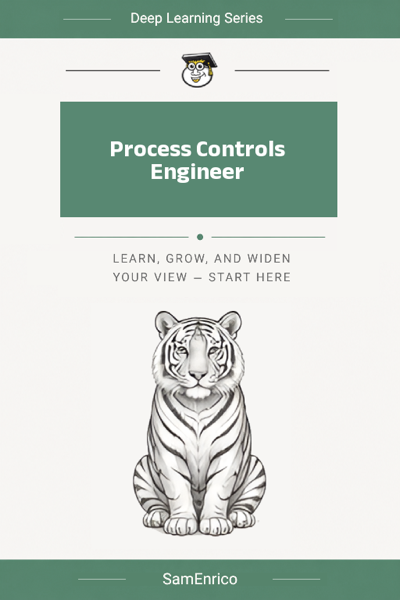
Non-FictionInformativeEducational
Process Controls Engineer eBook
A Coursebook on Process Controls Engineer
A Coursebook on Process Controls Engineer
Formats
Free sample
Chapter 1: The Safety Contract--The alarm sounded at 2:17 AM. Not the soft chime of a DCS advisory, but the hard shriek of a pressure trip on a propane deethanizer. You’ve been a process controls engineer for exactly eleven days. Your phone lights up with a text from the shift supervisor: “Column 2100 tripped. Need you here.”You pull on boots, grab a hard hat, and drive toward the refinery.
On the way, you replay the training module about PID tuning and valve sizing. None of it mentions what you’re about to face: a control room filled with tired operators, a supervisor who wants the column back online now, and a pressure transmitter that was bypassed three years ago and never documented.When you walk in, the senior operator looks at you and says: “We need you to disable the pressure override. Just temporarily. We’ll turn it back on once we’re stable.”This is your first test. And it is not a test of your ability to tune a loop.
It is a test of something far more important.The Three Souls of the Process Controls Engineer Let me tell you a secret that no textbook will admit: the technical skills—PID tuning, valve sizing, cascade design—are the easy part. Any engineer with six months of dedication can learn those. What separates a great process controls engineer from a mediocre one is something else entirely. I call them the Three Souls, and you must cultivate all three if you want to survive in this career.Soul One: The Operator Whisperer The first time I walked into a control room as a junior engineer, I made a classic mistake. I saw an operator adjusting a manual valve to bypass a stuck automatic control loop.
Without asking why, I said: “You shouldn’t do that. It’s unsafe.”The operator didn’t argue. He didn’t explain. He simply looked at me, turned back to his screen, and never spoke to me again for three months. That was a costly lesson.The operator whisperer understands that operators are not the enemy.
They are the ones who keep the plant running while engineers are in meetings. They know things that are not in the P&IDs. They know, for example, that the level transmitter on Tank 101 has been drifting for six months, but maintenance won’t replace it because the budget is frozen. They know that Valve HV-203 sticks at 30% open, so they never send it a setpoint below 32%. They know that the senior engineer who designed the cascade loop has never spent a night shift watching it fail.Being an operator whisperer means:Spending time in the control room during night shifts, not just day shifts.Asking operators what annoys them about the control system.
Listen without defending.Never bypassing an alarm or changing tuning without explaining why—in plain English, not transfer functions.Respecting that operators are certified professionals with years of experience. You are not their boss. You are their partner.One of the most effective tools I ever developed was a simple one-page “Why I Changed Your Loop” form. It had three lines: what changed, why it changed, and who to call if it causes problems. I printed a stack and filled one out every time I touched a controller.
Operators started trusting me because I communicated.Soul Two: The Process Detective The second soul is the detective. When a loop oscillates, when a valve sticks, when a composition analyzer reads nonsense, the process detective does not guess. They do not say: “Let’s try increasing the gain.” They say: “Let’s gather evidence.”The process detective treats every control problem as a crime scene. The victim is stable operation. The suspects include:The instrument (lying, drifting, stuck, or noisy)The valve (stiction, hysteresis, wrong characteristic, or failed positioner)The tuning (too aggressive, too slow, or inappropriate for the process type)The process design (excessive dead time, inverse response, or nonlinear behavior)The detective’s toolkit is simple but powerful: the DCS trend, a step test, and a systematic method.
In Chapter 12, we will walk through the complete Sloppy Loop Autopsy. For now, understand the mindset: evidence before action. Never change a tuning parameter until you have a hypothesis and a way to test it.I once spent two weeks on a loop that oscillated every 90 seconds. Multiple engineers had tried tuning it. I finally sat with the trend for an hour and noticed something strange: the oscillation was perfectly regular, like a metronome.
That suggested a mechanical cause, not a tuning cause. I traced the impulse line to the transmitter and found a small reciprocating compressor mounted on the same pipe rack. The compressor’s vibrations were shaking the impulse line. We moved the transmitter six feet, and the oscillation vanished. A detective, not a tuner, solved that problem.Soul Three: The Safety Backstop The third soul is the heaviest.
It is also the one that will keep you out of court.The safety backstop understands that process controls are not about optimization or efficiency. Those are important, but they are secondary. The primary purpose of process controls is to keep the plant within safe operating limits. Every control loop, every override, every alarm is a safety device. When you tune a loop aggressively to increase production, you are making a safety decision.
When you bypass an alarm because it’s annoying, you are making a safety decision. When you leave a valve with the wrong failure mode, you are making a safety decision.The safety backstop asks three questions before touching any loop:What is the worst thing that could happen if this loop fails?What safety systems (SIS, relief valves, interlocks) are behind this loop?If I make this change, can I defend it in front of a jury?That last question is not rhetorical. Engineers have gone to prison for bypassing safety controls. The case of the 2005 Texas City refinery explosion, which we will examine shortly, involved a control system that was bypassed, alarms that were ignored, and a level transmitter that was misconfigured. Fifteen people died.
The plant manager was indicted (though later acquitted). The engineers involved faced career-ending scrutiny.The safety backstop knows when to say no. And they know how to say no in a way that protects both the plant and their career.Reading P&IDs for Control Intent Before we go any further, we need to establish a common language. The Piping and Instrumentation Diagram (P&ID) is the primary document of process control. It is also one of the most misunderstood.Most engineers learn to read P&IDs as a map of pipes and instruments.
That’s like reading a novel by counting the letters. A P&ID is not a map. It is a story of control intent. Every line, every symbol, every tag tells you how the designer intended the process to be controlled.The Control Loop: A Four-Component Story Every control loop on a P&ID tells the same four-part story:Measurement – A transmitter (PT, TT, FT, LT) measures a process variable.Controller – A controller (typically in the DCS, shown as a bubble with a tag like TIC-101)…
This is the end of the free sample. Get the eBook to keep going. Buy now
About this book
Details
- Author
- Ainsworth Raymundo
- Publisher
- SamEnrico
- Language
- English
- Genre
- Non-Fiction, Informative, Educational
- Released
- 2026-06-02
- Pages (approx.)
- 135
- Available as
- eBook, Audiobook

Read better in the ZLOADR app
Your eBooks on your phone or tablet. Sign in with your SamEnrico account and start reading.
More by Ainsworth Raymundo
 Discord Server Detox MethodAinsworth Raymundo$11.99
 Sibling Therapy GuideAinsworth Raymundo$11.99
 TCM Seasonal LivingAinsworth Raymundo$11.99
 HIIT for Yoga GuideAinsworth Raymundo$11.99
 The Vanishing Billionaire: The Untold Spy Games of Robert VescoAinsworth Raymundo$11.99
 How to Produce ChandeliersAinsworth Raymundo$11.99
 Seasonal Business Factoring GuideAinsworth Raymundo$12.99
 How to Become a Patch FinisherAinsworth Raymundo$11.99
You may also like
 Hong Kong Handover 1997Dunn Johnnie$11.99
 Zumba For Postnatal Recovery CourseNeal Christian$11.99
 Zumba for BeginnersLadner Nikia$11.99
 YouTube Comment Mining GuideHumes Pandora$12.99
 Worry Box MeditationCarlin Rudy$11.99
 Workplace Stress MeditationNguyen Lynn$11.99
 Workplace Stress and Sleep RepairHawley Ivory$11.99
 Workplace Perfectionism CureDelaney Jeffry$11.99
 Workplace Injustice Anger GuideWallen Isabelle$11.99
 Work Addiction and Burnout LinkGreenwood Ester$11.99
 Women in Yoga and WellnessBeattie Galina$11.99
 Women in Stand Up ComedyChun Evangeline$11.99