
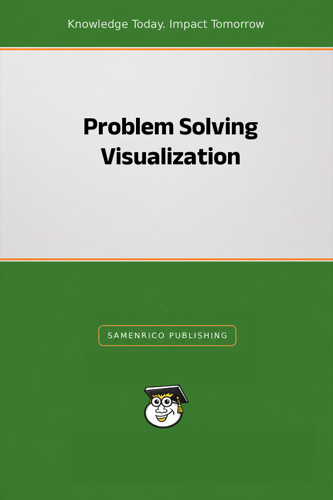
Problem Solving Visualization eBook
See solutions emerging from a calm mental space ra
by Weeks Jamar
See solutions emerging from a calm mental space rather than frantic thinking.
Formats
Free sample
Chapter 1: The Effort Trap--–- You are reading this book because you have a problem. Not just any problem—a problem that has resisted your best efforts. You have thought about it from every angle. You have made lists, diagrams, spreadsheets. You have stayed up late, woken up early, and spent your weekends “grinding” on it.
And yet, the solution remains as distant as when you started. If anything, the problem feels larger now, more tangled, more oppressive.This is not because you are not smart enough. It is not because you have not worked hard enough. It is because you have been trying to solve the problem with the wrong kind of effort—and the harder you try, the further the solution recedes.Let me say that again, because it is the single most important sentence in this book: Trying harder to think almost never solves the hardest problems.What feels like productive effort is often a panic loop—a neurological trap that your brain falls into when urgency spikes. In that trap, you are not solving anything.
You are simply running in circles, exhausting yourself, and mistaking the exhaustion for progress.This chapter will show you why the “try harder” instinct fails precisely when you need it most. You will learn to recognize the difference between frantic effort (the noise trap) and focused effort (the calm state). You will understand the neuroscience of why your best ideas never come when you are grinding. And you will learn your first, most essential tool: the Three Breath Reset, a 60-second intervention that can pull you out of the noise trap and into the calm state where real solutions emerge.By the end of this chapter, you will never look at “hard work” the same way again.The $10 Million Mistake Let me tell you about Priya. She is a composite of dozens of people I have worked with—engineers, executives, artists, and entrepreneurs—but her story is real in every way that matters.Priya is a senior software architect at a mid-sized tech company.
At 2:47 on a Tuesday morning, she is alone in her home office, staring at a database migration that has gone catastrophically wrong. If the migration fails by 8 a.m., her company will lose $2 million in client data. If she fixes it, she will be a hero. If she makes it worse, she might lose her job.She has been working on this problem for eleven consecutive hours. She has drunk six cups of coffee.
Her jaw is clenched so tight that she will later discover she cracked a molar. Her shoulders are up around her ears. Her thoughts are racing in loops: What if I try this query? No, that failed three hours ago. What about this index rebuild?
No, that made it worse. Oh god, what if I can’t fix this? What if they find out it was my code that caused the problem?She is working harder than she has ever worked in her life. She is also making zero progress. Worse, she is about to make a decision that would have seemed obviously insane to her well-rested self: she is going to run a destructive command that will permanently delete the backup.
She has convinced herself that this is the only way forward.At 3:15 a.m., her husband appears in the doorway. He does not understand the technical details, but he understands her. He says, “Come to bed. You’re not thinking clearly.”She snaps at him. “I don’t have time to sleep.
This has to be fixed by morning.”He says, “It’s already morning. And you’ve been at this for eleven hours. What have you solved?”She opens her mouth to list her accomplishments—and realizes she has none. She has tried thirty-seven different approaches. Thirty-six failed.
The thirty-seventh is still running, but she knows in her gut it will also fail. She has spent eleven hours spinning in place.She goes to bed. She sleeps for four hours. She wakes up, makes tea, sits in her kitchen, and closes her eyes for ninety seconds. In that ninety seconds, without thinking about the database at all, she sees a single image: a pipe with a clog in the middle, but water flowing around the clog through a bypass channel she had not noticed before.She opens her eyes, walks to her computer, and writes eleven lines of code.
The migration completes in twenty-three minutes. The fix was there the whole time—but she could not see it while she was trapped in the noise.Priya’s story is not exceptional. It is the rule. The harder you try to force a solution, the less likely you are to find it. The most important insights of your life will arrive when you are not trying—in the shower, on a walk, while driving, upon waking.
And the reason for this is not mystical. It is biological.The Neuroscience of Noise: Why Your Brain Betrays You Under Pressure To understand why frantic thinking fails, you need to understand what is happening inside your skull when you feel urgent pressure to solve a problem.Your brain produces electrical activity at different frequencies, measured in hertz (cycles per second). These frequencies are not just abstract numbers—they correspond directly to different mental states, different cognitive capabilities, and different problem-solving abilities.High-beta frequency (above 21 Hz) is the brain’s emergency broadcast system. This state evolved for one purpose: physical survival. When your ancestors saw a saber-toothed tiger, their brains shifted into high-beta.
In this state, your attention narrows dramatically. Peripheral vision (literal and metaphorical) shuts down. You focus intensely on the most obvious threat—the tiger’s teeth—while ignoring everything else. This is excellent for running away from predators. It is terrible for solving complex problems.Low-beta frequency (15-20 Hz) is the state of normal alertness.
You are awake, attentive, but not panicked. This is fine for routine tasks—answering emails, driving a familiar route, making a sandwich. But it is still not ideal for creative problem solving.Alpha frequency (8-12 Hz) is the calm state. This is relaxed alertness—the state experienced by skilled meditators, elite athletes before a performance, and musicians during improvisation. In alpha, your brain is not panicked or bored.
It is quietly, powerfully focused. Your peripheral awareness expands. You can see the whole field, not just the most obvious threat. This is where real problem solving happens.Theta frequency (4-8 Hz) is the state of deep relaxation, light sleep, and creative wandering. This is where “daydreaming” lives—and also where many of your best ideas will surface, just before sleep or upon waking.Here is the cruel irony: when you feel the most pressure to solve a problem, your brain automatically shifts into high-beta.
It thinks it is helping you. It is actually disabling your most powerful problem-solving circuits. The very act of “trying harder” triggers the neurological state that makes creative solutions invisible.Let me repeat that: The feeling of urgency triggers the brain state that makes solutions hardest to see.This is not a character flaw. It is not a failure of willpower. It is biology.
Your brain is doing exactly what evolution programmed it to do. The problem is that evolution did not program your…
This is the end of the free sample. Get the eBook to keep going. Buy now
About this book
Details
- Author
- Weeks Jamar
- Publisher
- SamEnrico
- Language
- English
- Genre
- Non-Fiction, Self-Help, Problem Solving
- Released
- 2026-06-09
- Pages (approx.)
- 142
- Available as
- eBook, Audiobook

Read better in the ZLOADR app
Your eBooks on your phone or tablet. Sign in with your SamEnrico account and start reading.
More by Weeks Jamar
 Sacaltar Indigenous Prayer ManualWeeks Jamar$11.99
 Mistake Apology OvercorrectionWeeks Jamar$11.99
 Journalist Breaking News StressWeeks Jamar$11.99
 The French Religious WarsWeeks Jamar$11.99
 Summer Break SchedulingWeeks Jamar$11.99
 Constipation MythsWeeks Jamar$11.99
 Layoff Survival Emotional GuideWeeks Jamar$11.99
 Active Listening in SalesWeeks Jamar$11.99
 The Golden Court of the Nubian Pharaohs: Splendor and Sovereignty Along the NileWeeks Jamar$11.99
 The Alchemist’s Cure: Ibn Sina and the Birth of Pharmacology in the Islamic Golden AgeWeeks Jamar$11.99
 The Velvet Underground and the Exploding Plastic RevolutionWeeks Jamar$11.99
 Growing PileostegiaWeeks Jamar$11.99
You may also like
 Define Problem Statement WorkshopNichols Curtis$11.99
 The Interruption MVP MethodLyon Camellia$11.99
 Pain Point Innovation GuideHagan Davina$11.99
 The Struggle Is Data GuideBattle Kirby$11.99
 Problem Solving DBT WorkbookCriswell Violette$11.99
 Problem Solving for EmotionsCollado Zelda$11.99
 Problem Framing WorkshopDancy Rosario$11.99
 Group Creative Problem Solving HandbookOliveira Mardell$11.99
 Problem Solving DreamsSchmid Ray$11.99
 Collaborative Problem SolvingGilson Dara$11.99
 Collaborative Problem Solving HandbookCross Lisa$11.99
 TM Obstacle TroubleshootingRubio Carly$11.99