
Non-FictionStartup GuideProblem SolutionPitch
Problem Solution Fit Guide eBook
Articulate problem solution fit in your pre seed p
by Duke Von
Articulate problem solution fit in your pre seed pitch to convince investors across three markets.
Formats
Free sample
Chapter 1: The Parallel Lies--–- The pitch deck was beautiful. Twenty-seven slides of crisp typography, professional mockups, and a logo that cost five thousand dollars. The founder had rehearsed his delivery forty-two times. He knew exactly when to pause, when to lean in, and when to click to the next slide. He had raised money before.
He knew the game.The investor looked at the first slide. Then the second. Then the third. Halfway through, she stopped him."Let me save you some time," she said. "I'm going to say no.
And I want you to know why."The founder blinked. This was not in the script."Your deck tells me everything about your product," the investor continued. "It tells me nothing about your problem. You've shown me features, roadmaps, and market size calculations that belong in a Series A pitch. But you haven't answered the only question that matters at your stage."She leaned forward.
"Why should I believe this problem is real?"The founder opened his mouth. Closed it. Opened it again. He realized, in that terrible silence, that he had no answer. He had customer quotes.
He had a waitlist. He had a prototype. But he did not have belief. He had never asked himself the one question that every pre-seed investor asks silently, continuously, ruthlessly.That question is the subject of this chapter. And the answer to it will determine whether you raise capital or collect rejection letters.The Most Expensive Mistake in Early-Stage Startups After analyzing over five hundred pre-seed pitch decks and interviewing dozens of venture capitalists, a pattern emerges with uncomfortable clarity.
Founders spend ninety percent of their time building solutions and ten percent of their time understanding problems. They invert the correct ratio.This is not laziness. It is psychological. Building feels productive. Writing code, designing interfaces, recruiting engineers—these activities produce tangible artifacts.
You can see progress. You can measure output. Understanding problems, by contrast, feels ambiguous. It requires talking to strangers, hearing criticism, and admitting that your brilliant idea might be solving something nobody actually cares about.The human brain is wired to avoid ambiguity. So founders build.
And they build. And then they pitch. And then they wonder why investors say "come back with traction" instead of writing checks.Here is what investors actually mean when they say "come back with traction." They do not mean "get more users." They mean "prove to me that the problem exists independent of your solution."Traction, in the pre-seed investor's vocabulary, is not about revenue. It is about evidence of active pain. A waitlist of two thousand people who signed up after seeing a landing page is weak evidence.
A single letter of intent from a customer who says "I will pay you fifty thousand dollars the day this works" is strong evidence. Ten customers who have already built their own spreadsheets to hack around the problem is strong evidence. A founder who can describe, in vivid detail, the specific workflow where the problem lives, the specific moment when the pain peaks, and the specific cost of ignoring it—that is strong evidence.But most founders cannot do this. Not because they are unintelligent. Because they never learned how.The Three Markets You Are Actually Pitching Here is the first hard truth of this book: You are not pitching one market.
You are pitching three. And if you fail to convince all three, you will not raise capital.Market One: Customers The first market is obvious. Customers are the people who will eventually exchange money for your solution. At the pre-seed stage, you do not need thousands of customers. You do not need revenue.
You need something more fundamental: credible evidence that real human beings feel this problem as an active, urgent pain.What does credible evidence look like? It is not a survey. It is not a friend saying "that's a great idea." It is not a tweet with twenty likes. Credible evidence looks like stories. Specific, dated, verifiable stories of struggle."I spent eight hours last Tuesday manually reconciling invoices because our accounting software doesn't talk to our inventory system.""I almost lost a client last month because I couldn't answer their question about delivery times, and I had to apologize three times.""I built a Python script that kind of works, but it breaks every week, and I have to pay a freelance developer two hundred dollars each time to fix it."These are not compliments.
They are confessions of pain. And they are worth more than a thousand waitlist signups.Market Two: Investors The second market is the one founders obsess over, but usually misunderstand. Investors are not evaluating your product. They are evaluating the shape of the problem. A venture capitalist needs to return a fund.
To return a fund, they need companies that can become worth at least one hundred million dollars. To become worth that much, a company needs to solve a problem that is:Large: Affects many people or businesses, or affects a few people but with enormous economic consequences.Growing: Getting worse over time, not better. The pain is accelerating.Structural: Cannot be fixed with a small tweak. Requires a fundamental rethinking of how something works.Urgent: Customers are suffering now, not in some distant future.When an investor asks "how big is the market?" they are not asking for a TAM calculation copied from a Gartner report. They are asking: "Is this problem big enough to matter?" When they ask "why now?" they are asking: "Is the pain acute enough to drive purchasing behavior today?"Investors are not heartless.
They simply understand that a small problem produces a small company. And a small company does not return their fund.Market Three: Talent The third market is the one pre-seed founders ignore most often. And it is the one that separates successful raises from desperate ones.Elite talent has options. A senior engineer at a top tech company receives dozens of recruiter emails per week. A world-class product manager can have a new job within seventy-two hours.
These people do not join startups for the ping-pong tables or the craft coffee or the "unlimited vacation policy that nobody actually takes."They join startups for the problem.The problem is the recruiting pitch. Not the product. Not the technology stack. Not the valuation. The problem.
"We are building an AI-powered platform" attracts mediocre talent. "We discovered that every hospital in America loses forty-seven million dollars per year to a specific billing error that nobody has figured out how to automate" attracts elite talent.Why? Because elite talent is motivated by intellectual curiosity and impact. A hard, interesting, important problem is intrinsically motivating. An easy problem, or a fake problem, or a problem that has been solved ten times before—those are boring.
Boring problems attract average people. Average people build average companies.When you can attract elite talent without paying above-market salaries, you have found a magnetic problem. That magnetism is part of Problem-Solution Fit.The Three Arrows Framework These three markets are not sequential. You do not prove Customer Fit, then Investor Fit, then Talent Fit. They are parallel.
Every pre-seed founder is pulling on three arrows simultaneously. The strength of each arrow determines whether you are ready to…
This is the end of the free sample. Get the eBook to keep going. Buy now
About this book
Details
- Author
- Duke Von
- Publisher
- SamEnrico
- Language
- English
- Genre
- Non-Fiction, Startup Guide, Problem Solution, Pitch
- Released
- 2026-05-29
- Pages (approx.)
- 133
- Available as
- eBook, Audiobook

Read better in the ZLOADR app
Your eBooks on your phone or tablet. Sign in with your SamEnrico account and start reading.
More by Duke Von
 Pinterest VA Hashtag StrategyDuke Von$11.99
 Russian Mafia Brighton BeachDuke Von$11.99
 Meditation for Chronic Foot PainDuke Von$11.99
 Breast Cyst Aspiration GuideDuke Von$11.99
 Sugar Addiction and Gut HealthDuke Von$11.99
 The Ancient Healers of Angkor: Mental Health in the Stone TemplesDuke Von$11.99
 Glitch in the Matrix: The 2016 Internet Outage That Almost Broke the WebDuke Von$11.99
 Understanding Colonic AtresiaDuke Von$17.99
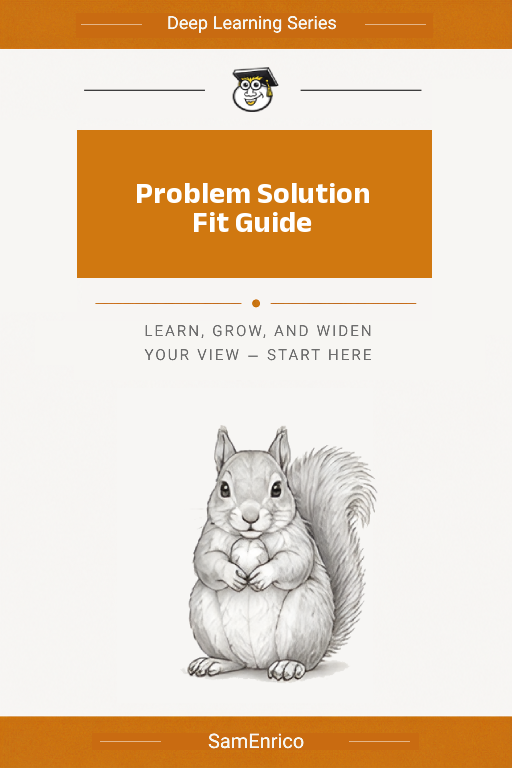 Problem Solution Fit GuideDuke Von$12.99Problem Solution Fit GuideDuke Von$12.99Problem Solution Fit GuideDuke Von$12.99Problem Solution Fit GuideDuke Von$12.99
You may also like
 Hong Kong Handover 1997Dunn Johnnie$11.99
 Zumba For Postnatal Recovery CourseNeal Christian$11.99
 Zumba for BeginnersLadner Nikia$11.99
 YouTube Comment Mining GuideHumes Pandora$12.99
 Worry Box MeditationCarlin Rudy$11.99
 Workplace Stress MeditationNguyen Lynn$11.99
 Workplace Stress and Sleep RepairHawley Ivory$11.99
 Workplace Perfectionism CureDelaney Jeffry$11.99
 Workplace Injustice Anger GuideWallen Isabelle$11.99
 Work Addiction and Burnout LinkGreenwood Ester$11.99
 Women in Yoga and WellnessBeattie Galina$11.99
 Women in Stand Up ComedyChun Evangeline$11.99