
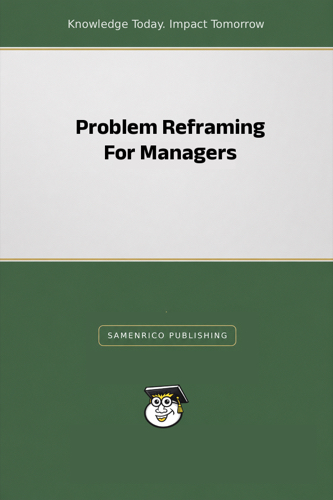
Problem Reframing For Managers eBook
Change how you define problems to unlock novel sol
Change how you define problems to unlock novel solutions and avoid solving wrong problems.
Formats
Free sample
Chapter 1: The Most Expensive Mistake--Most managers fail not because they can't find solutions, but because they never stop to ask whether they are solving the right problem in the first place.Imagine you are the facility manager of a twenty-story office building in a busy downtown district. Tenants have been complaining for months. The elevator is too slow. People wait in the lobby every morning, watching the minutes tick by, arriving at their desks frustrated and already behind. The building owner calls you into her office.
"Fix it," she says. "I don't care what it costs. Just fix it."You call three elevator engineering firms. They all tell you the same thing. The motor is underpowered for the building's current occupancy.
A replacement will cost approximately two hundred thousand dollars, plus six weeks of construction, plus elevator shutdowns that will inconvenience every tenant. You present the quote to the owner. She approves it, reluctantly, and you begin the process.But before you sign the contract, you mention the problem to a junior employee in the marketing department. She listens politely, then asks a question that stops you cold: "Have you considered installing mirrors next to the elevator doors?"You blink. "Mirrors?""People aren't upset because the elevator is slow," she says.
"They're upset because they have nothing to do while they wait. Mirrors would give them something to look at. They could check their appearance, people-watch, adjust their hair. The wait would feel shorter."The mirrors cost five hundred dollars. Complaints disappeared entirely within a week.
The engineering firms never mentioned mirrors because they were solving a different problem: "How do we make the elevator faster?" The marketing employee reframed the problem entirely: "How do we make the wait feel shorter?"This is the difference between solving the wrong problem and solving the right one. And it is the single most expensive mistake managers make.The 85% Problem Let that story sink in for a moment. Two hundred thousand dollars versus five hundred dollars. Six weeks of construction versus an afternoon with a handyman. Angry tenants versus delighted ones.
The only difference was the way the problem was defined.Now consider this: research suggests that approximately eighty-five percent of organizations struggle to define the right problems before solving them. Eighty-five percent. That means the vast majority of teams, in the vast majority of companies, are rushing toward solutions that address symptoms, not causes. They are climbing mountains efficiently—and then discovering they are climbing the wrong mountain.Why does this happen? The answer is uncomfortable but simple.
Managers are rewarded for speed. When a problem arises, the implicit demand is almost always the same: "Fix it quickly." The person who asks "Is this the right problem?" can seem slow, indecisive, or even obstructionist. The person who proposes a solution—any solution—seems decisive, action-oriented, and valuable.But speed is useless if you are going in the wrong direction.Peter Drucker, the legendary management thinker, put it this way: "There is nothing so useless as doing efficiently that which should not be done at all." He meant that efficiency is only valuable when paired with effectiveness—and effectiveness begins with asking whether you are solving the right problem. A faster horse is still a horse. A faster elevator is still an elevator.
The mirrors worked because someone questioned the premise that speed was the issue.Throughout this book, we will use a specific definition of reframing. Reframing is the deliberate act of stepping outside your current problem definition to question whether you are solving the right problem at all. This is different from analysis, which asks "Why is this happening?" while accepting the problem definition. Analysis stays inside the frame. Reframing challenges the frame itself.Consider the difference in practice.
Analysis asks: "Why is the elevator slow?" That question leads you to motors, pulleys, cables, and speed metrics. It is a useful question, but it assumes that slowness is the problem. Reframing asks: "Is speed actually the problem?" That question leads you to human psychology, waiting behavior, and perception. It challenges the assumption that the initial problem statement is correct.Most managers are excellent at analysis. They have been trained to break down problems, gather data, identify root causes, and propose solutions.
But analysis without reframing is like aiming a telescope at the wrong star. You can adjust the focus perfectly. You can calculate the distance with exquisite precision. You will still never see what you are looking for, because you are looking in the wrong place.The Hidden Cost of Wrong-Problem Solving Let me be specific about what is at stake. Solving the wrong problem carries four distinct costs, and most managers only recognize the first one.Cost One: Wasted Resources This is the obvious cost.
You spend money, time, and effort on a solution that doesn't work. In the elevator example, the wasted resource would have been two hundred thousand dollars. In your organization, the numbers might be smaller or larger, but the pattern is the same. Teams build features no one uses. Departments implement processes that create more work than they save.
Companies launch products that solve problems customers don't have.Cost Two: Opportunity Cost This is the cost that almost never appears on a budget, but it is almost always larger than the first cost. Every hour you spend solving the wrong problem is an hour you are not spending solving the right problem. Every dollar you invest in the wrong solution is a dollar you cannot invest in the right one. When the elevator manager almost spent two hundred thousand dollars on a new motor, that money was not available for anything else—lobby renovations, security upgrades, tenant amenities. The opportunity cost of wrong-problem solving is invisible but enormous.Cost Three: Organizational Fatigue This is the cost that destroys morale.
When teams repeatedly solve problems that don't matter, they become cynical. They learn that effort does not produce results. They stop believing that leadership knows what it is doing. The next time a problem arises, they put in less effort—not because they are lazy, but because they have learned that their effort is unlikely to produce meaningful change. This is not a people problem.
It is a reframing problem.Cost Four: The Wrong Solution Becomes the New Baseline This is the most insidious cost of all. When you implement a solution to the wrong problem, that solution becomes part of the organization's infrastructure. It shapes what people think is possible. It constrains future decisions. The wrong solution to a problem from five years ago might be the reason you cannot solve today's actual problem.
You are not just wasting resources. You are actively making the future harder.I once worked with a manufacturing company that had spent three years building a sophisticated inventory forecasting system. The system was brilliant—machine learning algorithms, real-time data feeds, predictive analytics. The only problem was that no one had asked whether accurate forecasting was the actual problem. The real problem turned out to be that suppliers were unreliable.
No forecast, no matter how accurate, could fix a supplier who shipped the wrong parts on the wrong day. The company had…
This is the end of the free sample. Get the eBook to keep going. Buy now
About this book
Details
- Author
- Cottrell Russell
- Publisher
- SamEnrico
- Language
- English
- Genre
- Non-Fiction, Self-Help, Reframing, Problem Definition
- Released
- 2026-06-09
- Pages (approx.)
- 148
- Available as
- eBook, Audiobook

Read better in the ZLOADR app
Your eBooks on your phone or tablet. Sign in with your SamEnrico account and start reading.
More by Cottrell Russell
 Education Nonprofit Turnaround GuideCottrell Russell$11.99
 The Pain Monitoring DiaryCottrell Russell$11.99
 Emotional Eating and Body ImageCottrell Russell$11.99
 Construction Site Safety ManagerCottrell Russell$11.99
 The Deep Silence: Neutrinos and the Birth of Astroparticle PhysicsCottrell Russell$11.99
 Whispers of the Lost Library: The Forgotten Scrolls of AlexandriaCottrell Russell$11.99
 Understanding Familial HyperlipoproteinemiaCottrell Russell$17.99
 Ghana Cedi Risk GuideCottrell Russell$12.99
 Data Presentation Grading Rubric for Quality ControlCottrell Russell$12.99
 Product TesterCottrell Russell$11.99
 How to Become a Converter OperatorCottrell Russell$11.99