
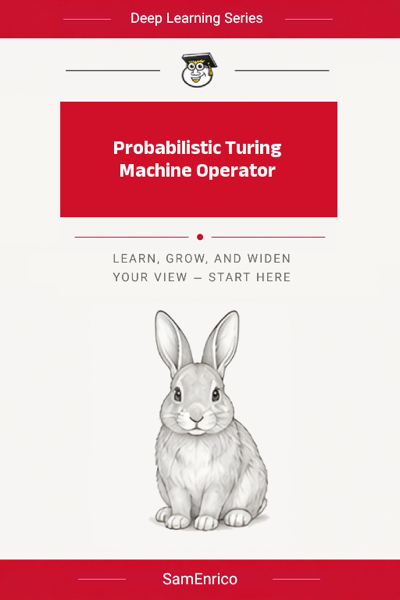
Non-FictionInformativeEducational
Probabilistic Turing Machine Operator eBook
A Coursebook on Probabilistic Turing Machine Opera
A Coursebook on Probabilistic Turing Machine Operator
Formats
Free sample
Chapter 1: The Clockwork Lie...--–- In 1814, Pierre-Simon Laplace made a promise that haunted computation for two centuries. He wrote of an intellect so vast that it could know the position and velocity of every particle in the universe, and from that knowledge, compute the entire future and past as easily as you or I might add two and two. This "demon" would need no coin flips, no randomness, no probability. It would be perfectly deterministic. It would be, in the cold language of mathematics, a Turing machine with perfect information operating on a noiseless tape in a frictionless vacuum.There is only one problem with Laplace’s demon.
It does not exist. It cannot exist. And understanding why it cannot exist is the first step toward becoming an operator of probabilistic Turing machines.This book is about what happens when we admit that the demon is dead. When we accept that every real computation happens in a world of thermal noise, cosmic rays, timing jitter, measurement uncertainty, and fundamental quantum indeterminacy. When we stop pretending that our machines are deterministic and start building them to thrive on randomness.This chapter establishes the foundation for everything that follows.
We will review the deterministic Turing machine and the Church-Turing Thesis. We will confront the Halting Problem and understand what it means for a problem to be undecidable. We will then examine the gap between the clean, logical world of deterministic computation and the messy, noisy reality of physical systems. Finally, we will introduce the concept of the operator – the human who must navigate this gap – and preview how probabilistic machines offer a way forward.By the end of this chapter, you will understand why deterministic computation, for all its mathematical elegance, is insufficient for modeling the physical world. You will see why probability is not a bug in our machines but a feature of the universe.
And you will be ready to meet the probabilistic Turing machine.The Deterministic Turing Machine: A Brief Review Before we can understand what probabilistic machines add, we must understand what deterministic machines are and what they can – and cannot – do.The Turing machine, conceived by Alan Turing in 1936 as a thought experiment before the first electronic computers existed, is the foundational model of computation. It consists of several components that you, as a future operator of probabilistic machines, must internalize as thoroughly as a pilot internalizes the instruments of a cockpit.First, there is the tape. In its simplest form, the tape is an infinite linear sequence of cells, each containing a symbol from a finite alphabet. The tape extends infinitely in both directions, providing unbounded memory. In practice, of course, no physical computer has infinite memory, but the mathematical idealization allows us to reason about what is computable in principle, not just what fits in a finite RAM.Second, there is the head.
The head sits above a single cell of the tape at any given moment. It can read the symbol in that cell, write a new symbol in its place, and move one cell left or right. The head is the machine's active interface with its memory.Third, there is the state register. The machine occupies one of a finite set of states at any moment. These states encode everything the machine needs to remember about what it is doing beyond what is written on the tape.
One state is designated as the start state, where the machine begins its computation. Two additional states – often called accept and reject – are halting states. When the machine enters either of these, computation stops, and the output is determined.Fourth, and most critically, there is the transition function. This is the machine's program. It takes as input the current state and the symbol currently under the head, and it outputs three things: the symbol to write in the current cell, the direction to move the head (left or right), and the next state to enter.Notice what is missing from this description.
There is no randomness. The transition function is deterministic: for every pair (state, symbol), there is exactly one possible action. This is what makes the Turing machine deterministic. If you run it twice on the same input, you will get the same sequence of configurations every time, leading to the same output.The Church-Turing Thesis, articulated by Alonzo Church and Alan Turing in the 1930s, asserts that any function that can be computed by any effective method – any algorithm, any program, any mechanical procedure – can be computed by a Turing machine. This thesis has never been disproven, and it has become a cornerstone of computer science.
Every programming language you have ever used, every algorithm you have ever implemented, every computation you have ever witnessed is, in a precise mathematical sense, equivalent to some deterministic Turing machine.This is an astonishing claim. It means that there is a single, simple model of computation that captures the full power of all possible algorithmic processes. It means that if a problem cannot be solved by a Turing machine, it cannot be solved by any computer, no matter how advanced, no matter how fast, no matter how much memory it has.But this power comes with limits. And those limits are where our story begins.The Halting Problem: The First Wall In 1936, the same year he introduced the Turing machine, Alan Turing proved a theorem that shattered any hope of universal computation. He proved that there is no Turing machine that can solve the Halting Problem.The Halting Problem is deceptively simple.
Given a description of a Turing machine M and an input w, determine whether M, when started on w, will eventually halt (enter either the accept or reject state) or will run forever. That is it. Just tell us, for any program and any input, whether the program will finish or loop infinitely.Turing proved that no deterministic Turing machine can solve this problem for all possible inputs. The proof, which you have likely encountered in an introductory theory course, uses a diagonalization argument. Suppose such a machine H existed.
We could construct a new machine D that takes a machine description M, runs H to ask whether M halts on its own description, and then does the opposite: if H says M halts, D goes into an infinite loop; if H says M does not halt, D halts. Then we ask what D does when run on its own description. Paradox ensues. Therefore, H cannot exist.The Halting Problem is undecidable. No deterministic algorithm can solve it.This is the first brick wall of computation.
But notice something important about this wall. It is a logical wall, not a physical one. The Halting Problem is undecidable because of the internal logic of computation itself, not because of any limitation of physical hardware, not because of noise, not because of measurement error. Even if you had a perfectly noiseless, infinite, frictionless computer running in a vacuum at absolute zero, you could not solve the Halting Problem. It is not a matter of insufficient speed or memory.
It is a matter of logical impossibility.This distinction – between logical impossibility and physical limitation – is crucial for everything…
This is the end of the free sample. Get the eBook to keep going. Buy now
About this book
Details
- Author
- Espinal Daniell
- Publisher
- SamEnrico
- Language
- English
- Genre
- Non-Fiction, Informative, Educational
- Released
- 2026-05-18
- Pages (approx.)
- 142
- Available as
- eBook, Audiobook

Read better in the ZLOADR app
Your eBooks on your phone or tablet. Sign in with your SamEnrico account and start reading.
More by Espinal Daniell
 Binge Eating Recovery GuideEspinal Daniell$11.99
 Gaming Relationship RepairEspinal Daniell$11.99
 Cambodian Labor Migration OutlookEspinal Daniell$11.99
 Workaholism In Corporate CultureEspinal Daniell$11.99
 Workplace Anger Trigger IdentificationEspinal Daniell$11.99
 The 72-Hour Standoff: The Untold Siege of the Japanese Embassy in LimaEspinal Daniell$11.99
 Echoes of the Ark: The Forgotten Mission of the Genesis-7Espinal Daniell$11.99
 YouTube Channel Validation GuideEspinal Daniell$12.99
 Cross Border Buyer MappingEspinal Daniell$12.99
 Understanding Chromosome 6, Deletion 6q13 Q15Espinal Daniell$17.99
 How to Start a Hobby in Pinball MachinesEspinal Daniell$11.99
You may also like
 Hong Kong Handover 1997Dunn Johnnie$11.99
 Zumba For Postnatal Recovery CourseNeal Christian$11.99
 Zumba for BeginnersLadner Nikia$11.99
 YouTube Comment Mining GuideHumes Pandora$12.99
 Worry Box MeditationCarlin Rudy$11.99
 Workplace Stress MeditationNguyen Lynn$11.99
 Workplace Stress and Sleep RepairHawley Ivory$11.99
 Workplace Perfectionism CureDelaney Jeffry$11.99
 Workplace Injustice Anger GuideWallen Isabelle$11.99
 Work Addiction and Burnout LinkGreenwood Ester$11.99
 Women in Yoga and WellnessBeattie Galina$11.99
 Women in Stand Up ComedyChun Evangeline$11.99