
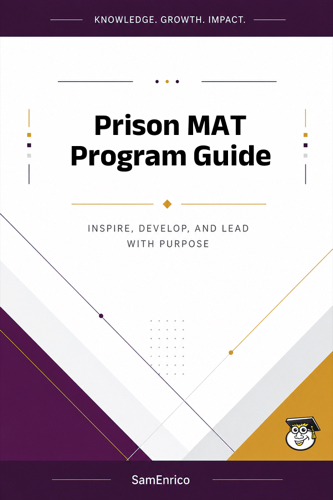
Prison MAT Program Guide eBook
Continue medication treatment for incarcerated ind
Continue medication treatment for incarcerated individuals during detention.
Formats
Free sample
Chapter 1: The 40x Risk...--–- The coroner’s report was two pages long. It listed fentanyl as the cause of death, which was no surprise to anyone who had been watching the overdose crisis unfold over the past decade. What made this report different—what made it land on the desk of a jail administrator three counties away—was the timing. Marcus had been released from the county detention center at 8:15 AM. His body was found in a gas station bathroom at 11:47 PM.
Fifteen hours and thirty-two minutes. He had been clean for sixty days inside. His tolerance was gone. His medication was gone. His life was gone.
His mother, Angela, later testified before a state legislative committee. She held up that two-page report and said, "My son didn't die from fentanyl. He died from the door they opened."Every person who works in corrections has a version of Marcus’s story. Maybe the name is different. Maybe the drug is different—heroin, counterfeit pills, a bag of powder sold as cocaine that turned out to be fentanyl.
Maybe the timeline is longer or shorter. But the pattern is the same: someone leaves jail or prison, and within days or even hours, they are dead. Families call it "the gate overdose." Medical examiners call it "post-incarceration mortality." But whatever name you give it, the math is brutal and unforgiving. Studies across multiple states and multiple years have converged on a single, chilling number: formerly incarcerated individuals face a risk of fatal overdose that is forty times higher in the first two weeks following release compared to the general population. Forty times.
That is not a mistake or a statistical artifact. That is a death sentence written into the very structure of how correctional systems manage—or fail to manage—addiction medication.This book is about how to change that number. It is about how to transform jails and prisons from places that systematically interrupt life-saving treatment into places that continue it. And it begins with a fundamental question that too few correctional facilities have asked out loud: Why are we forcing people off medications that keep them alive?The Tolerance Trap To understand why the first two weeks after release are so dangerous, you have to understand what happens to the human body during forced withdrawal—what the medical field calls "precipitated abstinence" when it happens suddenly, or simply "detox" when it happens over time. Opioids are not like other drugs.
When a person uses opioids regularly, their brain adapts. The receptors that opioids bind to actually change in number and sensitivity. This is called tolerance, and it is the reason people need higher doses over time to achieve the same effect. But tolerance is also a shield. A person with high opioid tolerance can survive a dose that would kill a person with no tolerance.
Their body has learned to handle it.When you force someone off opioids—whether it is heroin, fentanyl, prescription oxycodone, or the medication they were prescribed for addiction—that tolerance begins to disappear. The brain starts to revert to its pre-addiction state. The receptors down-regulate. The body forgets how to handle opioids. This process takes about two weeks, which is why the first fourteen days after release are the most dangerous.
A person who was stable on 120 milligrams of methadone in the community, then forced off it during sixty days in jail, emerges with the tolerance of a teenager trying opioids for the first time. But their psychology has not forgotten. They may seek out the same dose they used before incarceration. That dose—which their body could once handle—is now lethal.This is the tolerance trap. And the tragedy is that it is entirely preventable.
The solution is not complicated, expensive, or experimental. It is simply this: do not interrupt medications for opioid use disorder (OUD) or alcohol use disorder (AUD) during incarceration. Continue the same medication, at the same dose, for the same duration, as the patient was receiving in the community. That is it. That is the entire premise of this book.
And yet, the vast majority of jails and prisons in the United States do the opposite.The Myth of "Detox as Treatment"Why do correctional facilities routinely discontinue addiction medications? The answer is a combination of stigma, misinformation, and a deeply flawed belief that forced withdrawal is actually therapeutic. This belief is usually expressed in phrases like, "They need to be clean before they can get better," or "We don't believe in trading one drug for another," or "Jail should be a time of abstinence." These statements sound reasonable on the surface, especially to people who have never experienced opioid withdrawal or watched a loved one go through it. But they are dangerously wrong.Let us be explicit: Forced withdrawal is not treatment. It is not detoxification in any meaningful medical sense.
It is the abrupt discontinuation of a chronic disease medication, and it has no therapeutic benefit whatsoever. No credible medical organization recommends forced withdrawal from methadone or buprenorphine as a treatment for opioid use disorder. The National Commission on Correctional Health Care (NCCHC), the American Society of Addiction Medicine (ASAM), the American Medical Association (AMA), and the World Health Organization (WHO) all explicitly state that medications for addiction treatment should be continued during incarceration unless there is a specific medical contraindication. There is no debate about this in the medical community. The only debate exists in correctional settings, where non-medical staff often make medical decisions based on outdated beliefs.Let us also be explicit about what forced withdrawal actually feels like, because stigma thrives on ignorance.
Opioid withdrawal is not like quitting smoking or cutting out caffeine. It is a severe, multisystem illness. Symptoms include: severe nausea and vomiting, diarrhea, abdominal cramping, muscle and bone pain, sweating, chills, goosebumps, dilated pupils, runny nose and eyes, insomnia, anxiety, panic attacks, depression, suicidal ideation, and an overwhelming, primal craving for relief that can drive people to almost any behavior. Withdrawal from high-dose methadone or long-acting opioids can last for weeks. Withdrawal from fentanyl, which is now ubiquitous in the illicit drug supply, is particularly severe because fentanyl is lipophilic—it stores in fat cells and releases unpredictably, causing a withdrawal syndrome that is both intense and erratic.Forcing someone to go through withdrawal does not teach them anything.
It does not build character. It does not increase their motivation for recovery. What it does is cause immense suffering, increase the risk of post-release death, and communicate a clear message: your medical needs do not matter here. That is not correctional philosophy. That is cruelty.The Legal Revolution: From Discretion to Mandate For decades, correctional facilities could refuse MAT with impunity.
Courts were reluctant to intervene, deferring to "professional judgment" of jail administrators. But that era is ending rapidly, driven by three converging legal forces: the Eighth Amendment, the Americans with Disabilities Act (ADA), and aggressive enforcement by the Department of Justice (DOJ).The Eighth Amendment: Deliberate Indifference The Eighth Amendment prohibits cruel and unusual punishment. In the context of prison healthcare, the Supreme Court has held that "deliberate indifference to serious medical needs" violates the Constitution. The question…
This is the end of the free sample. Get the eBook to keep going. Buy now
About this book
Details
- Author
- Watters Merna
- Publisher
- SamEnrico
- Language
- English
- Genre
- Non-Fiction, Health & Wellness, Corrections
- Released
- 2026-06-11
- Pages (approx.)
- 146
- Available as
- eBook, Audiobook

Read better in the ZLOADR app
Your eBooks on your phone or tablet. Sign in with your SamEnrico account and start reading.
More by Watters Merna
 Active Listening For NegotiationsWatters Merna$11.99
 Purchase Approval SystemWatters Merna$11.99
 Opioid Withdrawal Comfort KitWatters Merna$11.99
 AI Pair Programming for DevelopersWatters Merna$12.99
 Learn to Play the Sub-subcontrabassWatters Merna$11.99
 How to Start a Fish Liver Oil Refining Business (Beginners Guide)Watters Merna$11.99
 Design Technology SpecialistWatters Merna$11.99