
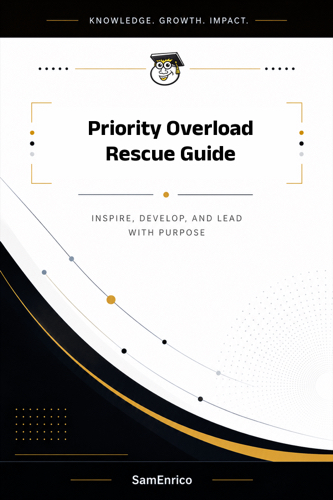
Priority Overload Rescue Guide eBook
Use ABCDE ranking when everything feels urgent to
Use ABCDE ranking when everything feels urgent to find true priorities.
Formats
Free sample
Chapter 1: The 10AM Confession--–- You start your day with three important tasks clearly in mind. By 10:00 a.m., you have responded to forty-seven emails, attended a “quick” status update that lasted forty-two minutes, and extinguished a minor fire for a colleague involving a misplaced spreadsheet. You have accomplished nothing you intended. The three important tasks remain untouched. Your inbox has grown.
Your calendar now shows back-to-back meetings until 2:00 p.m. And somewhere in the back of your mind, a small, insistent voice is whispering: You are failing.This is not a productivity problem. This is not a time management problem. This is not a sign that you lack discipline, intelligence, or work ethic. This is the Urgency Trap—and you are not alone in it.Over the past decade, researchers have documented a staggering rise in the number of knowledge workers who report feeling “constantly overwhelmed.” A 2023 study published in the Journal of Organizational Behavior found that 87% of professionals in high-skill industries—technology, finance, healthcare administration, education, marketing, and law—report that they regularly end their workweeks with their most important tasks incomplete.
When asked why, the most common response was not “I didn’t have enough time.” The most common response was: “Everything felt urgent.”Everything felt urgent.Let that phrase sit for a moment. These are not people who are lazy, disorganized, or unmotivated. These are people who worked sixty, seventy, even eighty hours last week. These are people who answered emails at 11:00 p.m. from their phones.
These are people who canceled dinner plans, skipped workouts, and missed their children’s school events. And despite all of that effort, they still ended the week with their real priorities untouched.How is this possible?The answer is both simple and deeply uncomfortable: Most of what feels urgent is not actually urgent. The feeling of urgency—the racing heart, the narrowed attention, the compulsive need to respond right now—is often a cognitive mirage. It is manufactured by the structure of modern work, the design of our digital tools, and the habits we have learned in response to both. And until you learn to distinguish between genuine urgency and manufactured urgency, you will continue to work harder and harder while accomplishing less and less of what truly matters.This chapter exists to help you make that distinction.
It will show you why your brain treats email notifications like survival threats. It will introduce the critical difference between Task Scarcity (not enough time) and Priority Ambiguity (not enough clarity). And it will guide you through the first and most important tool of this book: the Urgency Audit, a one-week log that will forever change how you see your own to-do list.But first, we need to understand how you got here.The Evolution of Urgency Your brain was not designed for the twenty-first century workplace. It was designed for the African savanna approximately two hundred thousand years ago. On that savanna, novelty was danger.
A rustle in the bushes might be a predator. An unexpected sound might signal an attack. A sudden movement in peripheral vision required immediate, full attention. Your ancestors who ignored novel stimuli did not survive to pass on their genes. The ones who survived were the ones who snapped to attention at every unexpected event, assessed the threat quickly, and responded immediately.This is called threat salience—the brain’s tendency to prioritize novel, unexpected, or emotionally charged stimuli over familiar, predictable, or neutral ones.
It is the reason you can be deeply focused on a complex task and yet instantly look up when someone says your name across a crowded room. It is the reason a flashing light draws your attention even when you know it is just a notification. It is the reason you feel a jolt of adrenaline when your phone buzzes—even though nine hundred previous buzzes have contained nothing more important than a grocery store coupon.In the modern workplace, this evolutionary inheritance has been weaponized. Every email that arrives in your inbox is novel. Every Slack message is unexpected.
Every calendar invitation is a new event demanding assessment. Your brain, still operating on savanna rules, treats each of these as a potential threat requiring immediate attention. And because there are dozens—sometimes hundreds—of these novel stimuli every single day, your brain spends the vast majority of its time in a state of low-grade emergency response.This is not a character flaw. It is biology. But it is biology that can be retrained.Task Scarcity vs.
Priority Ambiguity One of the most important distinctions in this entire book is the difference between two very different problems that people routinely confuse.Task Scarcity means you do not have enough time to complete all of your tasks. This is a real problem, and it affects certain professions more than others. Emergency room physicians experience Task Scarcity. Air traffic controllers during a storm experience Task Scarcity. A single parent working two jobs to pay rent experiences Task Scarcity.
In Task Scarcity, the issue is clear: there are more hours of work than there are hours in the day. The solution, when possible, is to reduce the workload, delegate, or accept that some tasks will simply not get done.Priority Ambiguity means you do not know which tasks actually matter. This is a very different problem, and it is far more common among knowledge workers than Task Scarcity. In Priority Ambiguity, you may have enough time to complete your most important work—but you cannot identify which work is most important. Every task looks urgent.
Every request feels critical. Every email seems like it needs an immediate response. As a result, you spend your time reacting to the loudest and most recent inputs rather than strategically advancing your real priorities.Here is the crucial insight that most productivity books miss: When people complain about being “too busy,” they are almost always suffering from Priority Ambiguity, not Task Scarcity. The evidence for this is overwhelming. Study after study has found that when knowledge workers track their time with precision, they discover that they actually have significant blocks of focused time available.
The problem is not the absence of time. The problem is that this time gets eaten by tasks that feel urgent but are not important.Consider a typical marketing manager named Sarah. Sarah works fifty hours per week. When she tracks her time, she discovers that she spends twelve hours per week on email, eight hours in meetings that do not require her presence, five hours “researching” (reading industry news and social media), and three hours putting out minor fires created by poor communication. That is twenty-eight hours per week—more than half her working time—spent on tasks that do not move any meaningful needle.
She is not too busy. She is too ambiguous about what actually matters.The solution to Priority Ambiguity is not more hours. It is not better software. It is not a standing desk or a meditation app. The solution is a systematic method for distinguishing genuine priority from manufactured urgency.
That method is the ABCDE ranking system, which you will learn throughout this book. But before you can rank anything…
This is the end of the free sample. Get the eBook to keep going. Buy now
About this book
Details
- Author
- Keegan Jospeh
- Publisher
- SamEnrico
- Language
- English
- Genre
- Non-Fiction, Self-Help, Overwhelm
- Released
- 2026-06-11
- Pages (approx.)
- 139
- Available as
- eBook, Audiobook

Read better in the ZLOADR app
Your eBooks on your phone or tablet. Sign in with your SamEnrico account and start reading.
More by Keegan Jospeh
 Breaking the Cycle WorkbookKeegan Jospeh$11.99
 Night Stalker Forensics ReviewKeegan Jospeh$11.99
 Late Night Snack TrackerKeegan Jospeh$11.99
 Franchising Your Local Brand Across Borders Data PrivacyKeegan Jospeh$11.99
 The Ocean’s Hidden Code: Terence Tao and the Pacific’s Mathematical RevelationsKeegan Jospeh$11.99
 The Night the Sky Blew Orange: The Bhopal Gas Tragedy UncoveredKeegan Jospeh$11.99
 Understanding Cytochrome C Oxidase DeficiencyKeegan Jospeh$17.99
 Q2 Marketing One PagerKeegan Jospeh$12.99
 Green Bond Tax ExemptionKeegan Jospeh$12.99
 How to Become a Chemical CompounderKeegan Jospeh$11.99
 Contact TracerKeegan Jospeh$11.99
You may also like
 Recurring Dreams of DrowningFreitas Dayna$11.99
 ABCDE For Overwhelm RescueKozlowski Cleora$11.99
 DBT For OverwhelmMcnair Herlinda$11.99
 ABCDE For OverwhelmDunn Clyde$11.99
 Remote Work Overwhelm SolutionsBroyles Deangelo$11.99Remote Work Overwhelm SolutionsBroyles Deangelo$11.99
 MBSR For Overwhelm CourseHarman Zana$11.99
 Daily Review for OverwhelmNixon Nu$11.99
 Zombie Dream Survival GuideTimm Minh$11.99
 Prioritization for Overwhelmed PeopleParis Shonna$11.99
 ABCDE for Overwhelm RecoveryNicholas Beryl$11.99
 Loving Kindness For OverwhelmLauer Zenaida$11.99