
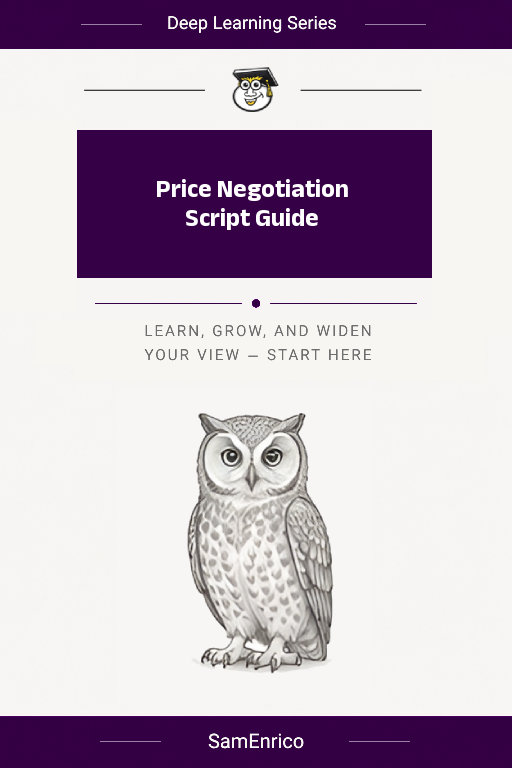
Non-FictionFirst 30 DaysNegotiation
Price Negotiation Script Guide eBook
Hold your ground in price negotiations with script
Hold your ground in price negotiations with scripts that pivot to value instead of discounting.
Formats
Free sample
Chapter 1: The Flinch Point--–- The proposal lands on the table. The buyer glances at the bottom line. Their eyebrows lift. Their lips press together. And then they say the four words that have destroyed more margin than any recession, any competitor, any market crash in commercial history: "That's a bit high."Your stomach tightens.
Your throat goes dry. Before you can stop yourself, your mouth opens and you hear a voice that sounds like yours but isn't—not really—saying: "Well... I could maybe do ten percent off if that helps."The buyer smiles. You feel relief. The deal moves forward.And you just left thousands of dollars on the table for absolutely no reason.This is the Flinch Point.
It is the precise millisecond when a seller abandons their price, their margin, and their confidence in response to a stimulus that isn't even a real threat. It is a reflex, not a strategy. And until you understand why your brain does this, no script in the world will save you. Because you will say the right words, feel the Flinch, and then throw in a discount anyway.This chapter is not about scripts. It is about the neurological, psychological, and emotional machinery that makes otherwise intelligent professionals give away money for free.
You cannot hold your ground until you understand why your ground feels so unstable in the first place.The Anatomy of a Flinch Let us slow down the tape. Frame by frame.At time zero, the buyer says a variation of "too expensive." The exact wording does not matter. "That's outside our budget." "Your competitor is cheaper." "I wasn't expecting that number." "Can you do better?" All of these are the same stimulus. They all mean: the price you presented has created discomfort, and I am returning that discomfort to you.At time zero plus one second, your brain performs a series of calculations so fast you are not consciously aware of them. Your amygdala—the ancient, reptilian part of your brain responsible for threat detection—interprets the buyer's words not as a negotiation tactic but as a predator.
In evolutionary terms, a threat to a deal is processed similarly to a threat to physical survival. The amygdala does not know the difference between a saber-toothed tiger and a procurement manager. Both trigger the same cascade.At time zero plus two seconds, your body responds. Cortisol rises. Adrenaline spikes.
Your heart rate increases. Blood flows away from your prefrontal cortex—the rational, thinking part of your brain—and toward your limbs, preparing you for fight or flight. This is the amygdala hijack, a term coined by psychologist Daniel Goleman. Your thinking brain has been partially shut down by your survival brain.At time zero plus three seconds, you experience the subjective feeling of panic. You interpret this physical sensation as evidence that the situation is genuinely dangerous.
You do not think, My amygdala is overreacting to a routine negotiation stimulus. You think, I am scared, which means I should be scared, which means I need to make this fear go away.At time zero plus four seconds, you search for the fastest way to eliminate the discomfort. Discounting is the fastest. It requires no explanation, no defense, no emotional labor. You simply say a lower number, and the tension dissolves.
The buyer smiles. The threat is gone.At time zero plus five seconds, you speak. You offer a discount you were not asked for, to a buyer who did not demand one, based on a physiological reflex you did not know you had.This is the Flinch Point. And it happens in nearly every negotiation where the seller has not been trained to recognize it.Why Your Brain Confuses a Buyer with a Bear The human nervous system evolved to prioritize survival over profit. This is not a character flaw.
It is a design feature. For one hundred thousand years, the creatures that survived were the ones who reacted immediately to threats—who ran from the rustling grass without stopping to check if it was a lion or just the wind. The ones who paused to analyze got eaten.Modern sales negotiations do not involve lions. But your nervous system does not know that. It processes social threats—rejection, criticism, loss of status, potential failure—using the same neural circuitry as physical threats.
When a buyer says "too expensive," your brain interprets it as: You are about to fail. You will lose status. You will be rejected. This is dangerous.Neuroimaging studies have shown that social rejection activates the same brain regions as physical pain. Specifically, the dorsal anterior cingulate cortex and the anterior insula—areas associated with the unpleasantness of physical pain—light up when someone feels excluded, criticized, or devalued.
A price objection is a form of social rejection. The buyer is rejecting your offer, your judgment, your proposal. That hurts. And you will do almost anything to make the hurt stop.Discounting is the verbal equivalent of pulling your hand off a hot stove. It is fast.
It is effective. And it is entirely reflexive.But here is the paradox: the buyer's words are not actually a threat. They are a test. The buyer is not rejecting you. They are probing you.
And most sellers fail the test not because they lack intelligence or skill, but because their nervous system has tricked them into believing they are in danger when they are merely in discomfort.The Discount Spiral: How One Flinch Becomes a Lifetime of Margin Erosion Let us trace the long-term consequences of a single Flinch.You offer a ten percent discount to a buyer who did not ask for one. The buyer accepts. You feel relieved. But what have you actually done?First, you have taught the buyer that your price is flexible. They will remember this.
Next time, they will not wait for you to offer a discount. They will ask for one immediately, because you have conditioned them to expect it.Second, you have devalued your own offering in the buyer's mind. Psychologists have known for decades that people value things more when they pay more for them. This is called the price-quality heuristic. A higher price signals higher quality.
A discount signals desperation or inflated initial pricing. By discounting, you have inadvertently told the buyer: My first price was too high, and I know it.Third, you have set a new baseline for future negotiations. The next time you meet with this buyer, your discounted price becomes the new "regular price." If you try to raise it back to the original number, you will face resistance. You have effectively lowered your ceiling permanently.Fourth, you have trained yourself to flinch faster. Every time you discount reflexively, you strengthen the neural pathway that connects "price objection" to "discount offer." Your brain learns: This worked before.
Do it again. Over time, the Flinch Point moves earlier and earlier. You begin discounting before the buyer even finishes the sentence. You begin discounting preemptively, without any objection at all. ("I know this looks high, but...")This is the Discount Spiral.
It is a self-reinforcing loop of margin erosion that begins with a single physiological reflex and ends with a seller…
This is the end of the free sample. Get the eBook to keep going. Buy now
About this book
Details
- Author
- Silvia Porsche
- Publisher
- SamEnrico
- Language
- English
- Genre
- Non-Fiction, First 30 Days, Negotiation
- Released
- 2026-05-29
- Pages (approx.)
- 137
- Available as
- eBook, Audiobook

Read better in the ZLOADR app
Your eBooks on your phone or tablet. Sign in with your SamEnrico account and start reading.
More by Silvia Porsche
 Child Social Security BenefitsSilvia Porsche$11.99
 Stock Trader Stress GuideSilvia Porsche$11.99
 Self Hypnosis for Fear of ContaminationSilvia Porsche$11.99
 Team Hypnosis GuideSilvia Porsche$11.99
 The DBT Emotional Regulation GuideSilvia Porsche$11.99
 French West Africa DecolonizationSilvia Porsche$11.99
 Gut Brain Master GuideSilvia Porsche$11.99
 Alcohol Recovery for Young AdultsSilvia Porsche$11.99
 Whispers in the Bamboo: The Cursed Dance of the Yuki-OnnaSilvia Porsche$11.99
 The Lost Pharaoh's Last Stand: The Fall of AkhenatenSilvia Porsche$11.99
 Portuguese Water Dog: Working Water DogSilvia Porsche$11.99
 A Collector's Handbook to the Austin Sprite IvSilvia Porsche$11.99
You may also like
 Hong Kong Handover 1997Dunn Johnnie$11.99
 Zumba For Postnatal Recovery CourseNeal Christian$11.99
 Zumba for BeginnersLadner Nikia$11.99
 YouTube Comment Mining GuideHumes Pandora$12.99
 Worry Box MeditationCarlin Rudy$11.99
 Workplace Stress MeditationNguyen Lynn$11.99
 Workplace Stress and Sleep RepairHawley Ivory$11.99
 Workplace Perfectionism CureDelaney Jeffry$11.99
 Workplace Injustice Anger GuideWallen Isabelle$11.99
 Work Addiction and Burnout LinkGreenwood Ester$11.99
 Women in Yoga and WellnessBeattie Galina$11.99
 Women in Stand Up ComedyChun Evangeline$11.99