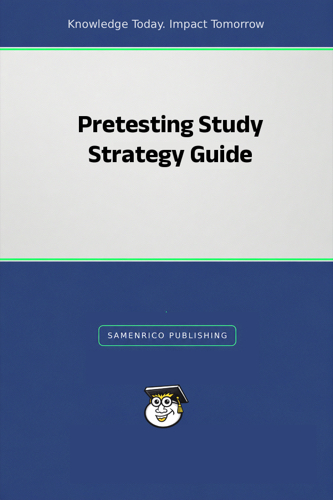
Pretesting Study Strategy Guide eBook
Attempt to recall information before learning it t
by Cordova Codi
Attempt to recall information before learning it to prime your brain.
Formats
Free sample
Chapter 1: The Highlighting Trap--You have been lied to about studying.Not maliciously. No one sat in a curriculum meeting and decided to deceive you. But the lie is everywhere, baked into every study guide, every “how to succeed in school” pamphlet, every well-meaning tutor who told you to read the chapter twice and highlight the important parts.The lie is this: Learning first, testing later is the correct order.It feels right, doesn’t it? Why would you test yourself on something you haven’t learned yet? That would be like taking a driving test before ever sitting behind the wheel.
It’s nonsensical. It’s inefficient. It’s embarrassing to fail at something you haven’t even studied.Everything you’ve been taught about studying has reinforced this sequence. Read the chapter. Take notes.
Review the notes. Then—and only then—quiz yourself. The quiz is the final step, the verification that learning has occurred. It’s the receipt you get after purchasing knowledge.What if the receipt came first? What if the quiz wasn’t the end of learning but the beginning?This chapter will dismantle the most common—and most comforting—study habits of the past fifty years: re-reading, highlighting, and summarization.
You will discover that the study methods that feel most productive are often the least effective. You will confront the uncomfortable truth that your brain is a terrible judge of its own learning. And you will be introduced to a simple, counterintuitive strategy that turns everything you know about studying upside down.But first, we need to talk about a medical student named Sarah.The Harvard Anatomy Lesson Sarah was a third-year medical student at Harvard when she walked into her anatomy practical exam feeling genuinely prepared. She had spent forty-seven hours studying for this exam—more than any previous test in her academic career. Her method was meticulous.
She had read each of the twelve assigned chapters twice. She had highlighted key structures in three colors: red for arteries, blue for veins, yellow for nerves. She had created handwritten summaries of every body region, fifteen pages in total. She had reviewed those summaries three times in the forty-eight hours before the exam.When the proctor said “begin,” Sarah walked to the first station. A cadaveric specimen with a pin in a small muscle near the shoulder.
“Identify the structure indicated by the pin.”Sarah stared at the muscle. She knew she had seen it. She had highlighted it. She had written its name in her summary. But the name would not come.
The letters felt stuck behind a door in her brain that would not open. She moved to the next station. A nerve in the forearm. Same feeling. Same stuck door.
By station five, her hands were shaking. By station ten, she was guessing. By station fifteen, she was silently crying.She failed. Not by a small margin. By a catastrophic one.Here is what Sarah told the academic advisor afterward: “I don’t understand.
I studied harder than anyone I know. I read everything twice. I highlighted everything important. I made summaries. I reviewed.
How could I fail?”The advisor asked a simple question: “When did you quiz yourself?”Sarah paused. “I didn’t. I reviewed my summaries. I re-read my highlights. But I didn’t… I mean, I hadn’t learned it yet.
Why would I quiz myself before I learned it?”That pause—that honest, confused pause—is the entire problem in one sentence. Sarah believed, with complete sincerity, that quizzing is something you do after learning. She believed that re-reading and highlighting were studying. She believed that because the pages felt familiar, the information must be in her head.She was wrong about all of it.The Fluency Illusion: Why Familiarity Is Not Memory Sarah fell victim to what cognitive psychologists call the fluency illusion. This is the brain’s dangerous tendency to mistake the ease of processing text for genuine understanding.
When you read a sentence smoothly, without stumbling over words or concepts, your brain signals “I know this.” When you see a highlighted passage you’ve read before, the familiarity feels like mastery.But here’s the cruel trick: familiarity is not retrieval. Your brain can recognize a face without being able to name the person. Your brain can recognize a passage you’ve read without being able to recall a single fact from it. Recognition and recall are two entirely different cognitive processes, powered by different neural circuits, and only one of them—recall—predicts actual learning.Think about the last time you watched a movie with a complex plot. You understood every scene as it happened.
The dialogue made sense. The cause-and-effect was clear. But a week later, could you describe the plot to a friend? Probably not in detail. The fluency you experienced during viewing did not translate into durable memory.
You recognized each scene in the moment, but you could not recall the sequence afterward.This is the fluency illusion in action. Your brain is excellent at processing information in real time. It is much less excellent at storing that information for later retrieval. The two abilities are not the same. Yet students constantly confuse them.
“I understood it when I read it” becomes “I know it” becomes a failing grade.The research on this is sobering. In a classic study by Roediger and Karpicke (2006), students read a passage and then either re-read it or took a recall test. One week later, the students who had simply re-read the passage remembered only 40% of the information. The students who had taken a recall test—who had forced themselves to retrieve the information without looking—remembered 60%. That’s a 50% improvement from a single test.But here is the most disturbing finding from that study: when asked to predict their future performance, the re-reading group was more confident than the testing group.
They felt like they had learned more, even though they had learned less. The fluency illusion had fooled them completely.The Australia Capital Test Let me prove this to you directly. I want you to experience the fluency illusion in real time, then experience its opposite.Here is a sentence. Read it once, carefully: The capital of Australia is Canberra.Got it? Good.
Now, without looking back, write down the capital of Australia.Most people can do this immediately after reading. But the question is not whether you can recall it one second later. The question is whether you can recall it one week from now, or one month from now, or in the middle of an exam when you are stressed and tired.Now try a different approach. Before I tell you the capital, I want you to attempt to recall it. Do not look anything up.
Just guess.What is the capital of Australia?If you are like 85% of people who have never studied Australian geography, you guessed Sydney. A smaller number guess Melbourne. A very small number guess Perth or Brisbane. Almost no one guesses Canberra on the first try unless they already know it.Now I will tell you: The capital of Australia is Canberra.Here is what just happened in your brain.…
This is the end of the free sample. Get the eBook to keep going. Buy now
About this book
Details
- Author
- Cordova Codi
- Publisher
- SamEnrico
- Language
- English
- Genre
- Non-Fiction, Self-Help, Priming
- Released
- 2026-06-10
- Pages (approx.)
- 148
- Available as
- eBook, Audiobook

Read better in the ZLOADR app
Your eBooks on your phone or tablet. Sign in with your SamEnrico account and start reading.
More by Cordova Codi
 Pre Learning Sleep BenefitsCordova Codi$11.99
 Testosterone and Skin HealthCordova Codi$11.99
 Nairobi Cryptocurrency Exchange GuideCordova Codi$11.99
 Polio Vaccine Race Against ParalysisCordova Codi$11.99
 The Silk Road Reborn: Rediscovering Central Asia's Forgotten FrontiersCordova Codi$11.99
 The Last Voyage of the SS United States: A Race Against TimeCordova Codi$11.99
 Head of Research and InnovationCordova Codi$11.99
 All Hands Meeting Global GuideCordova Codi$12.99
 Cooperative Turnaround GuideCordova Codi$12.99
 How to Become a Building InspectorCordova Codi$11.99
 Understanding ChemodectomaCordova Codi$17.99