
Non-FictionProfessional's Cheat SheetMedia RelationsProfessional's Cheat Sheet / Quotes
Press Release Quote Guide eBook
undefined
undefined
Formats
Free sample
Chapter 1: The Wah Wah Wah Syndrome...--–- Most press release quotes are not merely ignored. They actively annoy the very people you are trying to reach. This is the first and most brutal truth this book will teach you, and coming to terms with it is the difference between getting quoted and getting deleted.Imagine a journalist named Sarah. She has been a reporter for eleven years. She covers the technology beat for a respected national outlet.
Every single day, her inbox receives between 150 and 200 press releases. She ignores most of them. But occasionally, a subject line catches her eye. A company she has been following. A product that seems genuinely new.
A data point that feels important.She opens the release. She scans the headline. She reads the first paragraph. She is still interested. Then she scrolls down to the quote.And then she sighs.Because what she finds, 90 percent of the time, is this: “We are thrilled to announce this exciting new partnership, which represents a significant milestone for our company as we continue to deliver innovative solutions to our valued customers.”She closes the release.
She moves on to the next email. She does not write the story.This is not because she is lazy. It is not because she dislikes the company. It is because the quote added absolutely nothing to her understanding of the news. It was a collection of empty adjectives strung together by corporate verbs.
It was, in a word, meaningless.This chapter is called “The Wah Wah Wah Syndrome” for a reason. If you have ever watched the classic Peanuts cartoons, you know the sound: whenever an adult speaks to Charlie Brown, all he hears is “Wah wah wah wah wah.” The words are there. The mouth is moving. But there is no meaning. No signal.
Just noise.That is what your quote sounds like to a journalist if you write it the way most companies do.And the problem is not that you are bad at writing. The problem is that you have been taught to write quotes for the wrong audience, using the wrong metrics, with the wrong goal in mind.This book will fix all of that. But first, we have to understand the full scope of the problem. Because until you accept how badly most quotes fail, you will never have the motivation to write one that succeeds.The Data That Should Terrify You Let us start with numbers, because numbers do not lie. In a comprehensive study conducted by Greentarget, a public relations research firm, researchers analyzed the reading habits of 550 journalists across print, broadcast, and digital media.
The findings were devastating for anyone who has ever written a press release quote.Fifty percent of journalists reported that the quotes they receive in press releases feel “unnatural.” Not just a little awkward. Actively unnatural. As if the person speaking had never actually spoken to another human being before.Thirty-four percent of journalists said the quotes were “insubstantial.” That is PR-speak for “there is nothing there.” No news. No insight. No reason to include the quote in an article.But the most damning statistic came from a follow-up question.
When journalists were asked what they did with quotes that felt unnatural or insubstantial, 72 percent said they simply deleted them. Not rephrased them. Not paraphrased them. Deleted them entirely.Think about that for a moment. Nearly three out of every four quotes you send to the media are being erased before the journalist finishes reading the paragraph.
They are not being quoted. They are not being adapted. They are being removed from existence.And yet, companies continue to write quotes exactly the same way. They spend hours crafting the perfect press release. They obsess over the headline.
They fact-check the lede. And then they slap a generic quote at the bottom as if it were an afterthought.In reality, the quote is the first thing many journalists skip. Or the only thing they read. Or the thing that makes them decide whether to trust you.The problem is not that journalists are hostile to quotes. The problem is that journalists are hungry for good quotes.
They need them. A news article without a single quote is a press release. A news article with a great quote is a story.The difference between those two things is the difference between coverage and silence.The Trust Gap: Why Reporters Prefer Their Own Interviews Here is another uncomfortable truth: most journalists would rather conduct their own interview than use your quote. Even if your quote is well-written. Even if it is accurate.
Even if it perfectly captures the sentiment of the announcement.Why?Because they do not trust you.This is not personal. It is structural. The relationship between a journalist and a source is built on independence. A reporter wants to ask their own questions, hear the answers in real time, and judge for themselves whether the speaker is being evasive, enthusiastic, or candid.When you hand a journalist a pre-written quote, you are removing all of that. You are giving them a finished product, like a frozen dinner instead of a home-cooked meal.
It might be nutritious. It might taste fine. But it was not made for them, and they know it.The trust gap is even wider when the quote is obviously written by a committee. You have seen these quotes. They are the ones that use perfect grammar, complete sentences, and no contractions.
They sound like a robot reading a legal document. They contain phrases like “leverage our core competencies” and “deliver a best-in-class experience.”No human being talks like that. And journalists know it.So they do the only thing they can do: they ignore your quote and ask for an interview. Or they ignore your quote and write the story without it. Or they ignore your quote and move on to the next pitch.The solution to the trust gap is not to stop sending quotes.
The solution is to send quotes that sound like they came from a human being who was actually speaking. That means contractions. That means sentence fragments. That means the occasional “um” edited out but the energy kept in.It also means writing quotes that add something the journalist could not get from reading the rest of the release. If your quote only repeats the headline, the journalist learns nothing new.
If your quote adds context, implications, or a contrarian perspective, the journalist suddenly has a reason to include it.We will spend the rest of this book teaching you exactly how to do that. But first, we have to talk about what happens when you fail.The Sound of Silence: The Cost of Generic Quotes You might be thinking, “So what if journalists delete my quotes? They still have the facts. They can still write the story.”This is a dangerous assumption. And it is wrong.When a journalist deletes your quote, they are not just removing a few sentences.
They are removing your voice from the story. They are removing your perspective. They are removing the one element of the press release that carries emotional weight and human…
This is the end of the free sample. Get the eBook to keep going. Buy now
About this book
Details
- Author
- Delagarza Jonie
- Publisher
- SamEnrico
- Language
- English
- Genre
- Non-Fiction, Professional's Cheat Sheet, Media Relations, Professional's Cheat Sheet / Quotes
- Released
- 2026-06-07
- Pages (approx.)
- 134
- Available as
- eBook, Audiobook

Read better in the ZLOADR app
Your eBooks on your phone or tablet. Sign in with your SamEnrico account and start reading.
More by Delagarza Jonie
 Flow State for SurgeonsDelagarza Jonie$11.99
 Remote Work Email BatchingDelagarza Jonie$11.99
 Supply Forecasting MethodsDelagarza Jonie$11.99
 Gambling Addiction for Truck DriversDelagarza Jonie$11.99
 The Boy Thief of Victorian London: The Dark Tale of James 'Jimmy' the WeaselDelagarza Jonie$11.99
 NOC AnalystDelagarza Jonie$11.99
 Learn to Play the SanshinDelagarza Jonie$11.99
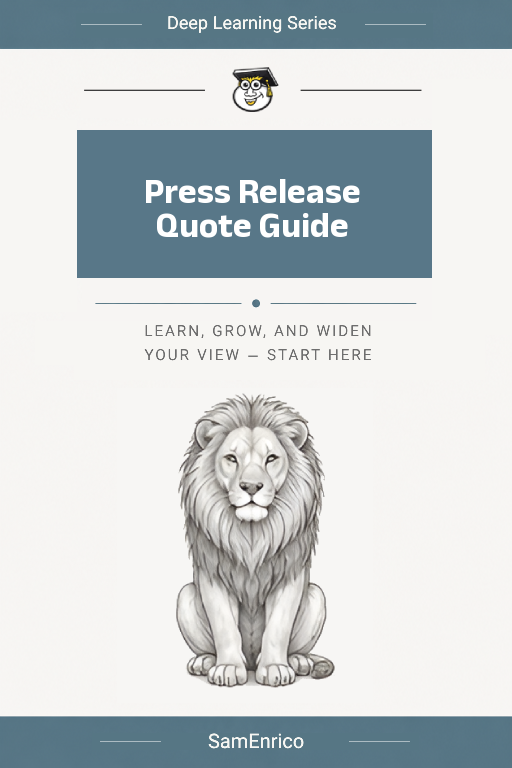 Press Release Quote GuideDelagarza Jonie$12.99
 How to Start a Boxes Made of Aluminium Business (Beginners Guide)Delagarza Jonie$11.99
You may also like
 Hong Kong Handover 1997Dunn Johnnie$11.99
 Zumba For Postnatal Recovery CourseNeal Christian$11.99
 Zumba for BeginnersLadner Nikia$11.99
 YouTube Comment Mining GuideHumes Pandora$12.99
 Worry Box MeditationCarlin Rudy$11.99
 Workplace Stress MeditationNguyen Lynn$11.99
 Workplace Stress and Sleep RepairHawley Ivory$11.99
 Workplace Perfectionism CureDelaney Jeffry$11.99
 Workplace Injustice Anger GuideWallen Isabelle$11.99
 Work Addiction and Burnout LinkGreenwood Ester$11.99
 Women in Yoga and WellnessBeattie Galina$11.99
 Women in Stand Up ComedyChun Evangeline$11.99