
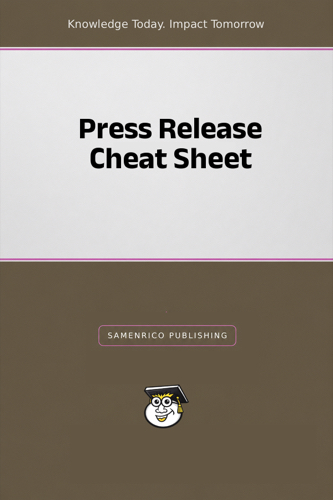
Non-FictionProfessional's Cheat Sheet / PR
Press Release Cheat Sheet eBook
Provides templates, formatting rules, and distribu
Provides templates, formatting rules, and distribution tips for media pickup.
Formats
Free sample
Chapter 1: The Invisible Graveyard--–- Every morning, before most authors have finished their first cup of coffee, roughly thirty-seven thousand press releases land in the inboxes of journalists across the United States. By noon, thirty-six thousand of them will have been deleted without being read. Some will be flagged as spam. Some will be skimmed for two seconds and discarded. A handful—fewer than one percent—will survive long enough to be considered.
And of those, only a tiny fraction will ever become actual news stories, radio interviews, or television segments.This is the invisible graveyard of unread press releases. It is where most book announcements go to die, unnoticed and unmourned, buried under the weight of the journalist's delete key.If you are reading this book, you have probably already contributed to this graveyard. Perhaps you sent a press release announcing your new book to a list of fifty journalists. Perhaps you paid a wire service three hundred dollars to distribute it more broadly. Perhaps you waited by your email for days, refreshing your inbox, expecting coverage that never came.
Perhaps you blamed the journalists for being rude, or the wire service for being ineffective, or the world for being unfair.The problem was none of those things.The problem was that your press release was not a press release at all. It was an announcement. And announcements, as you are about to learn, are not news.This chapter is called The Invisible Graveyard because that is where most book announcements end up. But it is also called that because the journey out of the graveyard begins with understanding why you are there in the first place. Before you write a single word of your press release—before you choose a headline, before you format your dateline, before you upload a single image—you must understand the single most important principle in all of public relations:Your book is not the story.Let me say that again, because it is the foundation upon which everything else in this book is built, and because most authors never truly believe it until they have wasted months or thousands of dollars learning the hard way.Your book is not the story.
Your book is a product. And journalists do not write about products. They write about stories that matter to their audiences.This chapter will teach you how to find the story that is hiding inside your book. It will introduce you to the Hook Framework, a systematic method for transforming any book announcement into something journalists actually want to publish. It will give you seven specific news hooks that work in the current media environment, drawn from analysis of thousands of successful press releases.
It will teach you the So What Test, a brutal self-editing tool that separates amateurs from professionals. And it will introduce you to the concept of the micro-audience—the single most effective targeting strategy that almost no one uses correctly.By the end of this chapter, you will never look at your book the same way again. More importantly, journalists will never look at your press release the same way again. Because you will no longer be sending them an announcement. You will be sending them a story.The Seven Graveyard Mistakes Before we build the framework that will rescue your press release from the invisible graveyard, we must first understand why so many releases end up there in the first place.
Based on an analysis of more than two thousand rejected press releases—those that received zero media pickup despite being distributed—the following seven mistakes account for nearly ninety percent of all failures.The first mistake is leading with the book title. The vast majority of press releases begin with something like this: "Author John Smith is pleased to announce the release of his new book, 'The Ultimate Guide to Everything.'" From the journalist's perspective, this is the equivalent of walking into a room and shouting your own name. It signals that you are focused on yourself, not on what you can offer their readers.The second mistake is writing for the author instead of the audience. Phrases like "labor of love," "passion project," and "years in the making" are meaningless to journalists. They describe the author's emotional experience, not the reader's benefit.
A journalist does not care how hard you worked. They care whether their audience will care.The third mistake is burying the lede. Somewhere inside your press release, there is probably a genuinely interesting fact, statistic, or story. But it is likely buried in the fifth paragraph, after four paragraphs of throat-clearing and self-congratulation. Journalists will never find it because they will never read that far.The fourth mistake is writing for everyone.
A press release that tries to appeal to all possible audiences appeals to none. Journalists have specific beats—technology, parenting, finance, books, lifestyle—and they delete anything that does not directly relate to their beat. A release about a memoir that mentions mental health might interest a psychology blogger, but only if the release is written specifically for that blogger. The same release written in generic terms will be deleted by everyone.The fifth mistake is using hype words. "Exciting," "groundbreaking," "revolutionary," "unprecedented"—these words have been used so many times that they now signal the opposite of what they intend.
When a journalist sees "exciting new book," they read "boring book that the author cannot describe concretely."The sixth mistake is forgetting the journalist's constraints. The average journalist receives more than two hundred pitches per day. They have approximately five seconds to decide whether to read or delete. They are almost always behind deadline, underpaid, and overworked. Most press releases are written as if the journalist has unlimited time and boundless curiosity.
They do not.The seventh mistake is treating the press release as the final destination rather than the vehicle. A press release does not exist to be read in full. It exists to be mined for quotes, facts, and angles that a journalist can turn into their own story. The best press releases are those that can be copy-pasted directly into an article with minimal editing.If any of these seven mistakes feel familiar, do not be discouraged. Nearly every author makes them, and nearly every author learns about them only after wasting time and money.
The purpose of this book is to ensure that you never make them again.The Hook Framework The solution to the seven graveyard mistakes is the Hook Framework. This is a systematic method for identifying, testing, and refining the newsworthy angle inside any book. The framework has three steps, and it must be completed before you write a single word of your press release.Step one is to generate possible hooks. A hook is the answer to the question: why would a journalist's audience care about this book right now? Not in general.
Not someday. Right now. The hook is the specific, timely, audience-centered reason that this book matters at this particular moment.Step two is to test each hook against the So What Test, which you will learn in detail later in this chapter. The So What Test asks…
This is the end of the free sample. Get the eBook to keep going. Buy now
About this book
Details
- Author
- Flemming Leana
- Publisher
- SamEnrico
- Language
- English
- Genre
- Non-Fiction, Professional's Cheat Sheet / PR
- Released
- 2026-06-07
- Pages (approx.)
- 151
- Available as
- eBook, Audiobook

Read better in the ZLOADR app
Your eBooks on your phone or tablet. Sign in with your SamEnrico account and start reading.
More by Flemming Leana
 Unexpected Departure Workflow Recovery GuideFlemming Leana$11.99
 Arthritis Meditation GuideFlemming Leana$11.99
 Spouse Death and VolunteeringFlemming Leana$11.99
 Uber Quest Bonus OptimizationFlemming Leana$11.99
 Night Owl Acceptance GuideFlemming Leana$11.99
 The Five Minute Urge DelayFlemming Leana$11.99
 Reframing Excitement AnxietyFlemming Leana$11.99
 Foreign Subsidy Regulation FinesFlemming Leana$11.99
 The Great Unbinding: When Rome’s Senate Faced a RecallFlemming Leana$11.99
 The Last Radio Station: How a Tiny Town Saved a Dying ArtFlemming Leana$11.99
 How to Produce Bar FurnitureFlemming Leana$11.99
 How to Become a Data Communications AnalystFlemming Leana$11.99
You may also like
 Hong Kong Handover 1997Dunn Johnnie$11.99
 Zumba For Postnatal Recovery CourseNeal Christian$11.99
 Zumba for BeginnersLadner Nikia$11.99
 YouTube Comment Mining GuideHumes Pandora$12.99
 Worry Box MeditationCarlin Rudy$11.99
 Workplace Stress MeditationNguyen Lynn$11.99
 Workplace Stress and Sleep RepairHawley Ivory$11.99
 Workplace Perfectionism CureDelaney Jeffry$11.99
 Workplace Injustice Anger GuideWallen Isabelle$11.99
 Work Addiction and Burnout LinkGreenwood Ester$11.99
 Women in Yoga and WellnessBeattie Galina$11.99
 Women in Stand Up ComedyChun Evangeline$11.99