
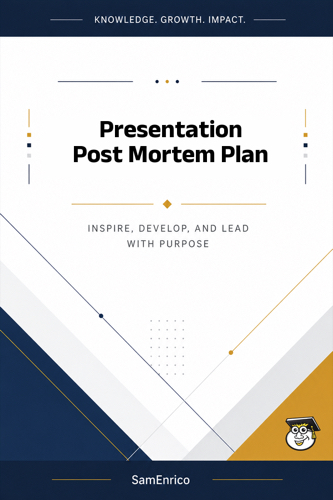
Presentation Post Mortem Plan eBook
Schedule reflection after talk to separate learnin
Schedule reflection after talk to separate learning from self judgment.
Formats
Free sample
Chapter 1: The Replay Trap--You have just finished a presentation. The room is emptying. People are approaching you with polite smiles and generic compliments. Nice job. Great points.
Really interesting. You smile back, shake hands, collect your materials, and walk to your car or your office or your hotel room. And then it begins. The replay. The mental videotape that starts at the beginning and runs through every moment, pausing on the parts where you stumbled, rewinding to the question you answered poorly, zooming in on the faces of people who looked bored or confused or skeptical.
By the time the replay is finished, you have transformed a presentation that was probably fine into a disaster that proves something terrible about your competence, your preparation, and your future.This is the replay trap. The very thing that could help you improve—reflecting on your performance—is the thing that causes you the most pain. And because it causes pain, you avoid it. Or you do it badly, in ways that reinforce your worst fears about yourself. Or you do it obsessively, in ways that consume hours of your life without producing any useful insight.
The replay trap is the reason most presenters never truly learn from their experiences. They are too busy being haunted by them.The Anatomy of the Mental Replay Let us look more closely at what happens during the replay. Your brain is not conducting an objective review. It is not weighing evidence or balancing positives against negatives. It is doing something much more primitive.
It is scanning for threats.The moments that replay most vividly are the moments that felt dangerous. The question you could not answer felt dangerous because it threatened your credibility. The slide that would not advance felt dangerous because it threatened your control over the room. The joke that landed flat felt dangerous because it threatened your connection with the audience. The person who left early felt dangerous because it threatened your sense of being interesting or valuable.These moments replay because your brain has labeled them as threats.
From an evolutionary perspective, this is a feature, not a flaw. The caveperson who remembered the rustling in the bushes that turned out to be a predator survived. The caveperson who remembered the beautiful sunset did not. Your brain is wired to prioritize negative experiences because negative experiences are more likely to kill you.But here is the problem. A presentation is not a predator.
The stakes, while they may feel life-or-death in the moment, are not actually life-or-death. Your brain is applying a threat-detection system designed for the African savanna to a conference room in the twenty-first century. The mismatch between the system and the situation is enormous. You are not being objective when you relive your presentation. You are being biological.The Negativity Bias in Action The negativity bias is one of the most well-documented phenomena in psychology.
In study after study, researchers have found that negative events are more memorable, more emotionally intense, and more influential on future behavior than positive events of equal magnitude. A single criticism can outweigh a dozen compliments. One mistake can overshadow an hour of solid performance. A moment of embarrassment can linger for years, while moments of triumph fade within days.This bias operates automatically, without your conscious awareness. You do not choose to remember the bad moments more vividly.
It just happens. And because it happens without your permission, it feels like objective reality. The replay feels like an accurate record of what happened. But it is not. It is a distorted record, weighted toward the negative, amplified by your brain's survival mechanisms, and stripped of the context that would make it useful.Consider a simple experiment.
Recall your last three presentations. For each one, write down the first three moments that come to mind. Chances are, at least two of the three moments for each presentation are negative. The moment you forgot a point. The moment someone asked a question you could not answer.
The moment you noticed someone checking their phone. The positive moments—the engaged nod, the laugh at the right time, the person who thanked you afterward—will come later, if they come at all.This is not a sign that your presentations are mostly bad. It is a sign that your brain is doing exactly what evolution designed it to do. The replay trap is not your fault. It is biology.Reflection vs.
Rumination: The Critical Difference The replay trap would be less harmful if the replay led to learning. But it rarely does. Most post-presentation thinking falls into a category that psychologists call rumination, not reflection. The difference between these two is the single most important distinction in this entire book.Reflection is productive. It leads to insight.
It produces aha moments. It helps you understand what happened and why. It generates specific, actionable lessons that you can apply next time. Reflection leaves you feeling energized, curious, and motivated to improve. Reflection asks, What can I learn?Rumination is destructive.
It produces shame, guilt, and anxiety. It loops endlessly without resolution. It focuses on what you should have done differently without generating a clear path forward. Rumination leaves you feeling exhausted, defeated, and less confident than when you started. Rumination asks, What is wrong with me?The difference is not in the content of your thoughts.
You can think about the same mistake reflectively or ruminatively. The difference is in the structure. Reflection is focused, time-bound, and goal-oriented. Rumination is diffuse, open-ended, and emotion-driven. Reflection has a beginning, a middle, and an end.
Rumination is a loop.Here is an example of the same event processed two ways. The event: you stumbled over the transition between slides three and four. Rumination: I am so stupid. I always mess up the transitions. Everyone noticed.
They probably think I am incompetent. I should have practiced more. Why do I always do this? I am never going to be a good presenter. Reflection: I stumbled on that transition.
Why did that happen? Because I had not rehearsed that specific transition enough. What can I do differently next time? I will rehearse transitions specifically, not just the content. I will practice with the actual slide clicker.
I will slow down between slides.Notice the difference. Rumination is about your worth as a person. Reflection is about your behavior. Rumination uses words like stupid, always, and never. Reflection uses words like because, what, and next time.
Rumination leads to shame. Reflection leads to action.The post-mortem process in this book is designed to convert rumination into reflection. It gives your brain a structure, a container, a set of questions to answer. It channels the natural energy of post-presentation thinking into productive channels rather than letting it spiral into self-judgment.Why Most Post-Presentation Debriefs Fail If you have ever tried to debrief a presentation with yourself or with a colleague, you have probably experienced one of the common failure modes. These failures are not accidents.
They are the predictable result of a missing structure.The blame game is the most common failure mode. You spend the whole time assigning fault. You were too quiet. The…
This is the end of the free sample. Get the eBook to keep going. Buy now
About this book
Details
- Author
- Rinehart Dorthea
- Publisher
- SamEnrico
- Language
- English
- Genre
- Non-Fiction, Mental Wealth, After Action
- Released
- 2026-06-09
- Pages (approx.)
- 123
- Available as
- eBook, Audiobook

Read better in the ZLOADR app
Your eBooks on your phone or tablet. Sign in with your SamEnrico account and start reading.
More by Rinehart Dorthea
 The Remote Feedback GuideRinehart Dorthea$11.99
 Valorant Ranked AnxietyRinehart Dorthea$11.99
 Food Diary For IBDRinehart Dorthea$11.99
 The Bloodhound of the Gold Coast: A K9 Detective and the Rise of Organized Crime in SydneyRinehart Dorthea$11.99
 Operational Transfer Pricing ManagerRinehart Dorthea$11.99
 Construction Climate Delay InsuranceRinehart Dorthea$12.99
 How to Produce Acrylic LaTeX CaulkRinehart Dorthea$11.99
 How to Become a Highway-maintenance WorkerRinehart Dorthea$11.99