
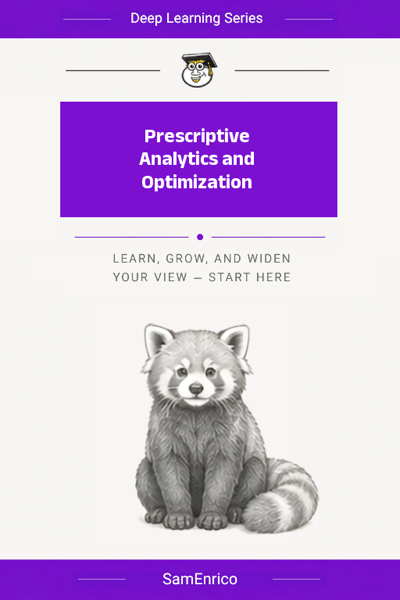
Prescriptive Analytics and Optimization eBook
A Coursebook on Prescriptive Analytics and Optimiz
A Coursebook on Prescriptive Analytics and Optimization
Formats
Free sample
Chapter 1: The Prediction Trap--In the summer of 2019, two logistics companies sat across from the same set of numbers. Both had built sophisticated forecasting models. Both predicted a 15 percent surge in holiday demand. Both presented their findings to leadership with confidence. And then they diverged completely.The first company, let us call them Logi Co, did what most organizations do after a forecast: they acted on the prediction directly.
They hired temporary workers based on the projected volume. They leased extra trucks. They increased inventory at their primary distribution centers. Their logic was straightforward and, on the surface, entirely reasonable. The forecast said demand would rise by 15 percent, so they scaled their operations by 15 percent.The second company, which we will call Opti Flo, did something different.
They looked at the same forecast and asked a harder question: "We know what is coming, but what should we do about it?" They built a prescriptive model that specified not just how much to scale, but where to place each temporary worker, which routes to reassign, which contingency plans to activate, and which suppliers to prioritize. They optimized across dozens of variables that Logi Co had left to intuition: the trade-off between warehouse overtime and third-party carriers, the cost of holding safety stock versus the risk of stockouts, the marginal value of an extra driver in Chicago versus Atlanta.The holiday season arrived. Demand did indeed surge by roughly 15 percent. Logi Co survived. Their warehouses were chaotic but functional.
Their drivers worked mandatory overtime. Their margins eroded by 8 percent due to inefficiencies and emergency spending. The CEO called it "a tough but successful season."Opti Flo had its best quarter in company history. Revenue increased by 22 percent. Margins expanded by 4 percent.
Customer complaints dropped by 30 percent. They did not have more trucks or better forecasts than Logi Co. They had the same prediction and worse weather in two regions. What they had was a decision engine that turned a forecast into an action plan.This book is about building that engine.The Hidden Cost of Prediction Addiction Let me start with an uncomfortable truth that most analytics professionals will whisper but rarely say aloud: prediction has become an addiction, and it is costing you money.We live in an era of forecasting fetishism. Organizations pour millions into predictive models that tell them what will happen.
They hire data scientists to build sophisticated time series forecasts, machine learning classifiers, and deep learning predictors. They celebrate when a model achieves 95 percent accuracy. They frame these predictions on metaphorical walls as trophies of analytical sophistication.But prediction alone does not make decisions. Prediction tells you the weather. Prescription tells you whether to pack an umbrella, cancel the picnic, or reschedule the outdoor wedding.
Prediction is a forecast of demand. Prescription is a production schedule, a staffing plan, and an inventory allocation.The gap between these two is where value is lost or captured.Consider a study published in the MIT Sloan Management Review that analyzed 287 organizations across fifteen industries. Researchers found that companies with world-class predictive capabilities were only 8 percent more profitable than average. But companies with world-class prescriptive capabilities were 38 percent more profitable. The difference was not in knowing the future.
The difference was in acting on it optimally.This gap exists because prediction and prescription require fundamentally different mindsets. Prediction asks, "What is likely to happen?" This is a passive, observational orientation. It treats the future as something to be anticipated but not shaped. Prescription asks, "What should we do?" This is an active, interventionist orientation. It treats the future as something to be engineered within the constraints of reality.Most organizations have built impressive prediction machines and then handed the outputs to humans who guess at the next step.
Those humans are smart, well-intentioned, and systematically suboptimal.The Anatomy of a Decision To understand why prescriptive analytics matters, we must first understand what a decision actually is. This sounds trivial, but the word "decision" is used so loosely in business that it has lost its sharp edges.A decision, in the sense used throughout this book, has three irreducible components.First, there must be a choice. If there is only one possible action, you are not deciding; you are complying. Many business problems that feel like decisions are actually executions of predetermined rules. "Should we ship the order?" when the customer has already paid and the product is in stock is not a decision.
It is a process.Second, there must be uncertainty about which choice is best. If you know with certainty that Option A dominates Option B on every dimension, you are not deciding; you are calculating. Real decisions exist in the space where trade-offs are real and information is incomplete.Third, the choice must matter. The distinction between a 1 percent and 2 percent improvement in a $10,000 process is not a decision; it is an optimization detail. The distinction between a 10 percent and 20 percent improvement in a $10 million process is a decision worth analyzing.This definition comes from the work of Herbert Simon, a Nobel laureate who spent his career studying how humans actually make choices.
Simon proposed a three-stage model of decision-making that remains the foundation of prescriptive analytics nearly seventy years later.Stage one: Intelligence. This is the work of identifying that a decision must be made. Something has changed. A gap has emerged between current reality and a desired state. A competitor has lowered prices.
A machine has broken. A new regulation has been announced. Intelligence is the radar system that detects decision opportunities.Stage two: Design. This is the work of generating possible courses of action. What could we do?
What are the levers we can pull? Most organizations shortchange this stage dramatically. They default to the first plausible option or the option that worked last time. Design requires creativity, divergent thinking, and a willingness to consider uncomfortable alternatives.Stage three: Choice. This is the work of selecting among the designed alternatives.
Which one is best? By what criteria? Choice is where prescriptive analytics provides the most leverage, but it cannot compensate for failures in intelligence or design. A perfect choice among bad options is still a bad outcome.Most analytics efforts focus almost exclusively on the choice stage. They assume that the decision has already been identified (intelligence) and that the options have already been generated (design).
This is like a GPS that assumes you have already decided to drive to Chicago and already chosen the highway; it only tells you which lane to take.Prescriptive analytics at its best participates in all three stages. It helps identify when a decision threshold has been crossed. It helps generate novel alternatives by revealing trade-offs that intuition misses. And it rigorously evaluates those alternatives against stated objectives.The Certainty, Risk, and Uncertainty Spectrum Not all decisions are created equal. The tools you use should depend on the environment in which you are deciding.
Decision theory has long recognized a spectrum of decision environments, and understanding where you sit on this spectrum is the first step toward choosing the right prescriptive method.Certainty is the simplest environment. In a certain environment, you know exactly what will happen when you take an…
This is the end of the free sample. Get the eBook to keep going. Buy now
About this book
Details
- Author
- Gunther Dotty
- Publisher
- SamEnrico
- Language
- English
- Genre
- Non-Fiction, Informative, Educational
- Released
- 2026-06-03
- Pages (approx.)
- 154
- Available as
- eBook, Audiobook

Read better in the ZLOADR app
Your eBooks on your phone or tablet. Sign in with your SamEnrico account and start reading.
More by Gunther Dotty
 The Ignite Talk MethodGunther Dotty$11.99
 Numbness Trigger ActivationGunther Dotty$11.99
 Sustainable Aviation FuelGunther Dotty$11.99
 Sheppard Case Ohio Supreme CourtGunther Dotty$11.99
 Iron Deficiency Recovery GuideGunther Dotty$11.99
 Contamination OCD GuideGunther Dotty$11.99
 Future Pacing Script TemplatesGunther Dotty$11.99
 Forgiveness After AngerGunther Dotty$11.99
 Lightfoot LoriGunther Dotty$11.99
 The Last Patient of Dr. Libby Zion: A Medical System in CrisisGunther Dotty$11.99
 The Hollow Hill's Last Bargain: A Fairy's Cruel PactGunther Dotty$11.99
 The Hollow Ones: The Forgotten Plague of the Black DeathGunther Dotty$11.99