
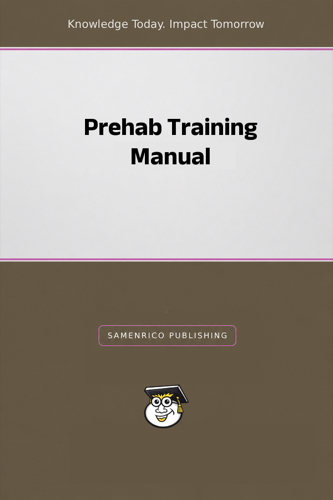
Non-FictionHealth & WellnessPrehabilitation
Prehab Training Manual eBook
Teaches proactive exercises for vulnerable joints
Teaches proactive exercises for vulnerable joints before injury occurs.
Formats
Free sample
Chapter 1: The Rehab Illusion--–- The first time my knee gave out, I was walking up a flight of stairs to my third-floor apartment. No warning. No twist, no jump, no heavy landing. Just a dull pop followed by a collapse that sent me crashing onto the concrete steps, my groceries rolling down to the landing below. I sat there for a full minute, stunned, waiting for the sharp pain that never came.
Instead, I felt something worse: confusion. How could a thirty-two-year-old who ran three times a week and had never been overweight lose the ability to climb stairs?The answer, I would learn over the following months of doctor visits, MRIs, physical therapy sessions, and eventually surgery, was not that I had done something wrong. It was that I had done nothing at all. I had ignored the whispers until my body was forced to scream.This book exists because that experience taught me a brutal truth that most of us learn too late: waiting for pain is a losing game. The traditional approach to joint health—hurt first, fix second—is not just inefficient.
It is a lie we have been sold by a medical system designed to treat crises, not prevent them. This chapter will dismantle that illusion and introduce you to a radically different way of thinking about your body: prehab.The 80% Reality Check Let us start with a number that should stop you cold. Among adults who do not perform any form of proactive joint maintenance, 80 percent will experience debilitating back pain by the age of fifty. Not mild stiffness. Not occasional twinges.
Debilitating pain—the kind that forces you to miss work, stop exercising, and rely on others for basic tasks like tying your shoes or lifting your grandchildren.I want you to sit with that number for a moment. Eighty percent. That means if you are in a room with five people who ignore their joint health, four of them will eventually suffer a back injury serious enough to disrupt their lives. The fifth person? They are not lucky.
They are simply not there yet.Here is what the fitness industry and the medical establishment will not tell you: the vast majority of these injuries are preventable. Not manageable. Not treatable. Preventable. The research is unequivocal on this point.
A 2018 systematic review published in the British Journal of Sports Medicine analyzed thirty-five studies on injury prevention programs and found that targeted prehab protocols reduced non-contact injury rates by 36 to 52 percent across multiple sports and populations. Another landmark study following 1,500 military recruits—a population subjected to extreme physical demands—found that those who performed a fifteen-minute daily prehab routine had 71 percent fewer stress fractures and 44 percent fewer overuse injuries than the control group.Let me translate that into human terms. Half of the pain, suffering, medical bills, surgeries, and lost time experienced by otherwise healthy people could be eliminated simply by starting before the injury occurs.Yet almost no one does it.The Medical Model: Built for Crisis, Not Prevention Why is this the case? To answer that question, we need to understand the fundamental flaw in how we think about healthcare. The traditional model looks like this:Hurt → Scan → Diagnose → Treat → Rehab → (Maybe) Recovery Notice what is missing from this sequence.
Prevention is not even an afterthought. It is an absence. The system is designed to activate only after you have already crossed the threshold from healthy to injured. And once you cross that threshold, everything changes: the timeline, the cost, the emotional toll, and the long-term prognosis for your joint.Consider the economics first. The average MRI for a knee or shoulder costs between $1,500 and $3,500.
A single physical therapy session runs $75 to $200, and the typical course of treatment is twelve to twenty sessions. Corticosteroid injections are $100 to $500 each, and their effects are temporary. Surgery? A rotator cuff repair averages $15,000 to $30,000. A single ACL reconstruction with rehabilitation can exceed $50,000.Now compare that to the cost of prehab.
A set of resistance bands: fifteen dollars. A foam roller: twenty dollars. A yoga mat: twenty-five dollars. That is sixty dollars total—less than a single copay for a specialist visit. And you can use these tools for years.But the economic argument, while compelling, misses the deeper point.
The real cost of waiting for pain is not financial. It is the slow erosion of your relationship with your own body.The Pain Pipeline: How Ignorance Becomes Injury I want to introduce you to a concept I call the Pain Pipeline. It has four stages, and most people do not realize they are in it until they reach stage four.Stage One: Subtle Stiffness. You wake up in the morning and your lower back feels tight for the first fifteen minutes. Or your shoulder clicks when you reach for a coffee mug.
Or your knee feels "weird" after a run, not painful exactly, just off. At this stage, the body is sending its first warning signal. Most people ignore it or dismiss it as "just getting older."Stage Two: Compensatory Patterns. Your body is exceptionally good at solving problems. When one joint is vulnerable, it recruits neighboring joints and muscles to take on the load.
A weak hip? The lower back works harder. A stiff thoracic spine? The shoulder and neck compensate. These compensations are invisible to you but damaging over time.
You might not feel pain at the original site, but you will eventually feel it somewhere else.Stage Three: Chronic Discomfort. This is when the whispers become audible. Pain that is consistently present at a 2 or 3 out of 10. Pain that you can "push through" but that never fully goes away. At this stage, most people reach for over-the-counter anti-inflammatories, ice packs, or heating pads.
They modify their activity slightly—switching from running to the elliptical, lifting lighter weights, skipping the overhead press. They are treating symptoms while the underlying vulnerability worsens.Stage Four: Debilitating Injury. The pop. The tear. The sudden inability to perform a basic movement.
This is the stage that sends you to the doctor, the MRI machine, and eventually the physical therapist. This is when the medical system finally engages. And this is the stage that prehab is designed to prevent entirely.Here is the truth that changed my life: you can intercept the Pain Pipeline at any point before stage four. Stage one and stage two are ideal—you are preventing problems before they manifest. But even if you are already in stage three, with chronic discomfort that you have accepted as normal, prehab can reverse the damage and return you to pain-free movement.
Stage four is where the calculus changes. At stage four, you are no longer preventing injury; you are recovering from one. And while prehab can still help (more on that in a moment), the most powerful application is before the catastrophe.Prehab vs. Rehab: The Critical Distinction These two words sound similar, but they represent fundamentally different philosophies. Let me be precise about the difference.Rehab (rehabilitation) is reactive.
It begins after tissue damage has occurred. Its goal is to restore function to a joint that has already been compromised. Rehab is necessary—I am not…
This is the end of the free sample. Get the eBook to keep going. Buy now
About this book
Details
- Author
- Gilliam Dominique
- Publisher
- SamEnrico
- Language
- English
- Genre
- Non-Fiction, Health & Wellness, Prehabilitation
- Released
- 2026-06-05
- Pages (approx.)
- 149
- Available as
- eBook, Audiobook

Read better in the ZLOADR app
Your eBooks on your phone or tablet. Sign in with your SamEnrico account and start reading.
More by Gilliam Dominique
 Meal Delivery Services ReviewGilliam Dominique$11.99
 The Shamed Child RecoveryGilliam Dominique$11.99
 Asbestos Prevention GuideGilliam Dominique$11.99
 The Silent Heist: Ransomware's War on Latin America's HospitalsGilliam Dominique$11.99
 How to Produce CinchesGilliam Dominique$11.99
 How to Become a Personnel ClerkGilliam Dominique$11.99
 Shea Butter Shelf Life ManagementGilliam Dominique$12.99
 Sales Team LeaderGilliam Dominique$11.99
You may also like
 Hong Kong Handover 1997Dunn Johnnie$11.99
 Zumba For Postnatal Recovery CourseNeal Christian$11.99
 Zumba for BeginnersLadner Nikia$11.99
 YouTube Comment Mining GuideHumes Pandora$12.99
 Worry Box MeditationCarlin Rudy$11.99
 Workplace Stress MeditationNguyen Lynn$11.99
 Workplace Stress and Sleep RepairHawley Ivory$11.99
 Workplace Perfectionism CureDelaney Jeffry$11.99
 Workplace Injustice Anger GuideWallen Isabelle$11.99
 Work Addiction and Burnout LinkGreenwood Ester$11.99
 Women in Yoga and WellnessBeattie Galina$11.99
 Women in Stand Up ComedyChun Evangeline$11.99