
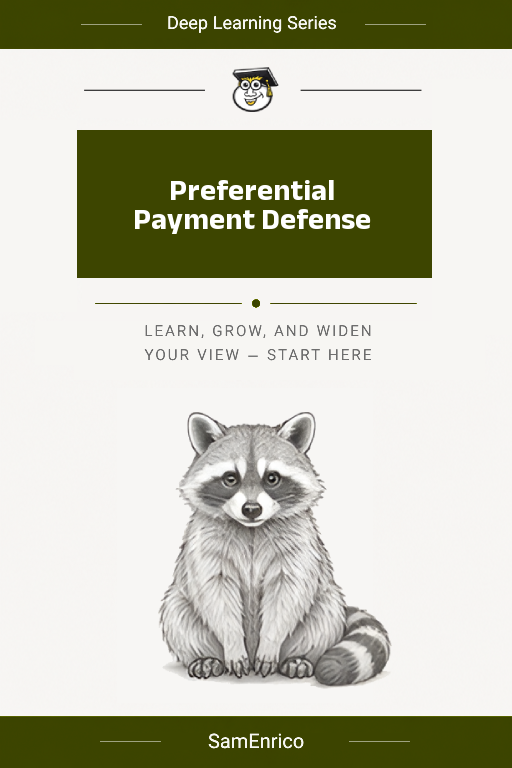
Preferential Payment Defense
Avoid lawsuits for preferential payments by knowin
Avoid lawsuits for preferential payments by knowing Section 547 defenses and timing rules.
Formats
About this book
Free sample
Chapter 1: The Six Bullets--–- The first lesson of preference defense is not about winning. It is about understanding what the other side must prove before you are even allowed to speak. Most creditors lose because they start arguing too early, about the wrong things, without ever realizing that the trustee has already satisfied six elements before the complaint was filed. This chapter dissects those six bullets, element by element, and reveals why fighting insolvency is almost always a waste of money, why the date on the check matters less than the date it clears, and why a single math error in the trustee’s complaint might be your cheapest path to dismissal.The Prosecutor’s Burden Imagine you are standing in a federal courtroom. Across the table sits a bankruptcy trustee or a creditors’ committee representative.
They have filed an adversary proceeding—that is the bankruptcy term for a lawsuit—seeking to recover a payment you received from a customer who later filed for Chapter 11 or Chapter 7. The amount might be 25,000.Itmightbe25,000. It might be 25,000.Itmightbe2.5 million. The number matters less than the feeling: you provided goods or services, you got paid in the ordinary course, and now someone wants that money back.Your first instinct is to shout, “But we shipped the products! Our invoice was valid!
They owed us the money!” That instinct is human, but it is legally irrelevant. Preference law under Section 547(b) of the Bankruptcy Code does not care whether the debt was legitimate. It does not care whether you acted in good faith. It does not even care whether the debtor was happy with your work. Preference law asks a single, cold question: Did this payment give the creditor more than it would have received in a Chapter 7 liquidation?If the answer is yes, the payment is presumptively avoidable.
The burden then shifts to you, the creditor, to prove one of the statutory defenses found in Section 547(c). But before you can even raise those defenses, you must understand exactly what the trustee must prove. That is the focus of this chapter. Think…
This is the end of the free sample. Get the eBook to keep going. Buy now
Contents
- Chapter 1
- Chapter 2
- Chapter 3
- Chapter 4
- Chapter 5
- Chapter 6
- Chapter 7
- Chapter 8
- Chapter 9
- Chapter 10
- Chapter 11
- Chapter 12
Details
- Author
- Flores Marcella
- Publisher
- SamEnrico
- Language
- English
- Genre
- Non-Fiction, Crisis Management, Litigation
- Released
- 2026-05-30
- Pages (approx.)
- 160
- Available as
- eBook, Audiobook

Read better in the ZLOADR app
Your eBooks on your phone or tablet. Sign in with your SamEnrico account and start reading.
More by Flores Marcella
 Russian Cigarette SmugglingFlores Marcella$11.99
 The Historical Demand CleanupFlores Marcella$11.99
 Anger And Low Blood SugarFlores Marcella$11.99
 Twenty Minutes Twice DailyFlores Marcella$11.99
 Procrastination for FirefightersFlores Marcella$11.99
 Anger and Job PerformanceFlores Marcella$11.99
 Senior Volunteer EsteemFlores Marcella$11.99
 Death and Rebirth in DreamsFlores Marcella$11.99
 The Renaissance of Speed: The Untold Story of Latin America's First Racing MaestroFlores Marcella$11.99
 The Siege of Chittorgarh: Blood and Honor in the Age of RajputsFlores Marcella$11.99
 The Photographer's Guide to PhotovoiceFlores Marcella$11.99
 Jute: Fiber Plant HarvestingFlores Marcella$11.99