
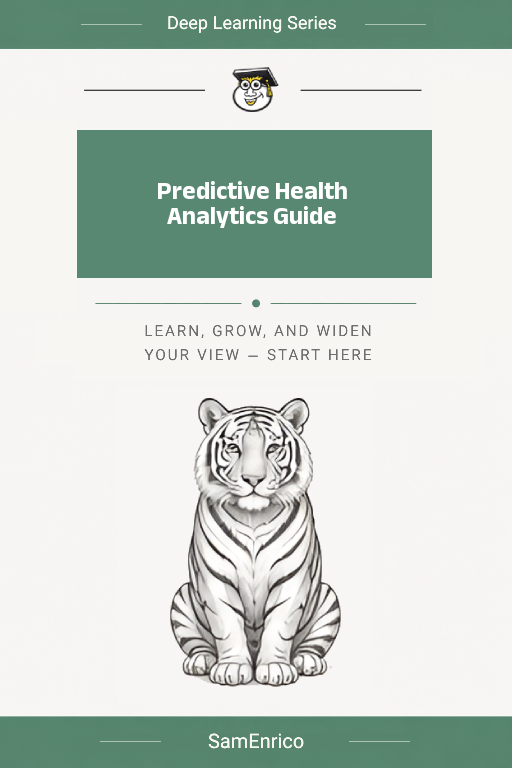
Non-FictionForecast & OutlookPredictive Health
Predictive Health Analytics Guide
Learn how AI forecasts disease risk, hospital read
Learn how AI forecasts disease risk, hospital readmissions, and treatment response using EHR and claims data.
Formats
About this book
Free sample
Chapter 1: The Prediction Paradox--–- In the winter of 2019, a large academic medical center launched what its data science team called the most sophisticated readmission model ever built for their system. The team had spent eight months cleaning electronic health record data from 150,000 admissions, engineering over 2,000 features, and training a gradient-boosted ensemble that achieved an area under the curve of 0.89 on holdout data—well above the published benchmark of 0.75. Hospital leadership celebrated. The model was deployed into the electronic health record, where it would flag high-risk patients for discharge planning teams. Within six weeks, not a single readmission had been prevented.
Nurses ignored the alerts. Case managers said the scores appeared too late. Physicians didn't trust them. The model, technically perfect, was functionally useless.This is the Prediction Paradox: the gap between a model that predicts accurately and a model that changes outcomes. In healthcare, that gap is where careers go to die and where millions of dollars in value-based care incentives evaporate.
Every year, hospitals and payers invest heavily in predictive analytics, only to discover that a high area under the curve in a Jupyter notebook does not translate to fewer readmissions, earlier sepsis detection, or better treatment selection. The problem is rarely the algorithm. It is almost always a failure to understand the ecosystem in which predictions must operate.This book exists to close that gap. Predictive Health Analytics Guide is not another textbook on machine learning theory. It will not derive the mathematics of backpropagation or compare thirty-seven variants of attention mechanisms.
Other books do that well. Instead, this guide bridges the space between data science and clinical reality. It teaches you how to take messy electronic health record data and claims data, build rigorous predictive models for disease risk, hospital readmissions, and treatment response, and then deploy those models into real clinical workflows where they actually improve patient outcomes. Along the way, you will learn where most projects fail, how to avoid bias and regulatory pitfalls, and how to build models that clinicians trust and use.The Predicted Patient Who Never Existed Consider two hypothetical patients. Both…
This is the end of the free sample. Get the eBook to keep going. Buy now
Contents
- Chapter 1
- Chapter 2
- Chapter 3
- Chapter 4
- Chapter 5
- Chapter 6
- Chapter 7
- Chapter 8
- Chapter 9
- Chapter 10
- Chapter 11
- Chapter 12
Details
- Author
- Bearden Jodie
- Publisher
- SamEnrico
- Language
- English
- Genre
- Non-Fiction, Forecast & Outlook, Predictive Health
- Released
- 2026-05-29
- Pages (approx.)
- 157
- Available as
- eBook, Audiobook

Read better in the ZLOADR app
Your eBooks on your phone or tablet. Sign in with your SamEnrico account and start reading.
More by Bearden Jodie
 Breath Awareness For IBSBearden Jodie$11.99
 Step Six Willingness PracticeBearden Jodie$11.99
 Evening Flexibility Wind DownBearden Jodie$11.99
 Franchise Builder's Video Marketing WinBearden Jodie$11.99
 The Banshee’s Wail: Ireland’s Death Omen UnveiledBearden Jodie$11.99
 The Night Visitor: The Unsolved Mystery of the Dreaming Man of 1921Bearden Jodie$11.99
 Understanding Hypertrichosis, Anterior CervicalBearden Jodie$17.99
 Heavy Equipment Shop TechnicianBearden Jodie$11.99
 Cruise Ship Crew WorkbookBearden Jodie$12.99
 How to Become a Jewel-hole CornererBearden Jodie$11.99
You may also like
 Hong Kong Handover 1997Dunn Johnnie$11.99
 Zumba For Postnatal Recovery CourseNeal Christian$11.99
 Zumba for BeginnersLadner Nikia$11.99
 YouTube Comment Mining GuideHumes Pandora$12.99
 Worry Box MeditationCarlin Rudy$11.99
 Workplace Stress MeditationNguyen Lynn$11.99
 Workplace Stress and Sleep RepairHawley Ivory$11.99
 Workplace Perfectionism CureDelaney Jeffry$11.99
 Workplace Injustice Anger GuideWallen Isabelle$11.99
 Work Addiction and Burnout LinkGreenwood Ester$11.99
 Women in Yoga and WellnessBeattie Galina$11.99
 Women in Stand Up ComedyChun Evangeline$11.99