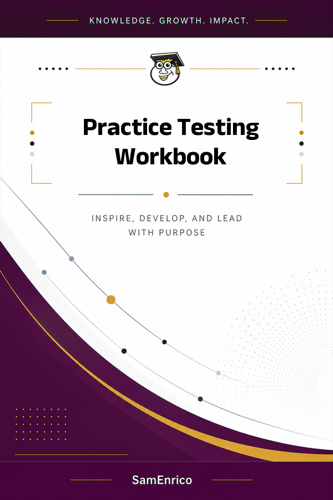
Practice Testing Workbook eBook
Simulate exam conditions to improve performance an
Simulate exam conditions to improve performance and reduce anxiety.
Formats
Free sample
Chapter 1: The Goldilocks Lie--–- Every student has heard some version of the same advice: “Just relax. Don’t stress. Calm down and you’ll do fine.” It sounds wise. It sounds soothing. It is almost completely wrong.The problem with the “just relax” commandment is not that relaxation is bad.
The problem is that it confuses two very different states of the nervous system. On one hand, there is the frantic, sweaty-palmed, racing-heart panic that ruins exam performance. On the other hand, there is the drowsy, slow, uninterested boredom that ruins exam performance just as thoroughly. Between them lies a narrow band of optimal arousal where your brain works at its full capacity. The lie of “just relax” is that it pushes you toward the boredom zone, not the performance zone.This chapter introduces the single most important concept in this entire workbook: the Yerkes–Dodson Curve, named after the psychologists who first described it in 1908.
Their discovery was simple but revolutionary. Performance does not increase linearly with arousal. It does not decrease linearly either. Instead, it follows an upside-down U shape. When arousal is very low, performance is low.
When arousal is very high, performance is also low. Somewhere in the middle, performance peaks.That peak is what this book calls The Zone.Most test-takers have never intentionally found their Zone. They stumble into it accidentally on a few good days, but they cannot recreate it on command. The purpose of this chapter is to change that. By the time you finish reading, you will know exactly where you currently fall on the Yerkes–Dodson Curve.
You will know whether you tend toward the Boredom Zone, the Panic Zone, or something closer to The Zone. And you will have specific, actionable interventions to move yourself toward optimal arousal in any testing situation.But first, you need to understand why your body reacts the way it does under pressure.The Two Engines Inside You Your nervous system has two major branches, and they work like the accelerator and brake in a car. The sympathetic nervous system is the accelerator. It revs you up. When it activates, your heart beats faster, your breathing quickens, your pupils dilate, and your muscles receive a surge of blood flow.
This is the fight-or-flight response, and it evolved for a very specific purpose: helping you escape from predators.The parasympathetic nervous system is the brake. It calms you down. When it activates, your heart rate slows, your breathing deepens, your digestion resumes, and your body enters a state of rest and repair. This is sometimes called the rest-and-digest response.Neither system is good or bad. Both are essential.
The problem is that most test-takers treat the accelerator as the enemy. They try to stomp on the brake the moment they feel any increase in heart rate. But if you slam the brake while the accelerator is still pressed, you do not achieve calm. You achieve a grinding, stressful stalemate.The secret is not to eliminate acceleration. The secret is to balance acceleration with just enough braking to stay in control.
That balanced state—alert but not frantic, focused but not rigid—is The Zone.The Upside-Down ULet us make this concrete with numbers. Imagine a scale of arousal from 0 to 10. Zero is deep sleep. One is drowsy grogginess. Two is relaxed but unfocused.
Three is calm alertness. Four is engaged attention. Five is focused intensity. Six is mild anxiety. Seven is moderate anxiety.
Eight is high anxiety. Nine is panic. Ten is terror.Now imagine a test. At arousal level two, you are too relaxed. You read questions slowly.
You miss key details. You do not check your work. You feel no urgency, so you make careless errors. Your score suffers.At arousal level eight, you are too anxious. Your heart is pounding.
Your palms are sweating. Your mind jumps from thought to thought without settling. When you encounter a difficult question, you freeze. Your working memory collapses, and information you know perfectly well becomes inaccessible. Your score suffers.At arousal level five, something different happens.
You feel the pressure, but it sharpens you rather than breaking you. You read carefully. You notice traps. You move through questions at a steady pace. When you hit a hard question, you take a breath, skip it strategically, and return later.
Your memory works. Your logic works. Your score reaches its maximum.This is the upside-down U. Low arousal = low performance. Medium arousal = peak performance.
High arousal = low performance. The shape of the curve is the same for everyone, but the location of the peak varies from person to person. Some people peak at level three. Others peak at level six. Your job in this chapter is to find your personal peak.The Three Zones Based on the Yerkes–Dodson Curve, every test-taker falls into one of three zones.
Understanding your dominant zone is the first step toward changing it.The Boredom Zone: Hypo-Arousal If you consistently score lower on practice tests than your knowledge would predict, and if you find yourself rushing through questions without checking answers, you may be in the Boredom Zone. This zone is characterized by low physiological arousal. Your heart rate is near resting levels. Your breathing is shallow and slow. You feel no urgency, no pressure, and no particular emotional reaction to the test.The irony of the Boredom Zone is that it often looks like confidence.
Students in this zone do not fidget. They do not sweat. They do not complain about anxiety. They simply underperform in a quiet, consistent way. Their problem is not fear.
Their problem is that the test has not engaged their nervous system enough to activate their full cognitive resources.Signs you may be in the Boredom Zone include: finishing sections with大量 time left but making obvious careless errors, feeling bored or annoyed rather than nervous during tests, having a resting heart rate below 60 beats per minute, and performing significantly better when someone adds a small incentive like a small reward for a high score.The Panic Zone: Hyper-Arousal If your mind goes blank during tests, if you forget information you knew five minutes before the exam, and if you experience physical symptoms like sweating, shaking, or nausea, you are likely in the Panic Zone. This zone is characterized by high physiological arousal. Your heart rate is elevated, often above 100 beats per minute. Your breathing is fast and shallow. Your sympathetic nervous system has taken over, and your prefrontal cortex—the logic center of your brain—has been partially shut down.The Panic Zone is far more common than the Boredom Zone, at least among students who seek help for test anxiety.
It is also more painful. The experience of knowing the answer but being unable to retrieve it is uniquely frustrating. Many students in the Panic Zone mistakenly believe they are stupid or unprepared. In reality, they may know the material perfectly well. Their nervous system is simply blocking access to that knowledge.Signs you may be in the Panic Zone include: scoring significantly lower on timed tests than on untimed tests, experiencing physical symptoms of anxiety before or during exams, having catastrophic thoughts ("I'm…
This is the end of the free sample. Get the eBook to keep going. Buy now
About this book
Details
- Author
- Runyon Maranda
- Publisher
- SamEnrico
- Language
- English
- Genre
- Non-Fiction, Self-Help, Practice
- Released
- 2026-06-08
- Pages (approx.)
- 148
- Available as
- eBook, Audiobook

Read better in the ZLOADR app
Your eBooks on your phone or tablet. Sign in with your SamEnrico account and start reading.
More by Runyon Maranda
 High Rise Window Cleaner StressRunyon Maranda$11.99
 Senior Positive AffirmationsRunyon Maranda$11.99
 The Family Pedophile ExposedRunyon Maranda$11.99
 Anger Management EAP GuideRunyon Maranda$11.99
 Pitcher Self Hypnosis GuideRunyon Maranda$11.99
 CPR for Hypothermia VictimsRunyon Maranda$11.99
 Action Planning for CoachesRunyon Maranda$11.99
 Tangaroa’s Wrath: The Ocean’s Forgotten RebellionRunyon Maranda$11.99
 Thomas Wedgwood and Humphry Davy: The Inventors Who Captured LightRunyon Maranda$11.99
 Nectarine: Smooth PeachRunyon Maranda$11.99
 Jumia vs Amazon Customer Demographics GuideRunyon Maranda$12.99
 Angel Investor Anti Dilution ClausesRunyon Maranda$12.99