
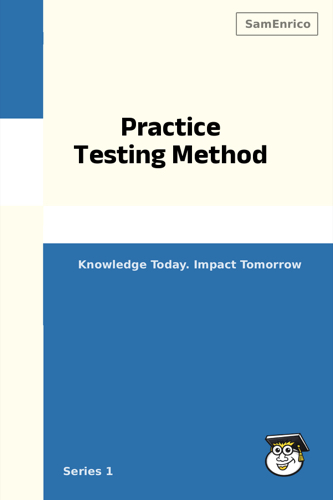
Free sample
Chapter 1: The Highlighting Trap--–- You have been lied to. Not by a malicious conspiracy, not by villains in dark rooms, but by something far more insidious: your own brain. Every time you have picked up a highlighter, every time you have reread a chapter and felt that warm glow of familiarity, every time you have crammed until 2 AM and walked into an exam feeling ready—only to freeze when the questions appeared—you have been deceived by the most convincing liar you will ever meet. That liar is your own sense of fluency. And today, we are going to catch it red-handed.This is not another study tips book.
This is not a collection of “life hacks” or “productivity secrets” borrowed from Silicon Valley executives who never had to pass organic chemistry. This is a book about the single most powerful, evidence-based learning strategy ever discovered—a strategy that has been replicated in hundreds of studies across decades, across subjects from anatomy to zoology, across ages from elementary school to medical residency. That strategy is called practice testing, also known as retrieval practice, also known as the Testing Effect. And despite its overwhelming scientific support, almost no one uses it correctly. In fact, most people actively avoid it because it feels hard.This chapter has one job: to convince you that almost everything you currently believe about studying is wrong.
Not slightly off. Not in need of minor adjustment. Wrong. And once you see why, you will never be able to unsee it.The Anatomy of a Study Session Let me describe a scene. You have a textbook.
You have a chapter to learn for an exam next week. You open to the first page, and you begin to read. About halfway down, you encounter a sentence that seems important—maybe the professor mentioned it in lecture, maybe it’s in bold, maybe it just feels significant. You reach for your highlighter. You draw a neat line of fluorescent yellow under the key phrase.
You feel a small pulse of satisfaction. Good, you think. I got that one. Then you continue reading. You highlight another sentence.
Then another. By the end of the chapter, your textbook looks like a rainbow threw up on it.When you finish, you go back and read the highlighted sentences again. They feel familiar now. You’ve seen them twice. You close the book, satisfied that you have “studied.” A few days later, you sit for the exam.
The question appears. It asks about a concept you highlighted. You know you saw it. You know you marked it. But the exact definition?
The three key components? The example the professor used? Gone. Vanished. You recognize the term, but you cannot produce the meaning.
This, right here, is the Highlighting Trap—and it is the single most common, most seductive, most ineffective study habit in existence.I want to be very clear about what is happening here, because the distinction is everything. When you read a highlighted sentence for the second time, your brain registers that sentence as familiar. You have seen those words before. They are not surprising. They do not require effort to process.
This feeling of ease—what cognitive psychologists call fluency—is the brain’s shortcut for “I know this.” But fluency is a liar. Fluency tells you that you have learned something when, in fact, you have only recognized it. Recognition and recall are not the same thing. Recognition is passive: you see something and it looks familiar. Recall is active: you produce something from memory with no cues.
Recognition feels easy. Recall feels hard. And here is the truth that will change the way you study forever: the hard feeling is the learning.The Dunlosky Ranking: What Actually Works In 2013, a team of cognitive psychologists led by John Dunlosky published a landmark paper in the journal Psychological Science in the Public Interest. They reviewed hundreds of studies on ten common learning techniques. They rated each technique on a scale from “low utility” to “high utility” based on four criteria: evidence of effectiveness, generalizability across contexts, ease of use, and durability of learning.
The results were shocking to anyone who had ever been a student.At the bottom of the ranking—rated “low utility”—were techniques like summarization, highlighting, underlining, rereading, and the keyword mnemonic. These are the strategies most students use almost exclusively. They are also the strategies that produce the smallest learning gains. In the middle—rated “moderate utility”—were techniques like elaborative interrogation (asking “why?”) and self-explanation (explaining steps to yourself). These are better, but still not the best.At the top—rated “high utility” and standing alone above all others—was practice testing.
Not just taking tests for a grade, but using tests as a learning tool. Practicing retrieval. Quizzing yourself on material before you think you’re ready. The effect sizes were dramatic. In study after study, students who practiced retrieval retained 50-80% more information after one week than students who restudied the same material.
In some studies, the gap widened to 200% after one month.Let that sink in. Practice testing is not slightly better than rereading. It is not a modest improvement. It is a transformative difference. A student who uses practice testing and a student who uses rereading will, after the same amount of study time, have completely different brains.
One will have built durable, accessible knowledge. The other will have built the illusion of knowing, which collapses under the pressure of an exam.The Fluency Illusion: Why Rereading Feels So Good To understand why we keep falling into the Highlighting Trap, we have to understand a fundamental quirk of the human brain. Your brain is not designed for accuracy; it is designed for efficiency. It takes shortcuts. It makes predictions.
And one of its most reliable shortcuts is the fluency heuristic: if something is easy to process, it must be true, familiar, and safe.When you reread a sentence, you process it faster the second time. Your eyes move more quickly. Your brain predicts the next word with greater accuracy. This feels like learning. It feels like progress.
But what you are actually experiencing is perceptual fluency—the ease of processing familiar visual patterns—not semantic learning—the encoding of meaning into long-term memory. The two are not the same, and your brain cannot tell the difference.This is why students so consistently overestimate how well they will perform on exams. In one study, researchers asked students to predict their scores after either restudying material or taking a practice test. The restudying group predicted significantly higher scores than the testing group. They felt more confident.
They felt more prepared. Then they took the actual exam. The testing group outperformed the restudying group by a wide margin. The students who felt less confident did better. Confidence, in this case, was a negative predictor of performance.This is the Fluency Illusion.
It is the reason you can read a chapter, feel great, and then bomb the quiz. It is the reason highlighting is a trap. And it is the reason that the most important skill you can develop as a learner is not memory—it…
This is the end of the free sample. Get the eBook to keep going. Buy now
About this book
Details
- Author
- Burdick Sherrie
- Publisher
- SamEnrico
- Language
- English
- Genre
- Non-Fiction, Self-Help
- Released
- 2026-06-07
- Pages (approx.)
- 148
- Available as
- eBook, Audiobook

Read better in the ZLOADR app
Your eBooks on your phone or tablet. Sign in with your SamEnrico account and start reading.
More by Burdick Sherrie
 The Prescription Side EffectBurdick Sherrie$11.99
 The Nap Light Exposure GuideBurdick Sherrie$11.99
 Spin Climbing TechniquesBurdick Sherrie$11.99
 Parent Loss in LGBTQ FamilyBurdick Sherrie$11.99
 The Quit Partner WorkbookBurdick Sherrie$11.99
 Evernote Memory GuideBurdick Sherrie$11.99
 Miscarriage Recurrent LossBurdick Sherrie$11.99
 Boundary Setting For GrandparentsBurdick Sherrie$11.99
 The Secret Ingredient: How a 1980s Fast-Food Chain Almost Toppled McDonald'sBurdick Sherrie$11.99
 The Mirage and the Storm: Israel's Tech Revolution in Two WarsBurdick Sherrie$11.99
 The Northern Throne: How Harald Hardrada United ScandinaviaBurdick Sherrie$11.99
 The Mineral Guide to JarosewichiteBurdick Sherrie$11.99
You may also like
 Workplace Stress MeditationNguyen Lynn$11.99
 Volcano Monitoring ScientistCox Alexis$11.99
 The Tech Professional NetAguiar Nevada$11.99
 The Morning Metta RitualCanales Anya$11.99
 The Chunking Memory TechniqueClanton Hyacinth$11.99
 The Beginner Mistake FixAmmons Cassondra$11.99
 Surrendering to What IsGrimm Reatha$11.99
 Self Hypnosis for Fear of FireBillups Eli$11.99
 Road Rage for Professional DriversBrackett Janise$11.99
 Psychiatric Ward Nurse StressDunning Wyatt$11.99
 Observation vs Evaluation NVCTimmons Alda$11.99
 Networking for Nonprofit ProfessionalsPoole Jesse$11.99