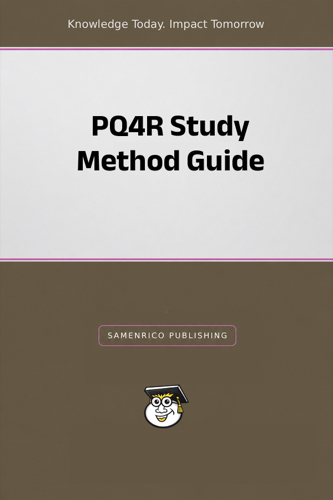
PQ4R Study Method Guide eBook
Preview, question, read, reflect, recite, review f
by Sowell Reena
Preview, question, read, reflect, recite, review for deep learning.
Formats
Free sample
Chapter 1: The Studying Illusion--Most students believe they know how to study. They open the book, read the assigned pages, maybe highlight a few sentences that seem important, and then close the cover feeling a quiet sense of accomplishment. They have done the work. They have put in the time. And yet, when the exam arrives, the information has vanished—not faded gradually, but evaporated entirely, leaving behind only a vague sense of familiarity with certain keywords or phrases.
This is not a failure of effort. It is a failure of method.The gap between feeling productive and actually learning is one of the most dangerous traps in education. You can spend three hours rereading a chapter, nodding along as the words pass before your eyes, and walk away with almost nothing stored in long-term memory. The following day, the material feels foreign. The week after, it might as well be new.
This experience is so common that most students have accepted it as normal—as simply the way learning works. But normal does not mean correct. And common does not mean inevitable.This chapter exists to shatter three illusions that keep students trapped in ineffective study habits. These illusions are not harmless. They cost you time, energy, and grades.
Worse, they convince you that you have studied adequately when you have not, leading to the terrible surprise of a failing grade on an exam you felt prepared for. By understanding why your current habits fail, you open the door to a completely different approach—one rooted in how the brain actually encodes, stores, and retrieves information.The chapters that follow will introduce the PQ4R method, a six-phase framework developed from decades of cognitive science research. But before you can embrace a new way of studying, you must first abandon the old one. That requires honesty about what is not working. Let us begin by examining the three studying illusions in detail, then explore the cognitive science that explains why they fail, and finally glimpse the alternative that will transform how you learn.The Three Studying Illusions Every ineffective study habit persists because it produces some form of immediate feedback that feels like progress.
Rereading feels productive because the text becomes more familiar with each pass. Highlighting feels useful because the act of marking a sentence creates a physical artifact of attention. Cramming feels necessary because the pressure of an impending deadline forces action. These feelings are seductive but deceptive. They are illusions.Illusion One: The Familiarity Trap The first and most pervasive illusion is mistaking recognition for recall.
When you read a textbook passage for the second or third time, the words flow more smoothly. The sentences make sense more quickly. The concepts seem obvious. This fluency creates a powerful subjective experience: you feel as though you know the material.But fluency is not understanding. Recognition is not recall.Here is the critical distinction.
Recognition occurs when you see information and it triggers a sense of having encountered it before. This is what happens when you read a highlighted sentence and think, "Yes, I remember this." Recall occurs when you generate information from memory without any external cues—when you close the book and explain the concept in your own words. These two processes engage entirely different neural pathways, and only one of them predicts exam performance.Decades of research confirm that students consistently overestimate their knowledge after rereading precisely because of this fluency illusion. The text feels easy, so the brain concludes that learning has occurred. But when the exam removes the text—when the cues vanish—the information cannot be retrieved.
The student is left staring at a question that felt obvious during studying but now seems impossible.This illusion explains why so many students walk out of exams genuinely surprised by their poor performance. They did study. They did reread. They did feel confident. But confidence born from recognition is a liar.Illusion Two: The Highlighting Hoax The second illusion is perhaps the most widespread in academic settings.
Walk into any college library during finals week, and you will see hundreds of students with colorful markers in hand, turning their textbooks into abstract art. Highlighting feels productive because it is active—your hand moves, you make choices about what matters, you create a visual hierarchy of importance. These are the surface behaviors of learning without the substance.The problem with highlighting is twofold. First, the act of marking a sentence does not meaningfully encode that information into memory. The physical motion of dragging a marker across a page is cognitively shallow.
Second, highlighting creates a dangerous dependency: students begin to believe that the marked text is the only text that matters, and they stop processing the surrounding context that gives those sentences meaning.Research on highlighting has produced remarkably consistent findings. In study after study, students who highlight perform no better on subsequent tests than students who simply read the text. In some cases, highlighting actually impairs performance because it fragments attention and creates an illusion of selectivity that is not supported by actual understanding.The worst part of the highlighting habit is that it feels so productive that it prevents students from seeking better methods. Why would you change something that seems to work? The answer is that highlighting does not work.
It only feels like it does. And that feeling is the hoax.Illusion Three: The Cramming Catastrophe The third illusion is the most urgent and the most damaging. Cramming—massing all study time into a single session immediately before an exam—produces a specific pattern of results that has deceived generations of students. Here is how the deception works.When you cram, you force information into short-term memory through intense, repetitive exposure. The next morning, during the exam, much of that information is still accessible.
You answer questions correctly. You receive a passing grade. You conclude that cramming works.But here is what you do not see. Within one week, nearly 80 percent of that crammed information will be gone. Not faded—gone.
The rapid forgetting that follows cramming is not a bug; it is a feature of how short-term memory operates. Information that enters the brain without meaningful connections to existing knowledge, without elaboration, and without distributed practice, decays at an alarming rate.The exam passed. The grade was acceptable. But the learning did not happen.This pattern creates a catastrophic cycle. Students cram for Exam 1, pass, forget everything, then cram for Exam 2, pass, forget everything.
When the final exam arrives—cumulative, requiring integration across the entire course—those same students find themselves unable to retrieve material they have "studied" multiple times. They are not stupid. They are not lazy. They are victims of an illusion that feels like success in the short term but guarantees failure in the long term.The cognitive science behind cramming is clear: massed practice produces rapid acquisition and equally rapid forgetting. Distributed practice—spacing study sessions over time—produces slower acquisition but dramatically better retention.
We will return to distributed learning in detail in Chapter 8, but for now, understand this: if your study method is designed around the night before the exam, you have already lost…
This is the end of the free sample. Get the eBook to keep going. Buy now
About this book
Details
- Author
- Sowell Reena
- Publisher
- SamEnrico
- Language
- English
- Genre
- Non-Fiction, Self-Help, Deep Processing
- Released
- 2026-06-10
- Pages (approx.)
- 153
- Available as
- eBook, Audiobook

Read better in the ZLOADR app
Your eBooks on your phone or tablet. Sign in with your SamEnrico account and start reading.
More by Sowell Reena
 Perceptual Mapping Excel WorkbookSowell Reena$11.99
 Remote Retreats Technology SetupSowell Reena$11.99
 French Resistance Courier GuideSowell Reena$11.99
 Deep Work for Legal ProfessionalsSowell Reena$11.99
 The Billionaire's Secret: How Warren Buffett's $100 Million Bet Changed PhilanthropySowell Reena$11.99
 Runes of the Forgotten: Loki's Lost GambitSowell Reena$11.99
 How to Become a Mock-up BuilderSowell Reena$11.99
 Understanding Choreoacanthocytosis AmyotrophicSowell Reena$17.99
 JEE Two Year Study PlannerSowell Reena$12.99
 Operations Department BudgetSowell Reena$12.99
 Pasta MakerSowell Reena$11.99