
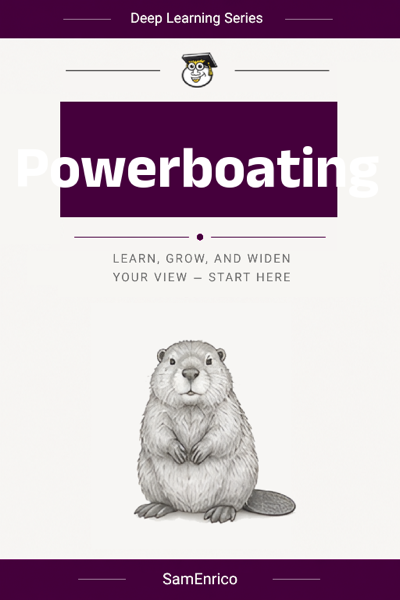
Non-FictionInformativeEducational
Powerboating eBook
A Coursebook on Powerboating
A Coursebook on Powerboating
Formats
Free sample
Chapter 1: The Machine Beneath--–- Every first-time powerboater remembers the moment their hand first closes around the throttle. Not the nervous grip of a car’s gearshift, not the tentative touch of a bicycle’s handlebar, but something altogether different—a promise of raw, unrestrained movement across an infinite blue expanse. The engine rumbles beneath the deck like a living thing, and in that instant, the line between machine and mastery begins to blur. But before that throttle ever moves forward, before the bow wave curls white against the hull, there is something far more important than speed or style. There is understanding.
The best-selling powerboating books of the past three decades all agree on one unshakeable truth: the boats that return to port safely are the ones whose operators know exactly what sits beneath their feet, how it moves, and why.Powerboating is not driving, not sailing, and certainly not intuition. It is a skill built on knowledge—knowledge of hulls that slice or plow, of engines that push or pull, of propellers that bite or cavitate. This first chapter strips away the romance of the open water and gets directly to the machine. By the time you finish these pages, you will look at a boat not as a mystery but as a collection of deliberate choices: every curve of fiberglass, every bolt on the outboard bracket, every degree of deadrise telling a story about where that boat belongs and what it can do. And you will know, with uncommon clarity, which boat is right for you.The Language of Powerboat Classifications Walk down any marina dock and you will see a bewildering variety of shapes and sizes.
Center consoles stand open to the sky, their helm stations perched over sharp bows. Cuddy cabins bulge forward with small sleeping berths hidden under fiberglass. Bowriders invite families to lounge on forward-facing seats, while walkarounds offer narrow side decks that let you reach the bow without crossing through the cabin. Express cruisers combine enclosed cabins with spacious cockpits, and offshore boats rise high out of the water, their deep-vee hulls promising to punch through waves that would send lesser craft scurrying for harbor.Each classification exists because it solves a specific problem. The center console, for example, puts the helm exactly in the middle of the boat, creating a 360-degree walkable deck.
Anglers love this layout because they can fight a fish around the entire perimeter without tripping over a windshield. Families with young children often prefer the bowrider, which trades open deck space for forward-facing seating that lets parents keep eyes on everyone. The cuddy cabin offers a compromise—a small V-berth for overnight trips or afternoon naps, combined with an open cockpit for daytime cruising.Walkaround designs emerged from the Northeast fishing tradition, where reaching the bow to handle anchors or fight fish required safe passage. These boats feature a console set slightly off-center or a narrow walkway squeezed between the cabin and gunwale. Express cruisers compress an entire weekend’s worth of amenities into a 30-foot package: galley, head, sleeping for four, and a helm with full electronics.
Offshore boats, by contrast, strip away luxury in favor of high freeboard (the distance from waterline to deck) and deep-vee hulls that prioritize rough-water capability over interior space.The novice’s mistake is choosing based on looks alone. The experienced buyer starts with mission: Where will you boat most often? How many people will you carry? Will you stay overnight? Do you need to trailer?
These questions narrow the field from dozens of options to a handful of genuine contenders.Hull Shapes That Define Performance Under the waterline, hidden from casual view, lies the most important decision any powerboat designer makes: hull shape. Three fundamental forms exist, each with distinct advantages and unforgiving limitations.Displacement hulls are the old salts of the fleet. These boats never plane—they cannot rise onto the water’s surface. Instead, they push water aside as they move, creating a bow wave and a stern wave with the boat settling into the trough between them. Maximum speed is governed by a mathematical relationship involving waterline length: a 30-foot displacement hull theoretically tops out around 7 to 8 knots, regardless of horsepower.
Add more engine and you simply create a bigger bow wave without going faster. Fishermen who spend days on the water love displacement hulls for their fuel efficiency (typically 2 to 4 nautical miles per gallon) and their gentle motion at anchor. Trawlers, lobster boats, and most commercial fishing vessels use displacement hulls because they prioritize economy over speed.Planing hulls revolutionized recreational boating. By shaping the bottom with a flat or moderately veed surface, naval architects created boats that could climb over their own bow wave and ride on top of the water. A planing hull at rest sits low, displacing its weight.
At speed—typically above 15 to 20 knots—the bow rises, the stern squats, and then the entire boat levels out as dynamic lift takes over. Fuel consumption tells the story: a planing hull may burn three times as much fuel as a displacement hull at cruising speed, but it covers five times the distance in the same hour. Most recreational powerboats—bowriders, center consoles, express cruisers, and many offshore boats—are planing hulls.Between these extremes lies the semi-displacement hull (sometimes called semi-planing). These boats cannot fully climb onto plane but can exceed displacement speed by pushing a larger bow wave and surfing down the backside. The ride is wetter and less efficient than true planing, but semi-displacement hulls handle rough water better than pure planing designs and offer more speed than displacement hulls.
Downeast-style cruisers and some trawlers use this configuration.The hull’s deadrise—the angle of the bottom measured from horizontal—adds another layer of complexity. Shallow deadrise (14 degrees or less) makes for a stable platform at rest and quicker planing, but slams into waves. Deep deadrise (22 degrees or more) cuts through chop smoothly but rolls more at anchor and requires more power to plane. Moderate deadrise (16 to 20 degrees) offers the best all-around compromise for coastal cruisers.Propulsion Systems: Where Power Meets Water The engine matters, but how that engine connects to the water matters more. Four primary propulsion systems dominate recreational powerboating, and each changes the boat’s personality.Outboards hang on the transom, self-contained packages of engine, drive shaft, and propeller.
They steer by rotating the entire lower unit, and they tilt up completely out of the water for trailering or beaching. Modern four-stroke outboards have closed the gap on noise and emissions, making them the fastest-growing segment in the industry. Advantages include easy maintenance (the entire powerhead tilts into the open air), excellent fuel economy, and the ability to repower without hauling the boat. Disadvantages include weight hanging off the stern (affecting trim) and vulnerability to saltwater corrosion in the tilt mechanism. Outboards dominate the under-30-foot market, especially center consoles, bay boats, and light cruisers.Sterndrives (also called inboard/outboards or I/Os) mount an automotive-derived engine inside the boat, connected through the transom to a drive unit that resembles the lower half of an outboard.
The engine sits forward, improving weight distribution, while the drive unit steers and tilts like an outboard. Sterndrives offer the…
This is the end of the free sample. Get the eBook to keep going. Buy now
About this book
Details
- Author
- Orourke Jesse
- Publisher
- SamEnrico
- Language
- English
- Genre
- Non-Fiction, Informative, Educational
- Released
- 2026-05-06
- Pages (approx.)
- 112
- Available as
- eBook, Audiobook

Read better in the ZLOADR app
Your eBooks on your phone or tablet. Sign in with your SamEnrico account and start reading.
More by Orourke Jesse
 PCOS CoQ10 Supplement GuideOrourke Jesse$11.99
 TM for Depression ReliefOrourke Jesse$11.99
 Smoking Cessation AnchorOrourke Jesse$11.99
 Scott Peterson Judge Delucchi Rulings BreakdownOrourke Jesse$11.99
 The Empathy at Work HandbookOrourke Jesse$11.99
 The Man Who Heard the Future: Sir George Martin and the Birth of British PopOrourke Jesse$11.99
 DuPont R&D GuideOrourke Jesse$12.99
 Domain Monitoring Service GuideOrourke Jesse$12.99
 Understanding Pemphigus FoliaceusOrourke Jesse$17.99
 How to Become a Odd-piece CheckerOrourke Jesse$11.99
You may also like
 Hong Kong Handover 1997Dunn Johnnie$11.99
 Zumba For Postnatal Recovery CourseNeal Christian$11.99
 Zumba for BeginnersLadner Nikia$11.99
 YouTube Comment Mining GuideHumes Pandora$12.99
 Worry Box MeditationCarlin Rudy$11.99
 Workplace Stress MeditationNguyen Lynn$11.99
 Workplace Stress and Sleep RepairHawley Ivory$11.99
 Workplace Perfectionism CureDelaney Jeffry$11.99
 Workplace Injustice Anger GuideWallen Isabelle$11.99
 Work Addiction and Burnout LinkGreenwood Ester$11.99
 Women in Yoga and WellnessBeattie Galina$11.99
 Women in Stand Up ComedyChun Evangeline$11.99