
Non-FictionProfessional's Cheat SheetMorningSelf-Help
Power Hour Time Blocking eBook
Protect the first 90 minutes of each day for your
by Decker Peg
Schedule one hour of hyper focused work using this practical technique guide.
Formats
Free sample
Chapter 1: The Decisive Window--–- At 7:03 on a Tuesday morning, Sarah opened her laptop and made a decision she didn’t even know she was making. She clicked the email icon. Forty-seven unread messages. She answered the urgent one from her boss, then the one from the client who was angry, then the one from accounting asking for the same spreadsheet she’d sent twice before. By 7:22, she had replied to eleven emails.
By 7:45, she was in a Slack thread debating the font size on a slide deck. By 8:30, she had her first meeting. By 5:00 that evening, she realized she had not touched the one thing that actually mattered for her quarterly goal. She felt busy. She felt exhausted.
She felt, in the privacy of her own mind, like a failure. And she had no idea that the moment she lost control was not at 2:00 PM when a meeting ran late, not at 11:00 AM when her boss dropped in unexpectedly, but at 7:03 AM when she clicked that email icon.This book exists because of Sarah. Because you have been Sarah. Because the first ninety minutes of your workday are not just another block of time to fill with whatever lands in your inbox—they are a decisive biological and psychological window that determines whether you spend the rest of the day building something that matters or extinguishing fires that someone else started.Most people never learn this. They wake up, reach for their phones, scroll through notifications, and assume they are being productive because they are moving fast.
But speed is not strategy. Activity is not achievement. And the first ninety minutes of your day are, without exception, the most valuable time you will ever have. Not because they are longer than any other ninety minutes—they are not. Not because the world is quieter—it may not be.
But because of something far more fundamental: the architecture of the human brain.THE BIOLOGY OF THE FIRST NINETYLet me be precise about what happens inside your skull during the first hour and a half after you begin your workday. Your body operates on something called the ultradian rhythm—a 90-to-120-minute cycle during which your alertness, focus, and cognitive performance rise, peak, and then naturally decline. You have experienced this rhythm whether you know it or not. It is why you can work deeply for about ninety minutes, then suddenly need coffee or a walk. It is why lectures lose you after the first hour.
It is why meetings scheduled back-to-back for three hours become torture after the second one.The first ultradian cycle of your workday is different from all the others. Here is why. When you wake up, your body releases a surge of cortisol and adrenaline. You have been told that cortisol is a stress hormone, something to be minimized. That is only half true.
Cortisol is also the alertness hormone. It sharpens your pattern recognition, heightens your working memory, and increases your willpower. Without it, you would stumble through the morning in a fog. With it, at the right levels, you are capable of cognitive work that is literally impossible later in the day.This surge peaks approximately thirty to forty-five minutes after you begin being awake and mentally engaged. That peak is your biological advantage.
It is the cleanest, clearest, most powerful cognitive state you will experience in any given twenty-four-hour period. And what do most people do with it? They check email. They scroll social media. They attend stand-up meetings where nothing stands up.
They waste the single best hour of their brain on tasks that require almost no brain at all.This is not a moral failing. It is a design flaw in modern work culture. But it is a design flaw you can fix.THE COST OF A WASTED WINDOWLet me quantify what you lose when you give away your first ninety minutes. Laura Vanderkam, in her book 168 Hours, analyzed time diaries from thousands of professionals and found that the average knowledge worker spends the first hour of their workday on what she calls “low-leverage activities”—email, scheduling, news reading, internal messaging. That hour, she calculated, could be redirected to high-leverage strategic work.
But almost no one does it.Why? Because email feels urgent. Notifications feel important. The red badge on your Slack icon is a psychological trigger designed by engineers who understand dopamine better than you do. Every time you check a notification, your brain releases a small amount of dopamine—the same neurotransmitter involved in gambling and slot machines.
You are not checking email because it is important. You are checking email because your brain has been trained to crave the variable reward of a message that might be interesting, or complimentary, or urgent.This is not speculation. Nir Eyal, in Indistractable, documents how external triggers—the buzz of a phone, the ping of a message—become internal triggers—the anxiety that you might be missing something. That anxiety is not a sign that you are diligent. It is a sign that your brain has been hijacked by a system designed to keep you reacting rather than acting.The cost is staggering.
If you start your day reactive—responding to whatever arrives—you will spend three to four times more willpower to pivot to strategic work later than if you had started strategic. This is the momentum cost. A stationary object requires less force to move than an object already moving in the wrong direction. Once you have answered ten emails, your brain is in reactive mode. Pivoting to deep strategic work at 9:30 AM is not a simple transition.
It is a full gear shift under load. Most people never make it. They tell themselves they will do the important work “after lunch,” but by after lunch, decision fatigue has set in, meetings have consumed their calendar, and the strategic initiative has been pushed to tomorrow—where the same cycle repeats.WHAT STRATEGIC WORK ACTUALLY MEANSWe need to be precise about language before we go any further. The word “strategic” is thrown around so often that it has lost its meaning. Everything is strategic.
Nothing is strategic. Let me fix that.In this book, I divide your work into three tiers. You need to understand these tiers because you cannot protect the first ninety minutes if you do not know what you are protecting them for.Tier One: Strategic Work. This is work that requires deep concentration, moves a long-term goal forward, and cannot be done in pieces of less than sixty minutes. Strategic work changes your trajectory.
Examples include writing a twenty-page proposal from scratch, designing a new system or process, analyzing a complex dataset to find a pattern that changes your strategy, coding a new feature, or reading a dense fifty-page technical document and synthesizing its implications. Strategic work is hard. Strategic work is slow. Strategic work is the only work that actually advances your career or your business in a meaningful way.Tier Two: Tactical Work. This is work that is important but does not require the same depth of concentration.
Tactical work typically takes fifteen to sixty minutes and can be done in pieces. Examples include outlining a report, preparing…
This is the end of the free sample. Get the eBook to keep going. Buy now
About this book
Details
- Author
- Decker Peg
- Publisher
- SamEnrico
- Language
- English
- Genre
- Non-Fiction, Professional's Cheat Sheet, Morning, Self-Help, Power Hour
- Released
- 2026-05-29
- Pages (approx.)
- 127
- Available as
- eBook, Audiobook

Read better in the ZLOADR app
Your eBooks on your phone or tablet. Sign in with your SamEnrico account and start reading.
More by Decker Peg
 Spiritual Purpose GuideDecker Peg$11.99
 Design Thinking for LearningDecker Peg$11.99
 Retrospective Meeting GuideDecker Peg$11.99
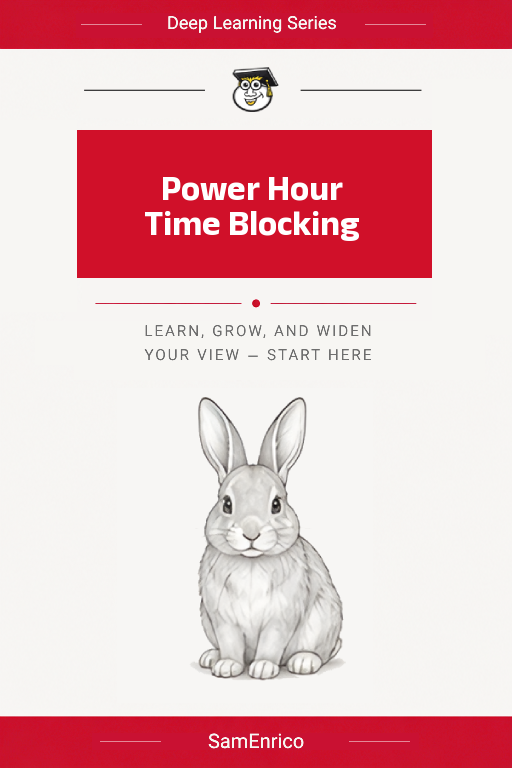 Power Hour Time BlockingDecker Peg$12.99
 SLAA Explained WorkbookDecker Peg$11.99
 NVC for Digital CommunicationDecker Peg$11.99
 Janitorial Shift SleepDecker Peg$11.99
 Meal Prep for ParentsDecker Peg$11.99
 Elizabeth Golden Age CultivationDecker Peg$11.99
 The Lion Builders of Great Zimbabwe: Stone Sculptors of the SavannahDecker Peg$11.99
 The Sonata of the Sun King: Chevalier de Saint-Georges and the Court of VersaillesDecker Peg$11.99
 Service Providers Guide to Imaging & Pediatric RadiologyDecker Peg$11.99
You may also like
 Hong Kong Handover 1997Dunn Johnnie$11.99
 Zumba For Postnatal Recovery CourseNeal Christian$11.99
 Zumba for BeginnersLadner Nikia$11.99
 YouTube Comment Mining GuideHumes Pandora$12.99
 Worry Box MeditationCarlin Rudy$11.99
 Workplace Stress MeditationNguyen Lynn$11.99
 Workplace Stress and Sleep RepairHawley Ivory$11.99
 Workplace Perfectionism CureDelaney Jeffry$11.99
 Workplace Injustice Anger GuideWallen Isabelle$11.99
 Work Addiction and Burnout LinkGreenwood Ester$11.99
 Women in Yoga and WellnessBeattie Galina$11.99
 Women in Stand Up ComedyChun Evangeline$11.99