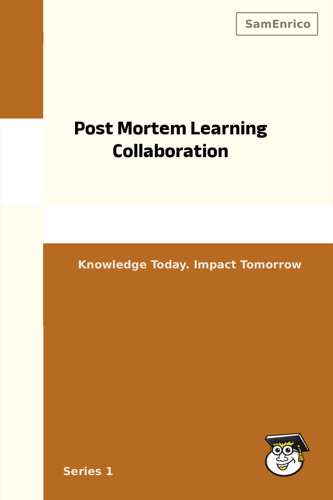
Post Mortem Learning Collaboration eBook
Turns team failures into creative lessons.
Turns team failures into creative lessons.
Formats
Free sample
Chapter 1: The Three Siblings--–- Every failure has a family. Most teams never bother to ask which branch it came from. They gather in a conference room, project the burndown chart onto a screen that has seen better days, and begin the ritual. Someone says, "Let's go around the room and talk about what went wrong." What follows is an hour of competing narratives, defensive postures, and the careful construction of a story that makes everyone look competent and unlucky. The developer who deployed at 4 PM on a Friday says nothing about the time.
The product manager who changed the requirement mid-sprint frames it as a "strategic pivot." The QA engineer who signed off on the broken feature mentions that they were "operating under resource constraints." By the time the meeting ends, the team has generated twenty-seven action items, zero genuine insights, and a collective resolve to never mention this project again. This is not a post-mortem. This is a funeral. And like most funerals, it is designed to comfort the living, not to teach them.The problem is not that teams are lazy or stupid. The problem is that they lack a shared language for what just happened.
They treat a server crash the same way they treat a typo. They treat a bold experiment that failed the same way they treat a preventable oversight. They lump together events that have nothing in common except the word "failure." And because they cannot distinguish between fundamentally different phenomena, they apply the same blunt instrument to all of them: shame, followed by a checklist, followed by a slow return to business as usual. This is a catastrophe disguised as a process improvement.The solution is a taxonomy. A simple, usable, memorable way of sorting failures into categories that demand different responses.
Not academic categories for journals. Operational categories for Monday morning. This chapter introduces the Three Siblings: Basic, Complex, and Intelligent. They are not enemies. They are not ranked from bad to worse.
They are different. And once you learn to recognize them, you will never again waste two hours analyzing a typo or thirty seconds glossing over a systemic collapse.The First Sibling: Basic Failure The first sibling is the simplest to understand and the easiest to misdiagnose. A Basic failure is a deviation from a known, standardized process in familiar territory. It is a slip, not a crash. It is forgetting to save a file before closing the application.
It is mislabeling a requirement in a ticketing system. It is deploying code without running the test suite because you were rushing to catch a train. It is the meeting that starts late because no one remembered to book the room. These are not mysteries. They do not require a detective.
They require a reminder.The defining characteristics of a Basic failure are three. First, the correct process was known to the team before the failure occurred. No one had to invent a new protocol. The protocol existed, was documented, and was accessible. Second, the failure occurred because someone deviated from that known process.
The deviation was not a creative workaround. It was not an intentional risk. It was a momentary lapse. Third, the deviation was unintentional. The person who made the error did not wake up that morning planning to cause trouble.
They looked at their phone, caught their toe on a crack in the sidewalk, and went down.Here is what most teams get spectacularly wrong about Basic failures. They over-investigate them. They hold two-hour post-mortems about a typo. They create elaborate root cause analyses with fishbone diagrams and five whys and color-coded sticky notes. They treat the forgetting as a profound organizational mystery requiring a cross-functional task force and an executive sponsor.
This is not rigor. This is ritualized avoidance of real work. A single Basic failure, in isolation, contains almost no useful information. It tells you that a human being made a human error. That is not news.
That is Tuesday.The correct response to an isolated Basic failure is lightweight to the point of invisibility. Add a checklist. Enable an automatic save. Change the color of a button. Send a one-sentence reminder in Slack.
The intervention should take five minutes to implement and should never require a meeting. If you find yourself scheduling a "retrospective" for a Basic failure, you have already lost. You are burning team hours to analyze something that could have been fixed in the time it took to book the conference room.But. And this is a crucial but. A repeating pattern of Basic failures is not a Basic failure at all.
It is a Complex failure wearing a disguise. If the same person forgets to run the test suite three times in a month, you do not have a memory problem. You have a system problem. Perhaps the test suite takes forty minutes to run, and skipping it has become rational behavior. Perhaps the person is working seventy-hour weeks, and fatigue has made them unreliable.
Perhaps the tooling is so badly designed that running the tests requires seven clicks and a password reset. The checklist will not fix any of these root causes. Only a systemic investigation will. So the taxonomy includes an escalation rule: when a Basic failure repeats, it ceases to be Basic. It becomes Complex.
And it deserves a different response entirely.The Second Sibling: Complex Failure The second sibling is the nightmare that keeps project managers awake at three in the morning. A Complex failure is a systemic, unpredictable collapse arising from the interaction of multiple factors, none of which would have caused failure on their own. It is the product launch that fails not because the code was bad, but because the code was bad AND the marketing campaign was mistimed AND the supply chain experienced a delay AND a key stakeholder was on vacation AND the testing environment didn't match production. Remove any one of those factors, and the launch might have succeeded. But they all converged, and the system collapsed.The defining characteristics of a Complex failure are these.
Multiple contributing causes, each insufficient on its own. The failure was not easily predictable from available information. And the failure emerged from the interaction of components, not from any single component's malfunction. Complex failures are the reason commercial aviation studies cockpit resource management. They are why nuclear power plants run constant simulations.
They are why your software team's "simple" deployment turned into a sixteen-hour firefight. They are not anyone's fault in the simple sense. But they are everyone's responsibility in the systemic sense.Here is what makes Complex failures so treacherous. The human brain is not wired to understand them. We evolved in an environment where most problems had single causes.
The rustle in the grass was either a predator or the wind. The fruit was either ripe or rotten. Linear causality is the operating system of the lizard brain. But Complex failures laugh at linear causality. They are webs, not chains.
They are networks, not sequences. And when a team tries to analyze a Complex failure with a linear tool, they inevitably produce a comforting fiction: the story of the one mistake, the…
This is the end of the free sample. Get the eBook to keep going. Buy now
About this book
Details
- Author
- Bradley Arthur
- Publisher
- SamEnrico
- Language
- English
- Genre
- Non-Fiction, Self-Help, Retrospectives
- Released
- 2026-06-10
- Pages (approx.)
- 138
- Available as
- eBook, Audiobook

Read better in the ZLOADR app
Your eBooks on your phone or tablet. Sign in with your SamEnrico account and start reading.
More by Bradley Arthur
 Scarcity and Urgency WritingBradley Arthur$11.99
 Periscope Live StreamerBradley Arthur$11.99
 Anger and NVCBradley Arthur$11.99
 The Cardiovascular Stress ResponseBradley Arthur$11.99
 Bipolar Treatment ResistanceBradley Arthur$11.99
 The Fishing Line LifeBradley Arthur$11.99
 Nap Product Equipment GuideBradley Arthur$11.99
 Blue Zone Meal TimingBradley Arthur$11.99
 Echoes of the Green Book: A Dystopian Roadmap to FreedomBradley Arthur$11.99
 The Sword of the Sun God: A Knight’s Quest in the MahabharataBradley Arthur$11.99
 The Queen of Rock and Roll: Tina Turner's Phoenix Rise (2008-2023)Bradley Arthur$11.99
 Compensation and Benefits ManagementBradley Arthur$11.99