
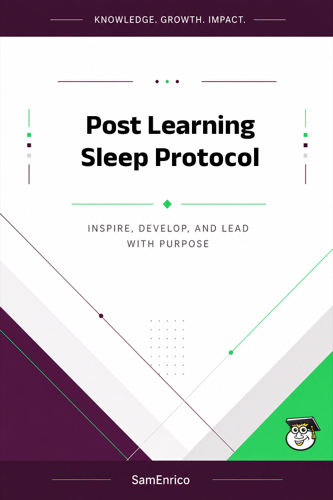
Post Learning Sleep Protocol eBook
Schedule study sessions before sleep to maximize m
Schedule study sessions before sleep to maximize memory consolidation.
Formats
Free sample
Chapter 1: The Forgetting Assassin...--We have all experienced the same quiet humiliation. You spend an evening with a textbook, highlighter in hand, rereading the same paragraph three times until the words feel sewn into your memory. You close the book feeling accomplished, even virtuous. Forty-eight hours later, someone asks you a simple question about that very material, and your mind offers nothing but the cognitive equivalent of static. You remember the color of the book cover.
You remember the coffee shop where you studied. You remember the frustration of not remembering. But the actual information—the facts, the formulas, the historical dates, the vocabulary—has vanished as if you had never opened the book at all.This experience is not a sign of laziness, low intelligence, or a bad memory. It is the predictable, mathematically precise outcome of ignoring a fundamental biological law. That law is called the forgetting curve, and until you understand its mechanics, every hour you spend studying is like pouring water into a bucket riddled with holes.The premise of this entire book rests on a single, counterintuitive truth: the most important moment for memory is not when you learn something.
It is what happens immediately after.Most people believe that memory is about the act of encoding—the moment when information first enters the brain. They assume that if they just focus harder, reread more times, or highlight more aggressively, the memory will stick. This assumption is wrong. Neuroscience has demonstrated conclusively that the first hour after learning is a period of extreme vulnerability, during which the fragile neural traces of new information can be either protected or destroyed by the simplest of choices.This chapter introduces the enemy: the forgetting curve. It explains why cramming fails, why your study sessions feel productive but deliver disappointing results, and why the solution has been hiding in plain sight for over a century.
More importantly, it establishes the central argument that will drive every subsequent chapter: the single most powerful tool for halting forgetting is not another study technique but the strategic use of sleep.The Mathematics of Forgetting In 1885, a German psychologist named Hermann Ebbinghaus did something no one had thought to do before. He decided to measure forgetting. Using himself as the only subject, he memorized lists of nonsense syllables—meaningless three-letter combinations like "WID" and "ZOF"—and then tested himself at varying intervals to see how much he had retained.What he discovered was not a gradual, gentle decline but a steep, merciless drop. Within twenty minutes of learning, he had forgotten nearly 40 percent of the material. Within one hour, more than 50 percent was gone.
After twenty-four hours, only about 30 percent remained. After forty-eight hours, the curve flattened out, but by then, most of the information had already been lost forever.This became known as Ebbinghaus's forgetting curve, and every replication since has confirmed its brutal efficiency. The curve applies to vocabulary words, historical dates, mathematical formulas, medical terminology, legal precedents, and even motor skills. It is not a quirk of laboratory conditions. It is the default operating system of the human brain.The curve follows a predictable logarithmic pattern.
The steepest drop occurs in the first hour. The second steepest drop occurs in the next twenty-four hours. After that, forgetting slows dramatically, but by then, the damage is already done.Let us translate this into real terms. Imagine you attend a two-hour lecture on Tuesday evening. You take detailed notes, underline key concepts, and feel confident that you understand the material.
According to the forgetting curve, by Wednesday morning—just twelve hours later—you will have forgotten approximately 60 percent of what you learned. By Thursday morning, you will remember less than 30 percent. By the following Tuesday, if you have done no review, you will be functioning on less than 15 percent of the original information.Most students respond to this reality by doing exactly the wrong thing. They cram. They spend hours rereading notes and textbooks in the days immediately before an exam, mistaking the temporary familiarity of recent exposure for true learning.
But cramming works only if the exam happens within twenty-four hours. For longer-term retention—the kind required for cumulative finals, professional certifications, or any real expertise—cramming is a catastrophic failure strategy.The reason cramming fails is not because it involves too much studying. It fails because it ignores the timing of the forgetting curve. When you cram, you are trying to outrun forgetting by sheer repetition, but you are doing so after the critical window of vulnerability has already closed. You are trying to fill a bucket that has already leaked most of its water.The 60-Minute Vulnerability Window Here is where the forgetting curve intersects with practical action.
The first sixty minutes after learning are not just the period of fastest forgetting. They are the period when the brain's memory systems are most sensitive to interference.Interference means any activity that occupies the same neural circuits that were used during learning. If you learn Spanish vocabulary and then immediately switch to studying French, the two sets of similar words will interfere with each other, and both will be forgotten faster. If you learn a complex mathematical procedure and then immediately check social media, the dopamine rush and attention shifts will overwrite the fragile neural trace of the math. If you learn a set of medical terms and then simply stay awake for several more hours, the ongoing stream of new experiences will gradually erode the memory before sleep has a chance to consolidate it.The vulnerability window exists because of how the brain initially stores new information.
When you learn something, the memory is first held in the hippocampus—a seahorse-shaped structure deep in the brain that acts as a temporary holding area. Think of the hippocampus as a whiteboard. You can write new information on it quickly, but that information is easily erased by new inputs. The hippocampus can only hold so much, and it is constantly being overwritten by the next thing you pay attention to.For a memory to become permanent, it must be transferred from the hippocampus to the neocortex, the outer layer of the brain where long-term memories are stored. This transfer does not happen instantly.
It requires time, biochemical processes, and most importantly, a specific neurochemical environment that is only reliably present during sleep.During the first sixty minutes after learning, the memory is still in the hippocampus. It has not yet been shipped to long-term storage. It is sitting in the whiteboard, vulnerable to being erased by anything that writes over it. This is why the immediate post-learning period is so critical. Every choice you make in that hour either protects the memory or destroys it.A student who finishes studying and immediately scrolls through Instagram for thirty minutes has just voluntarily erased a significant portion of what they learned.
A professional who attends a training session and then goes directly to a loud, distracting meeting has just thrown away most of the value of the training. A musician who practices a new piece and then immediately watches an hour of television has just undone much of the neural work of the…
This is the end of the free sample. Get the eBook to keep going. Buy now
About this book
Details
- Author
- Crenshaw Kathaleen
- Publisher
- SamEnrico
- Language
- English
- Genre
- Non-Fiction, Self-Help, Study Skills
- Released
- 2026-06-09
- Pages (approx.)
- 154
- Available as
- eBook, Audiobook

Read better in the ZLOADR app
Your eBooks on your phone or tablet. Sign in with your SamEnrico account and start reading.
More by Crenshaw Kathaleen
 Sleep Learning Consolidation GuideCrenshaw Kathaleen$11.99
 Kigali E Sports Startup ManualCrenshaw Kathaleen$11.99
 Low Testosterone and Gout LinkCrenshaw Kathaleen$11.99
 Victorian Surgery Without AnesthesiaCrenshaw Kathaleen$11.99Victorian Surgery Without AnesthesiaCrenshaw Kathaleen$11.99
 The Miracle at Medinah: A Golfer’s Redemption in the FireCrenshaw Kathaleen$11.99
 The Silent Whispers of Olympus: Gods, Power, and the First #MeTooCrenshaw Kathaleen$11.99
 Haxonite MiningCrenshaw Kathaleen$11.99
 Understanding Chemke–Oliver–mallek SyndromeCrenshaw Kathaleen$17.99
 How to Become a Building-equipment InspectorCrenshaw Kathaleen$11.99
 Cooperative Tax ComplianceCrenshaw Kathaleen$12.99
 Slack Channel Governance GuideCrenshaw Kathaleen$12.99
You may also like
 Spaced Repetition ScienceStratton Jed$11.99
 Anki For SAT StudyForbes Dusty$11.99
 Study Then Sleep ProtocolMarch Tisa$11.99
 Procrastination Overcoming WorkbookDowns Gianna$11.99
 Flow State for StudentsEutsey Anjelica$11.99
 Flow in Learning StudyingGaskin Easter$11.99
 Flow for Students GuideGamble Breanna$11.99
 Anki For PhysicsPinkerton Kerstin$11.99
 Anki For MCAT PrepBoynton Remedios$11.99
 Anki For Language LearningManess Ka$11.99
 Anki For AviationBurnside Prince$11.99
 Active Recall Study GuideWooden Luciana$11.99