
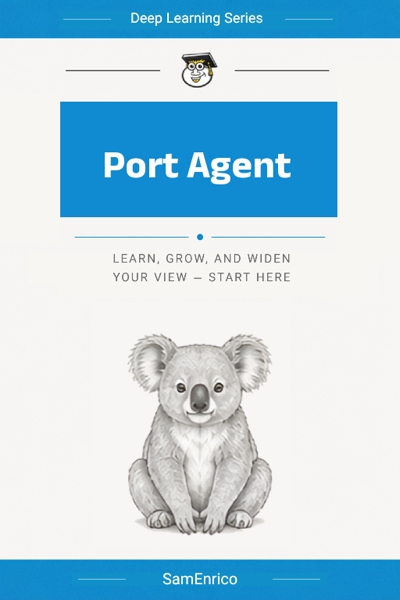
Non-FictionInformativeEducational
Port Agent eBook
A Coursebook on Port Agent
A Coursebook on Port Agent
Formats
Free sample
Chapter 1: The Local Knowledge Premium...--The phone rings at 2:47 AM. Not a call—a detonation. Maria Vasquez, three months into her first port agency role, jerks awake, knocking over a glass of water on her nightstand. The caller ID reads "Gulf Port Control." Her heart hammers. She has been told that calls before 5 AM are never routine.
They are always emergencies."The M/V Star Empress,'" the voice says, clipped and tense. "ETA advanced. She's now arriving at 0600 instead of 1400. Her berth window just collapsed. You have three hours to sort it out."Maria stumbles to her laptop, still in yesterday's clothes from a 16-hour shift.
She has never handled a vessel of this size—a 300-meter bulk carrier carrying $12 million worth of Brazilian soybeans. The owner is a major client. The charterer is notoriously litigious. Her supervisor is on a flight to Singapore, unreachable for seven more hours.She is alone.What Maria does in the next three hours—the phone calls she makes, the documents she checks, the questions she asks, and the ones she does not ask—will determine whether the vessel loads on time, whether the owner pays $40,000 in unnecessary demurrage, and whether Maria keeps her job.This book exists to ensure that when you get your 2:47 AM call, you know exactly what to do.The Problem That Created the Port Agent Global shipping is the circulatory system of the world economy. Ninety percent of everything you own—your phone, your shoes, your car, your coffee—spent time on a ship.
But here is the paradox: the people who own those ships are rarely anywhere near them. A shipowner in Monaco cannot see the rust on a hatch cover in Houston. A charterer in Geneva cannot hear the crane breakdown in Guangzhou. A cargo trader in Singapore cannot feel the humidity threatening to spoil the grain in Santos.This physical separation creates a gap—a dangerous, expensive gap between decision-makers and reality.The port agent exists to fill that gap.The agent is the principal's eyes and ears on the ground. The agent is the person who boards the vessel at 3 AM, who reads the body language of a customs officer, who knows which tug operator is reliable and which one bills for phantom services.
The agent is the bridge between the theoretical world of contracts and the messy, beautiful, chaotic world of steel hulls, salt spray, and exhausted crews.But here is what most people get wrong about port agency: it is not a logistics job. It is not a paperwork job. It is a risk management job.Every hour a vessel is idle, someone loses money. Every document that is misfiled can trigger customs detention. Every unchecked box on a Bill of Lading can become a lawsuit.
The port agent does not merely facilitate arrivals and departures. The port agent prevents disasters. Some disasters cost thousands. Some cost millions. Some end careers.This chapter introduces the foundational concept that will appear throughout this book: The Local Knowledge Premium.
It is the idea that proximity, relationships, and on-the-ground presence create value that cannot be replicated by software, algorithms, or remote management. It is why port agents still exist in an age of automation. And it is what you must develop to survive and thrive in this profession.The Anatomy of a Port Call Before we dive into the agent's role, we must understand what a port call actually entails. A vessel does not simply "arrive." It executes a choreographed sequence of events, each with its own risks, costs, and documentation requirements.A standard port call for a bulk carrier follows this timeline:72 Hours Before Arrival: The vessel nominates its estimated time of arrival (ETA). The agent begins the pre-arrival process: securing a berth window, notifying port authorities, confirming vendor availability.48 Hours Before Arrival: The agent submits electronic pre-arrival notifications to customs, immigration, port health, and security.
Any missing document can trigger a hold.24 Hours Before Arrival: The agent confirms pilot and tug bookings. The vessel provides final crew lists and cargo declarations. The agent checks for visa compliance.Arrival (Pilot Boarding): The pilot boards to navigate the vessel through the channel. The agent typically meets the vessel at the berth.Berthing: Tugs maneuver the vessel alongside. Linesmen secure mooring lines.
The gangway goes down.Free Pratique: Port health authorities grant permission for shore interaction. Until this is received, no crew can disembark and no shore personnel can board.Customs and Immigration Clearance: Officials board to check crew passports, ship's papers, and cargo manifests.Cargo Operations Begin: Stevedores start loading or discharging. The agent monitors draft and stowage.Cargo Operations Complete: The agent verifies final figures, obtains signed documents, and prepares the Statement of Facts.Departure: Pilot boards, tugs assist, vessel sails. The agent begins financial reconciliation.Between these steps, there are dozens of sub-steps, each a potential failure point. The agent does not control all of them—but the agent is responsible for coordinating them.
This is the distinction that defines the job: responsibility without full authority.Who Is the Principal? Understanding the Agency Relationship Every port agency relationship begins with a principal—the person or company that appoints the agent to act on their behalf. The principal might be a shipowner, a charterer, a cargo trader, or even a port authority. The agent's duties, priorities, and reporting lines shift depending on who pays the bill.This book uses the term principal throughout. But you must understand that different principals have different interests.
An owner wants to protect the vessel's value and avoid liability. A charterer wants to maximize cargo throughput and minimize time in port. These interests often conflict.The port agent's first duty is to understand whose interests they serve. This sounds obvious, but in practice, it is surprisingly complex. Consider this scenario:A vessel arrives under a voyage charter.
The owner appointed the agent. But the charterer controls the cargo. When the charterer asks the agent to expedite loading by skipping a draft survey, who does the agent obey?The answer is the owner. The agent's legal obligation runs to the principal who appointed them. But refusing the charterer's request could damage the commercial relationship.
This is the daily tension of port agency: legal duties versus commercial realities.We will explore the different charter party types and their implications in Chapter 3. For now, remember this rule: know your principal and know your authority.Authority: Actual, Apparent, and the Line You Cannot Cross Authority is the legal concept that both empowers and limits the port agent. Without authority, you are just a messenger. With authority, you can bind your principal to contracts, incur expenses, and make representations to third parties. But authority has limits, and crossing them is the fastest way to personal liability.There are two types of authority:Actual Authority is the authority explicitly granted in the agency agreement.
It might be broad—"handle all port call operations"—or narrow—"coordinate crew changes only." Actual authority is your safe harbor. Acts within actual authority, performed for a disclosed principal, generally shield you from personal liability.Apparent Authority is the authority that a reasonable third party would believe you have based on your conduct. This…
This is the end of the free sample. Get the eBook to keep going. Buy now
About this book
Details
- Author
- Sargent Tashina
- Publisher
- SamEnrico
- Language
- English
- Genre
- Non-Fiction, Informative, Educational
- Released
- 2026-05-11
- Pages (approx.)
- 140
- Available as
- eBook, Audiobook

Read better in the ZLOADR app
Your eBooks on your phone or tablet. Sign in with your SamEnrico account and start reading.
More by Sargent Tashina
 US Alternative Fuel RefuelingSargent Tashina$11.99
 OKRs for Students GuideSargent Tashina$11.99
 Instagram Carousel PerfectionismSargent Tashina$11.99
 Building Sober Friendships A ManualSargent Tashina$11.99
 Meth Paranoia Family GuideSargent Tashina$11.99
 The Shadow of Plato: Dialogues from the Asylum of AthensSargent Tashina$11.99
 Understanding Idiopathic Acute Eosinophilic PneumoniaSargent Tashina$17.99
 How to Start a British Association for The Advancement of Science Business (Beginners Guide)Sargent Tashina$11.99
 High Risk AI Requirements PrimerSargent Tashina$12.99
 Blockchain Lifelong PassportSargent Tashina$12.99
You may also like
 Hong Kong Handover 1997Dunn Johnnie$11.99
 Zumba For Postnatal Recovery CourseNeal Christian$11.99
 Zumba for BeginnersLadner Nikia$11.99
 YouTube Comment Mining GuideHumes Pandora$12.99
 Worry Box MeditationCarlin Rudy$11.99
 Workplace Stress MeditationNguyen Lynn$11.99
 Workplace Stress and Sleep RepairHawley Ivory$11.99
 Workplace Perfectionism CureDelaney Jeffry$11.99
 Workplace Injustice Anger GuideWallen Isabelle$11.99
 Work Addiction and Burnout LinkGreenwood Ester$11.99
 Women in Yoga and WellnessBeattie Galina$11.99
 Women in Stand Up ComedyChun Evangeline$11.99