
Non-FictionSelf-HelpProductivity
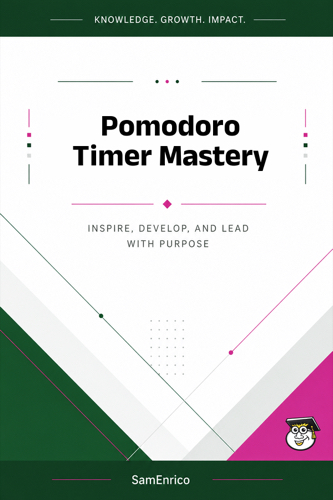
Pomodoro Timer Mastery eBook
Master the classic 25-minute work interval with 5-
Master the classic 25-minute work interval with 5-minute breaks for peak productivity.
Formats
Free sample
Chapter 1: The Origin Cage--–- Francesco Cirillo did not invent the Pomodoro Technique because he was productive. He invented it because he was desperate.It was the late 1980s at a university in Rome, and Cirillo—then a young, overwhelmed student—sat staring at a textbook. He had spent three hours in the same chair, but his mind had spent exactly zero minutes on the material. Every few seconds, a new thought intruded: Did I lock the door? What time is dinner?
I should call my girlfriend. This chapter is impossible. I’m going to fail.He was not lazy. He was not unintelligent. He was, by every honest measure, a prisoner of his own attention.And like millions of students and knowledge workers today, he had tried the standard solution: try harder.
He had made to-do lists. He had promised himself, “This time I’ll focus.” He had even pulled all-nighters, believing that brute force would eventually break through the wall of resistance. It did not. The wall remained. The anxiety grew.
The textbook remained unread.Then, on an ordinary afternoon, he did something small and strange. He looked at his kitchen timer—a mechanical device shaped like a tomato, red and unassuming—and made a bet with himself. I will focus for just ten minutes, he said. Not the whole chapter. Not two hours.
Just ten minutes. And when the timer ticks, I will stop, no matter what.He wound the timer. It began to tick.And something shifted.The Discovery That Changed Everything What Cirillo discovered in those ten minutes was not a productivity hack. It was a psychological breakthrough. Externalizing time—putting the ticking clock outside of his own head—transformed the nature of the task.
Before the timer, he was fighting against an infinite, formless ocean of “study.” After the timer, he was racing a small, finite, red tomato.The difference is everything.When you stare at a textbook (or a spreadsheet, or a blank document) without a time boundary, your brain perceives an open-ended threat. How long will this take? When will it end? These questions generate low-grade anxiety, and anxiety is the enemy of focus. The brain, seeking relief, begins to scan for distractions—any distraction—because distraction offers temporary escape from the discomfort of not knowing when the pain will stop.But a timer changes the equation.
Ten minutes has a beginning and an end. Your brain can tolerate ten minutes of discomfort. More importantly, your brain can win against ten minutes. The ticking clock becomes an ally, not an adversary. Each passing second is not a reminder of how much remains, but of how much you have already survived.Cirillo called his discovery the “Pomodoro Technique” after the tomato-shaped timer he used.
The original method was simple: choose a task, set the timer for 25 minutes, work until it rings, take a five-minute break, repeat. That’s it. No software. No complex tracking systems. Just a timer, a task, and a promise.But here is what most people miss: the Pomodoro Technique is not a time-management tool.
It is a focus tool. And more than that, it is a psychological tool—one that rewires your relationship with effort, resistance, and time itself.Why Most People Fail at the Pomodoro Technique Before we go any further, let me tell you what this book is not. This is not another blog post listing the “five steps to productivity.” This is not a shallow endorsement of a timer app. And this is not a book that pretends the Pomodoro Technique works perfectly for everyone right out of the box.Because here is the uncomfortable truth: most people who try the Pomodoro Technique abandon it within two weeks.They do not fail because the technique is flawed. They fail because they misunderstand what it is.
They treat the timer as a stopwatch—a tool to measure how much time they are wasting. They sit down, start the timer, and immediately feel the pressure to “perform.” When the timer rings, they look at what they accomplished (or did not accomplish) and judge themselves harshly. After a few days of feeling like a failure, they quietly stop using the timer and return to their old, scattered ways.This is the Productivity Trap. You believe that the goal of a productivity system is to get more done. So you measure yourself against completion.
You want to finish the report, clear the inbox, check all the boxes. When you do not finish, you feel like the system failed you—or worse, like you failed the system.But the Pomodoro Technique was never designed to help you finish tasks. It was designed to help you start them. To help you stay with them. To transform the relationship between your conscious mind and the resistance that arises whenever you face something difficult.Let me repeat that, because it is the central thesis of this entire book:The Pomodoro Technique is not a completion tool.
It is a commitment tool.Every time you start a Pomodoro, you are not promising to finish a task. You are promising to stay focused for 25 minutes. That is all. If the timer rings and the task is incomplete, you have not failed. You have succeeded at keeping your promise.
The task will still be there tomorrow. The only thing that matters is that you did not break the contract with yourself.This reframing is not semantic trickery. It is the difference between a system that creates shame and a system that creates momentum. Shame leads to abandonment. Momentum leads to mastery.The Neuroscience of 25 Minutes Why 25 minutes?
Why not 10, or 30, or 50?The answer lies in the architecture of human attention. Neuroscientists have studied the limits of focused concentration for decades, and the findings are remarkably consistent: the average adult can maintain intrinsic concentration—focus that is self-directed rather than reactive—for about 20 to 35 minutes before cognitive fatigue sets in.Let me be specific. When you are watching a movie or scrolling social media, your attention is being captured by external stimuli. That is reactive attention, and it can last for hours because the stimulus keeps changing. But when you are working on a difficult spreadsheet, writing a proposal, or studying a complex topic, you are using directed attention.
Directed attention is effortful. It requires the suppression of distractions, the maintenance of goals, and the constant monitoring of progress. Directed attention depletes a finite cognitive resource.After about 25 minutes of directed attention, your brain’s prefrontal cortex—the seat of executive function—begins to tire. You become more susceptible to distractions. Your working memory starts to leak.
The quality of your work declines, even if you do not notice it.This is not a personal failing. It is biology.The 25-minute Pomodoro is calibrated to fit comfortably within this attentional limit. It is long enough to make meaningful progress on most tasks—you can write several paragraphs, analyze a data set, read a substantial portion of a chapter. But it is short enough that you never hit the wall of fatigue. You stop before your brain forces you to stop.Think of it like interval training for the mind.…
This is the end of the free sample. Get the eBook to keep going. Buy now
About this book
Details
- Author
- Prosser Rhona
- Publisher
- SamEnrico
- Language
- English
- Genre
- Non-Fiction, Self-Help, Productivity
- Released
- 2026-06-05
- Pages (approx.)
- 140
- Available as
- eBook, Audiobook

Read better in the ZLOADR app
Your eBooks on your phone or tablet. Sign in with your SamEnrico account and start reading.
More by Prosser Rhona
 High Stress Job Couple SurvivalProsser Rhona$11.99
 Melatonin and Meditation ProtocolProsser Rhona$11.99
 Secretory IgA InterpretationProsser Rhona$11.99
 Oman Remote Tax GuideProsser Rhona$11.99
 Carpal Tunnel Syndrome GuideProsser Rhona$11.99
 Caregiver Sleep RescueProsser Rhona$11.99
 Transcendental Meditation for KidsProsser Rhona$11.99
 Auditory Mnemonic Devices GuideProsser Rhona$11.99
 Tokyo Drift: The Rise of Asian Skateboarding (1990s-Present)Prosser Rhona$11.99
 The Quantum Pioneers: Black Physicists Who Shaped the UniverseProsser Rhona$11.99
 Phoenix Rising: The Miraculous Return of the 2016 Chicago CubsProsser Rhona$11.99
 Pharmaceutical Regulatory AffairsProsser Rhona$11.99
You may also like
 Hong Kong Handover 1997Dunn Johnnie$11.99
 Zumba For Postnatal Recovery CourseNeal Christian$11.99
 Zumba for BeginnersLadner Nikia$11.99
 YouTube Comment Mining GuideHumes Pandora$12.99
 Worry Box MeditationCarlin Rudy$11.99
 Workplace Stress MeditationNguyen Lynn$11.99
 Workplace Stress and Sleep RepairHawley Ivory$11.99
 Workplace Perfectionism CureDelaney Jeffry$11.99
 Workplace Injustice Anger GuideWallen Isabelle$11.99
 Work Addiction and Burnout LinkGreenwood Ester$11.99
 Women in Yoga and WellnessBeattie Galina$11.99
 Women in Stand Up ComedyChun Evangeline$11.99