
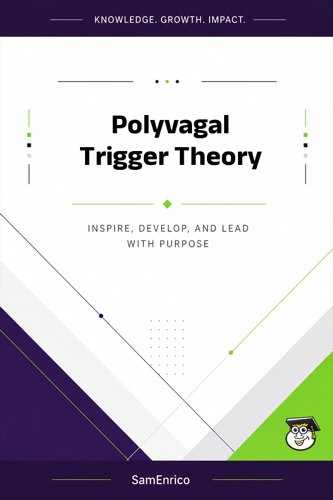
Polyvagal Trigger Theory eBook
Understand how your nervous system shifts between
Understand how your nervous system shifts between ventral vagal, sympathetic, and dorsal states.
Formats
Free sample
Chapter 1: The Silent Conductor...--–- You are sitting at your desk, trying to focus on a simple task. Your to-do list is clear. You have no immediate threats. And yet, your heart is racing. Your jaw is clenched.
A vague sense of dread sits in your stomach like a cold stone. You tell yourself to calm down. You take a deep breath. You repeat a positive affirmation: “I am safe. I am in control.” But nothing changes.
Your body refuses to listen.This is not a failure of willpower. It is not a lack of faith or a character flaw. It is the work of the silent conductor—your autonomic nervous system (ANS)—an ancient, lightning-fast network of nerves and sensors that has been running the show long before your conscious mind ever learned to speak.For decades, self-help and psychology have operated on a shared assumption: that if you change your thoughts, you change your feelings. Think positive, feel positive. Reframe the narrative, rewrite the emotion.
But anyone who has ever tried to reason their way out of panic, talk themselves down from rage, or think their way out of numbness knows the bitter truth: it rarely works, at least not in the moment. The reason is not that you are doing it wrong. The reason is that your nervous system is not waiting for your permission.The autonomic nervous system is the body’s automatic pilot. It manages your heart rate, digestion, breathing, pupil dilation, and—most critically for this book—your state of felt safety or threat. It evolved over 500 million years, long before the cortex (the “thinking brain”) developed.
And it operates at speeds that make conscious thought look like a horse-drawn carriage next to a bullet train. Neuroception—the nervous system’s unconscious scanning for danger or safety—happens in milliseconds. Conscious perception takes hundreds of milliseconds longer. By the time you know you are afraid, your body has already been afraid for a third of a second.This single fact dismantles the myth that emotions are products of thoughts. In reality, thoughts are often products of bodily states.
You do not feel anxious because you thought, “Something bad might happen.” You think, “Something bad might happen,” because your heart rate increased, your breathing shallowed, and your gut tightened. The body speaks first. The mind, ever the storyteller, scrambles to catch up and invent a narrative that fits the physical sensation.This chapter is the foundation of everything that follows. It introduces the autonomic nervous system as the true silent conductor of your emotional life, explains why traditional “positive thinking” approaches often fail when the body is triggered, and reveals why the Polyvagal Theory offers a more complete map than the old “fight or flight” model. By the end of this chapter, you will understand a truth that changes everything: You cannot talk yourself out of a nervous system state.
The body must be addressed first.The Body’s Ancient Operating System To understand why your body sometimes betrays your best intentions, you need to meet your autonomic nervous system. The word “autonomic” means self-governing. This system does not ask for your opinion. It does not wait for your conscious approval. It simply reacts, based on billions of years of evolutionary programming, to keep you alive.The ANS has two main branches that most people have heard of: the sympathetic nervous system (often called “fight or flight”) and the parasympathetic nervous system (often called “rest and digest”).
For a long time, that two-part model was the standard. It worked well enough to explain why your heart pounds when you are scared and why you relax after a meal. But it left gaping holes in our understanding of human experience.What about the person who freezes during a confrontation, unable to speak or move? That is not fight. That is not flight.
What about the trauma survivor who feels nothing at all—numb, disconnected, floating somewhere behind their own eyes? That is not rest and digest. That is something else entirely. And what about the feeling of safety you experience when you look into the eyes of a trusted friend, when your voice becomes warm and your face relaxes? That is not merely the absence of threat.
It is an active biological state.These gaps are exactly what Dr. Stephen Porges, the creator of Polyvagal Theory, set out to fill. His revolutionary insight was that the parasympathetic nervous system is not a single, unified system. It has two distinct branches, each with a different evolutionary age and a different function. One branch—the dorsal vagal—is the oldest.
It manages immobilization, shutdown, and “playing dead.” The other branch—the ventral vagal—is the newest. It manages social engagement, safety, and connection.This gives us not two but three fundamental nervous system states: ventral vagal (safety and connection), sympathetic (mobilization and threat), and dorsal vagal (immobilization and collapse). These three states are the colors on the palette of your felt experience. Every emotion you have ever felt—from the quiet joy of a morning coffee to the white-hot rage of an insult to the hollow numbness of grief—is a variation of these three states.But here is the crucial point: these states are not choices. You do not decide to feel safe.
Your nervous system decides, based on cues it detects below your awareness. And once it decides, it mobilizes your entire body—heart, lungs, gut, facial muscles, vocal cords—to match that state. Trying to think your way out of a sympathetic state is like trying to reason with a tidal wave. The wave does not speak your language.The Failure of Top-Down Only Approaches If you have ever struggled with anxiety, panic, depression, or chronic stress, you have likely been given a version of the same advice: change your thoughts. Cognitive behavioral therapy (CBT), positive affirmations, reframing, and thought-stopping techniques all operate on the assumption that cognition drives emotion.
Identify the irrational thought, challenge it, replace it—and the feeling will follow.For some people, for some problems, this works. Mild anxiety about public speaking? A thought reframe might help. Rumination about a social mistake? Challenging the distortion can bring relief.
But for the kinds of nervous system dysregulation that this book addresses—the sudden, overwhelming shifts, the triggers that seem to come from nowhere, the chronic hypervigilance or shutdown—top-down approaches often fail, and they fail spectacularly.There is a neurological reason for this. When your sympathetic nervous system is activated (fight or flight), blood flow is redirected away from the prefrontal cortex—the part of your brain responsible for logic, planning, and impulse control—and toward the muscles and survival centers. You literally cannot think clearly because the hardware for clear thinking has been deprioritized. Evolution decided that in a life-threatening situation, you do not need to solve a crossword puzzle. You need to run.When your dorsal vagal system is activated (collapse, freeze, dissociation), the situation is even more extreme.
Heart rate drops, blood pressure plummets, and consciousness itself may dim. You cannot think your way out of a faint. You cannot affirm your way out of a shutdown.This does…
This is the end of the free sample. Get the eBook to keep going. Buy now
About this book
Details
- Author
- Downey Julianna
- Publisher
- SamEnrico
- Language
- English
- Genre
- Non-Fiction, Self-Help, Polyvagal
- Released
- 2026-06-09
- Pages (approx.)
- 157
- Available as
- eBook, Audiobook

Read better in the ZLOADR app
Your eBooks on your phone or tablet. Sign in with your SamEnrico account and start reading.
More by Downey Julianna
 Stop Comparing Start LivingDowney Julianna$11.99
 Postpartum Infant Swim GuideDowney Julianna$11.99
 Intermediate Strength ProgramDowney Julianna$11.99
 Sarcopenia Omega 3 PrescriptionDowney Julianna$11.99
 Defensiveness Reduction GuideDowney Julianna$11.99
 AdTech Investment GuideDowney Julianna$11.99
 Alcohol Recovery and Sports EventsDowney Julianna$11.99
 Carter Georgia GovernorDowney Julianna$11.99
 The Trade That Changed the Game: How One Bold Move Reshaped the NBADowney Julianna$11.99
 The Forgotten Queen: Hecuba’s CurseDowney Julianna$11.99
 The Forgotten Navigators: How a Lost Tuareg Guide Rediscovered the SaharaDowney Julianna$11.99
 The Dancer's Guide to ZumbaDowney Julianna$11.99
You may also like
 Hong Kong Handover 1997Dunn Johnnie$11.99
 Zumba For Postnatal Recovery CourseNeal Christian$11.99
 Zumba for BeginnersLadner Nikia$11.99
 YouTube Comment Mining GuideHumes Pandora$12.99
 Worry Box MeditationCarlin Rudy$11.99
 Workplace Stress MeditationNguyen Lynn$11.99
 Workplace Stress and Sleep RepairHawley Ivory$11.99
 Workplace Perfectionism CureDelaney Jeffry$11.99
 Workplace Injustice Anger GuideWallen Isabelle$11.99
 Work Addiction and Burnout LinkGreenwood Ester$11.99
 Women in Yoga and WellnessBeattie Galina$11.99
 Women in Stand Up ComedyChun Evangeline$11.99