
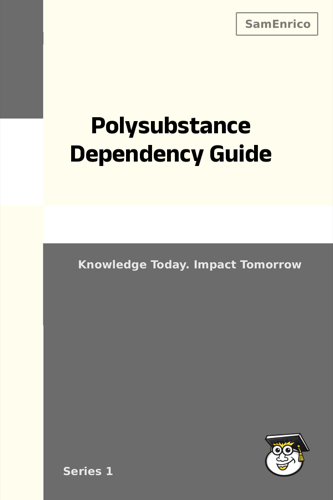
Polysubstance Dependency Guide eBook
Manage withdrawal from multiple drugs simultaneous
Manage withdrawal from multiple drugs simultaneously.
Formats
Free sample
Chapter 1: The Hidden Truth--–- The email arrived at 2:17 on a Tuesday afternoon. Sarah, a 34-year-old project manager, had just finished her third cup of coffee—her seventh of the day—and was staring at the blinking cursor on her performance review. Her hands trembled slightly, but not from caffeine alone. She had taken a small amount of alprazolam that morning to quiet the panic that had been building since Sunday night. By noon, she added two glasses of wine to "take the edge off" before a difficult video call.
Now, at 2:17, she was calculating how long until she could leave work, pick up the small bag of cocaine her dealer had texted her about, and feel like herself again—energized, focused, and in control. The email was from her primary care doctor: "Your liver enzymes are elevated. Please schedule a follow-up." Sarah closed the email and reached for her fourth cup of coffee. She did not have a "primary drug." She had a system.This chapter dismantles the most pervasive myth in addiction treatment: that every person who struggles with substances has one "primary" drug of choice—an opioid, or alcohol, or cocaine—and that all other substances are secondary, less important, or merely "experimental." Drawing on epidemiological data from national surveys and clinical intake studies spanning the past two decades, this chapter demonstrates a truth that treatment centers rarely acknowledge: the majority of individuals with substance use disorders regularly use two or more substances, often in carefully calibrated combinations designed to balance the side effects of each other. The term "polysubstance dependence" is not a niche diagnosis reserved for the "worst" cases.
It is the norm. And yet, most treatment programs force patients to name a single "primary" substance for insurance billing, clinical tracking, and treatment planning. This forced choice is not merely inconvenient—it is dangerous. It leads to dangerous underestimation of withdrawal risks from secondary substances, inappropriate medication selection, and, all too often, relapse and death.The Myth of the Primary Substance The idea that every person has one "true" addiction dates back to the early days of Alcoholics Anonymous, where members identified themselves as "alcoholics" first and foremost. This model worked reasonably well when alcohol was the dominant substance of abuse.
But the world has changed. The modern landscape of substance use includes prescription opioids, street fentanyl, methamphetamine, cocaine, benzodiazepines, designer stimulants, synthetic cannabinoids, and a dozen other compounds that did not exist when the "primary substance" model was codified into treatment protocols. Today, a person who uses heroin is statistically more likely to also use cocaine, benzodiazepines, or alcohol than to use heroin alone. A person who uses cocaine is more likely to also use opioids or alcohol than to use cocaine alone. The data are clear, but the treatment system has not caught up.Consider the following numbers, drawn from the National Survey on Drug Use and Health and multiple large-scale clinical studies: over sixty percent of individuals with opioid use disorder also meet criteria for benzodiazepine or alcohol use disorder.
Nearly fifty percent of individuals with cocaine use disorder also use opioids or alcohol regularly. Among young adults aged eighteen to twenty-five, the rate of polysubstance use in the past month exceeds the rate of single-substance use by a factor of nearly two to one. Polysubstance use is not a trend. It is the dominant pattern of substance use in the United States and across much of the developed world. Yet when these individuals seek treatment, they are asked to fill out intake forms that demand a "primary drug." They are assigned to groups labeled by substance—the opioid group, the alcohol group, the stimulant group.
They are prescribed medications designed for a single addiction. And when they relapse—as they often do—they are told they lacked motivation, or that they were not "ready" for recovery, or that they needed to hit a "lower bottom." Rarely does anyone ask whether the treatment itself failed to match the reality of their drug use.Intentional Mixing vs. Unintentional Polysubstance Use Before we go further, we must distinguish between two very different pathways into polysubstance dependence: intentional mixing and unintentional polysubstance use. Both create complex withdrawal syndromes, but they arise from different motivations and require different recovery strategies.Intentional mixing occurs when a person deliberately combines substances to achieve a specific effect. The most famous example is the "speedball"—heroin or another opioid combined with cocaine or another stimulant.
The opioid provides a wave of euphoria and sedation; the stimulant provides a rush of energy and alertness. The user experiences both simultaneously, feeling "balanced" in a way that neither drug alone can provide. Another common form of intentional mixing is using alcohol to calm the anxiety and agitation that follow methamphetamine use. The meth user spends hours in a state of hyperarousal; the alcohol provides a landing gear, a way to come down. Intentional mixing can also involve prescription medications: a person with chronic pain might take their prescribed oxycodone and then add a few drinks to "boost" the effect, or a person with anxiety might take their prescribed benzodiazepine and then smoke cannabis to enhance the relaxation.Unintentional polysubstance use is different.
It occurs when a person takes a prescribed medication while also using alcohol or other drugs, often without realizing the synergistic danger. A patient prescribed alprazolam (Xanax) for panic disorder might have a few glasses of wine at a dinner party, unaware that alcohol will double the sedative effect of the benzodiazepine and increase the risk of respiratory depression. A patient prescribed methadone for opioid use disorder might take a friend's benzodiazepine to help with sleep, unaware that methadone inhibits the liver enzyme that breaks down benzodiazepines, leading to unexpectedly high levels of the benzo in their blood. Unintentional polysubstance use is not "accidental" in the sense of being blameless—the person still chose to take the substances—but it is accidental in the sense that the person did not anticipate the specific pharmacological interaction. They thought they were taking two safe things.
Instead, they created a dangerous synergy.Both pathways lead to the same destination: a body that has adapted to multiple drugs simultaneously, developing cross-tolerance across receptor systems. Both pathways require the same type of treatment: a detox protocol that addresses all substances at once, not sequentially. But the psychology of recovery differs. The intentional mixer often has a sophisticated understanding of how drugs work; they have become, in effect, amateur pharmacologists. This knowledge can be leveraged in recovery—they can learn to apply the same analytical skills to building a sober toolkit.
The unintentional polysubstance user, by contrast, may need education first. They may not even realize they have a dependence on multiple substances; they thought they were "just taking their medicine." For them, the first step is simply seeing the full picture of their drug use.Uppers, Downers, and All-Arounders: A Simple Map To understand polysubstance withdrawal, you need a basic map of how drugs work in the brain. This book will not turn you into a neuroscientist, but it will give you enough vocabulary to talk to your doctors and to understand the protocols described in later…
This is the end of the free sample. Get the eBook to keep going. Buy now
About this book
Details
- Author
- Delafuente Rudolf
- Publisher
- SamEnrico
- Language
- English
- Genre
- Non-Fiction, Self-Help, Polysubstance
- Released
- 2026-06-06
- Pages (approx.)
- 144
- Available as
- eBook, Audiobook

Read better in the ZLOADR app
Your eBooks on your phone or tablet. Sign in with your SamEnrico account and start reading.
More by Delafuente Rudolf
 Self Compassion Self Talk GuideDelafuente Rudolf$11.99
 Commuter Rage At Work GuideDelafuente Rudolf$11.99
 Chinese Business NegotiationDelafuente Rudolf$11.99
 The Fear of Cooking GuideDelafuente Rudolf$11.99
 The Great Canadian Land Swindle: The Post-War Fraud That Shook a NationDelafuente Rudolf$11.99
 Emergency Evacuation Warden TrainingDelafuente Rudolf$11.99
 VAT Cash Flow ManagementDelafuente Rudolf$12.99
 Co Investment Fund LagosDelafuente Rudolf$12.99
 Understanding Ulcerative ColitisDelafuente Rudolf$17.99
 Ultimate Handbook Guide to Al-madinah : (Saudi Arabia) Travel GuideDelafuente Rudolf$11.99
You may also like
 Polysubstance Dependency HelpTyson Danika$11.99
 Polysubstance Abuse HelpMendez Sarah$11.99
 Benzo Polyaddiction GuideWorley Felton$11.99
 Substance Use Recovery and SmokingBurchfield Khadijah$11.99
 Meth Polyaddiction GuideAtwell Abby$11.99
 Cocaine Polyaddiction GuideCamarillo Kaylene$11.99
 Cannabis Tobacco Spliff CessationLandrum Veda$11.99